This longer reference provides the background behind the topic. Read it alongside the recipe collection when you want to connect an ingredient or food idea with a dish to prepare.
In this story
OverviewProductionComparison to other major staple foodsSoybean mealFood for human consumptionMeat and dairy alternatives and extendersCoffee substituteOverview
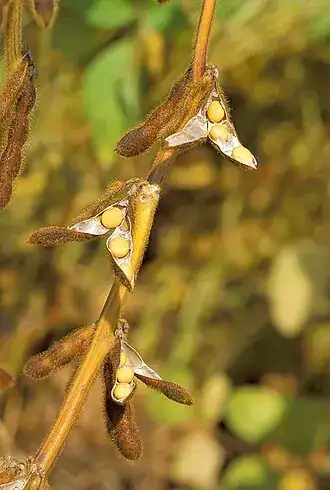
The soybean, soy bean, or soya bean (Glycine max) is a species of legume native to East Asia, widely grown for its edible bean. Soy is a staple crop, the world's most grown legume, and an important animal feed.
Soy is a key food source, owing to its high protein and oil content. Soybean oil is widely used in cooking, as well as in industry. Traditional unfermented food uses of soybeans include edamame, as well as soy milk, from which tofu and tofu skin are made. Fermented soy foods include soy sauce, fermented bean paste, nattō, and tempeh. Fat-free (defatted) soybean meal is a significant and cheap source of protein for animal feeds and many packaged meals. For example, soybean products, such as textured vegetable protein (TVP), are ingredients in many meat and dairy substitutes. Soy-based foods are traditionally associated with East Asian cuisines, and still constitute a major part of East Asian diets, but processed soy products are increasingly used in Western cuisines.
Soy was domesticated from the wild soybean (Glycine soja) in north-central China between 6,000 and 9,000 years ago. Brazil and the United States lead the world in modern soy production. The majority of soybeans are genetically modified, usually for either insect, herbicide, or drought resistance. Three-quarters of soy is used to feed livestock, which in turn go to feed humans. Increasing demand for meat has substantially increased soy production since the 1980s, and contributed to deforestation in the Amazon.
Production
In 2020, world production of soybeans was over 353 million tonnes, led by Brazil and the United States combined with 66% of the total (table). Production has dramatically increased across the globe since the 1960s, but particularly in South America after a cultivar that grew well in low latitudes was developed in the 1980s. The rapid growth of the industry has been primarily fueled by large increases in worldwide demand for meat products, particularly in developing countries like China, which alone accounts for more than 60% of imports. Soy is a staple crop; global soy production accounts for four times more legume production than all other legumes combined.
Comparison to other major staple foods
The following table shows the nutrient content of green soybean and other major staple foods, each in respective raw form on a dry weight basis to account for their different water contents. Raw soybeans, however, are not edible and cannot be digested. These must be sprouted, or prepared and cooked for human consumption. In sprouted and cooked form, the relative nutritional and anti-nutritional contents of each of these grains is remarkably different from that of raw form of these grains reported in this table. The nutritional value of soybean and each cooked staple depends on the processing and the method of cooking: boiling, frying, roasting, baking, etc.
Soybean meal
Soybean meal, or soymeal, is the material remaining after solvent extraction of oil from soybean flakes, with a 50% soy protein content. The meal is 'toasted' (a misnomer because the heat treatment is with moist steam) and ground in a hammer mill. Ninety-seven percent of soybean meal production globally is used as livestock feed. Soybean meal is also used in some dog foods.
Food for human consumption
In addition to their use in livestock feed, soybean products are widely used for human consumption. Common soybean products include soy sauce, soy milk, tofu, soy meal, soy flour, textured vegetable protein (TVP), soy curls, tempeh, soy lecithin, iru and soybean oil. Soybeans may also be eaten with minimal processing, for example, in the Japanese food edamame, in which immature soybeans are boiled whole in their pods and served with salt.
In China, Japan, Vietnam and Korea, soybean and soybean products are a standard part of the diet. Tofu (豆腐 dòufu) is thought to have originated in China, along with soy sauce and several varieties of soybean paste used as seasonings. Japanese foods made from soya include miso (味噌), nattō (納豆), kinako (黄粉) and edamame (枝豆), as well as products made with tofu such as atsuage and aburaage. In China, whole dried soybeans are sold in supermarkets and used to cook various dishes, usually after rehydration by soaking in water; they find their use in soup or as a savory dish. In Korean cuisine, soybean sprouts (콩나물 kongnamul) are used in a variety of dishes, and soybeans are the base ingredient in doenjang, cheonggukjang and ganjang.
In Vietnam, soybeans are used to make soybean paste (tương) in the North with the most popular products are tương Bần, tương Nam Đàn, tương Cự Đà as a garnish for phở and gỏi cuốn dishes, as well as tofu (đậu hũ or đậu phụ or tàu hũ), soy sauce (nước tương), soy milk (nước đậu in the North or sữa đậu nành in the South), and đậu hũ nước đường (tofu sweet soup).
Flour
Meat and dairy alternatives and extenders
Soybeans can be processed to produce a texture and appearance similar to many other foods. For example, soybeans are the primary ingredient in many dairy product substitutes (e.g., soy milk, margarine, soy ice cream, soy yogurt, soy cheese, and soy cream cheese) and meat alternatives (e.g. veggie burgers). These substitutes are readily available in most supermarkets. Soy milk does not naturally contain significant amounts of digestible calcium. Many manufacturers of soy milk sell calcium-enriched products, as well.
Soy products also are used as a low-cost substitute for meat and poultry products. Food service, retail and institutional (primarily school lunch and correctional) facilities regularly use such "extended" products. The extension may result in diminished flavor, but fat and cholesterol are reduced. Vitamin and mineral fortification can be used to make soy products nutritionally equivalent to animal protein; the protein quality is already roughly equivalent. The soy-based meat substitute textured vegetable protein has been used for more than 50 years as a way of inexpensively extending ground beef without reducing its nutritional value.
In China and Taiwan, soy milk (known as doujiang) is a traditional breakfast staple consumed for centuries. It is often perceived as a healthier, more natural alternative to cow's milk, which is a more recent addition to the local diet. Fresh soy milk is commonly distinguished from processed, packaged versions (dounai).
Coffee substitute
Roasted and ground soybeans can be a caffeine-free substitute for coffee. After the soybeans are roasted and ground, they look similar to regular coffee beans or can be used as a powder similar to instant coffee, with the aroma and flavor of roasted soybeans.
More to savor

Chicken Vindaloo
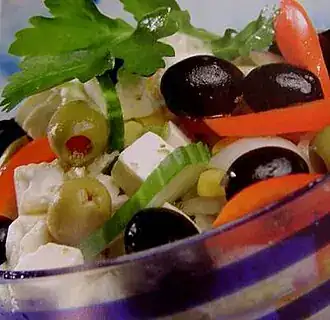
Greek Salad

Getting to Know Soy sauce: A Food Lover’s Guide