This longer reference provides the background behind the topic. Read it alongside the recipe collection when you want to connect an ingredient or food idea with a dish to prepare.
Overview
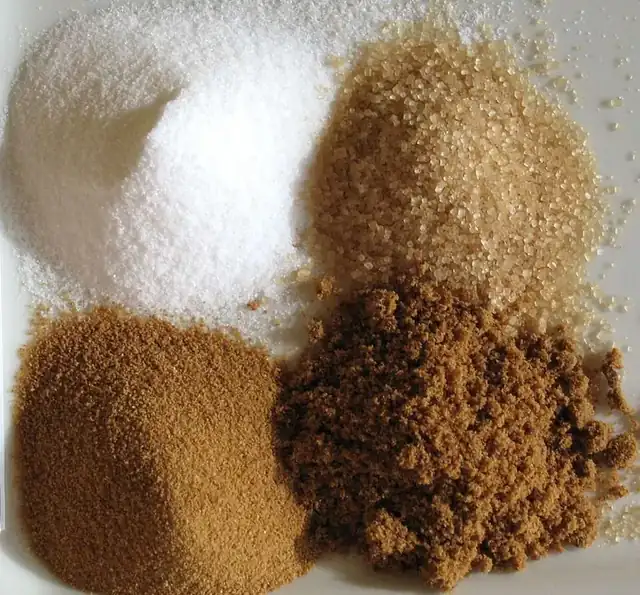
Sugar is a class of sweet-tasting, soluble carbohydrates, many of which are used in food. Simple sugars, also called monosaccharides, include glucose, fructose and galactose. Compound sugars, also called disaccharides or double sugars, are molecules made of two bonded monosaccharides; common examples are sucrose (glucose + fructose), lactose (glucose + galactose) and maltose (two molecules of glucose). White sugar is almost pure sucrose. During digestion, compound sugars are hydrolysed into simple sugars.
Longer chains of saccharides are not regarded as sugars, and are called oligosaccharides or polysaccharides. Starch is a glucose polymer found in plants – the most abundant source of energy in human food. Some other chemical substances, such as ethylene glycol, glycerol and sugar alcohols, may have a sweet taste, but are not classified as sugar.
Sugars are found in the tissues of most plants. Honey and fruits are abundant natural sources of simple sugars. Sucrose is especially concentrated in sugarcane and sugar beet, making them efficient for commercial extraction to make refined sugar. In 2016 the combined world production of those two crops was about two billion tonnes. Maltose may be produced by malting grain. Lactose is the only sugar that cannot be extracted from plants, as it occurs only in milk, including human breast milk, and in some dairy products. A cheap source of sugar is corn syrup, industrially produced by converting corn starch into sugars, such as maltose, fructose and glucose.
Sucrose is used in prepared foods (e.g., cookies and cakes), is added to commercially available ultra-processed food and beverages, and is used as a sweetener for foods (e.g., toast and cereal) and beverages (e.g., coffee and tea). Globally, on average, a person consumes about 24 kg of sugar each year. North and South Americans consume up to 50 kg, and Africans consume under 20 kg.
Chemistry
Scientifically, sugar loosely refers to a number of compounds typically with the formula (CH2O)n. Some large classes of sugars, ranked in increasing order of molecular weight are monosaccharides, disaccharides, or oligosaccharides.
Monosaccharides
Monosaccharides are also called "simple sugars", the most important being glucose. Most monosaccharides have a formula that conforms to C with n between 3 and 7 (deoxyribose being an exception). Glucose has the molecular formula C. The names of typical sugars end with -ose, as in "glucose" and "fructose". Such labels may also refer to any types of these compounds. Fructose, galactose and glucose are all simple sugars, monosaccharides, with the general formula . They have five hydroxyl groups (−OH) and a carbonyl group (C=O) and are cyclic when dissolved in water. They each exist as several isomers with dextro- and laevo-rotatory forms that cause polarised light to diverge to the right or the left.
Fructose, or fruit sugar, occurs naturally in fruits, some root vegetables, cane sugar and honey and is the sweetest of the sugars. It is one of the components of sucrose or table sugar. It is used as a high-fructose syrup, which is manufactured from hydrolysed corn starch that has been processed to yield corn syrup, with enzymes then added to convert part of the glucose into fructose.
Galactose generally does not occur in the free state but is a constituent with glucose of the disaccharide lactose or milk sugar. It is less sweet than glucose. It is a component of the antigens found on the surface of red blood cells that determine blood groups.
Glucose occurs naturally in fruits and plant juices and is the primary product of photosynthesis. Starch is converted into glucose during digestion, and glucose is the form of sugar that is transported around the bodies of animals in the bloodstream. Although in principle there are two enantiomers of glucose (mirror images one of the other), naturally occurring glucose is D-glucose. This is also called dextrose, or grape sugar because drying grape juice produces crystals of dextrose that can be sieved from the other components.
Disaccharides
Lactose, maltose and sucrose are disaccharides, also called "compound sugars". They share the formula . They are formed by the condensation of two monosaccharide molecules with the expulsion of a molecule of water.
Lactose is the naturally occurring sugar found in milk. A molecule of lactose is formed by the combination of a molecule of galactose with a molecule of glucose. It is broken down when consumed into its constituent parts by the enzyme lactase during digestion. Children have this enzyme, but some adults no longer form it and they are unable to digest lactose.
Maltose is formed during the germination of certain grains, the most notable being barley, which is converted into malt, the source of the sugar's name. A molecule of maltose is formed by the combination of two molecules of glucose. It is less sweet than glucose, fructose or sucrose. It is formed in the body during the digestion of starch by the enzyme amylase and is itself broken down during digestion by the enzyme maltase.
Sucrose is found in the stems of sugarcane and roots of sugar beet. It also occurs naturally alongside fructose and glucose in other plants, in particular fruits and some roots such as carrots. The different proportions of sugars found in these foods determines the range of sweetness experienced when eating them. A molecule of sucrose is formed by the combination of a molecule of glucose with a molecule of fructose. After being eaten, sucrose is split into its constituent parts during digestion by a number of enzymes known as sucrases.
Polysaccharides
Longer than disaccharides are oligosaccharides and polysaccharides. Cellulose and chitin are polymers, often crystalline, found in diverse plants and insects, respectively. Cellulose cannot be digested directly by animals. Starch is an amorphous polymer of glucose that is found in many plants and is widely used in the sugar industry.
Production
Due to rising demand, sugar production in general increased some 14% over the period 2009 to 2018. The largest importers were China, Indonesia, and the United States.
Consumption
Worldwide sugar provides 10% of the daily calories (based on a 2000 kcal diet). In 1750 the average Briton got 72 calories a day from sugar. In 1913 this had risen to 395. In 2015, sugar still provided around 14% of the calories in British diets. According to one source, per capita consumption of sugar in 2016 was highest in the United States, followed by Germany and the Netherlands.
More to savor

Chicken Vindaloo

Soft Sugar Cookies
Beyond the Shopping List: The Story of Banana