This longer reference provides the background behind the topic. Read it alongside the recipe collection when you want to connect an ingredient or food idea with a dish to prepare.
Overview
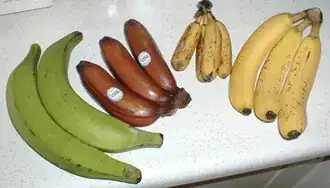
A banana is an elongated, edible fruit that is botanically a berry produced by several kinds of large treelike herbaceous flowering plants in the genus Musa. In some countries, cooking bananas are called plantains, distinguishing them from dessert bananas. The fruit is variable in size, color and firmness, but is usually elongated and curved, with soft flesh rich in starch covered with a peel, which may have a variety of colors when ripe. It grows upward in clusters near the top of the plant. Almost all modern edible seedless (parthenocarp) cultivated bananas come from two wild species – Musa acuminata and Musa balbisiana, or their hybrids.
Musa species are native to tropical Indomalaya and Australia; they were probably domesticated in New Guinea. They are grown in 135 countries, primarily for their fruit, and to a lesser extent to make banana paper and textiles, while some are grown as ornamental plants. The world's largest producers of bananas in 2022 were India and China, which together accounted for approximately 26% of total production. Bananas are eaten raw or cooked in recipes varying from curries to banana chips, fritters, fruit preserves, or simply baked or steamed.
Description
The banana plant is the largest herbaceous flowering plant. All the above-ground parts of a banana plant grow from a structure called a corm. Plants are normally tall and fairly sturdy with a tree-like appearance, but what appears to be a trunk is actually a pseudostem composed of multiple leaf-stalks (petioles). Bananas grow in a wide variety of soils, as long as it is at least 60 cm deep, has good drainage and is not compacted. They are fast-growing plants, with a growth rate of the sheathing leaves of up to 1.6 m per day; the woody stalk that later bears the fruits grows more slowly.
The leaves of banana plants are composed of a stalk (petiole) and a blade (lamina). The base of the petiole widens to form a sheath; the tightly packed sheaths make up the pseudostem, which is all that supports the plant. The edges of the sheath meet when it is first produced, making it tubular. As new growth occurs in the centre of the pseudostem, the edges are forced apart. Cultivated banana plants vary in height depending on the variety and growing conditions. Most are around 5 m tall, with a range from 'Dwarf Cavendish' plants at around 3 m to 'Gros Michel' at 7 m or more. Leaves are spirally arranged and may grow 2.7 m long and 60 cm wide.
Phylogeny
A 2011 phylogenomic analysis using nuclear genes indicates the phylogeny of some representatives of the Musaceae family. Major edible kinds of banana are shown in boldface.
‡ Many cultivated bananas are hybrids of M. acuminata x M. balbisiana (not shown in tree).
Work by Li and colleagues in 2024 identifies three subspecies of M. acuminata, namely sspp. banksii, malaccensis, and zebrina, as contributing substantially to the Ban, Dh, and Ze subgenomes of triploid cultivated bananas respectively.
Informal classification
In regions such as North America and Europe, Musa fruits offered for sale can be divided into small sweet "bananas" eaten raw when ripe as a dessert, and large starchy "plantains" or cooking bananas, which do not have to be ripe. Linnaeus made this distinction when naming two "species" of Musa. Members of the "plantain subgroup" of banana cultivars, most important as food in West Africa and Latin America, correspond to this description, having long pointed fruit. They are described by Ploetz et al. as "true" plantains, distinct from other cooking bananas.
The cooking bananas of East Africa belong to a different group, the East African Highland bananas. Further, small farmers in Colombia grow a much wider range of cultivars than large commercial plantations do, and in Southeast Asia—the center of diversity for bananas, both wild and cultivated—the distinction between "bananas" and "plantains" does not work. Many bananas are used both raw and cooked. There are starchy cooking bananas which are smaller than those eaten raw. The range of colors, sizes and shapes is far wider than in those grown or sold in Africa, Europe or the Americas. Southeast Asian languages do not make the distinction between "bananas" and "plantains" that is made in English.
Cavendish
In global commerce in 2009, by far the most important cultivars belonged to the triploid Musa acuminata AAA group of Cavendish group bananas. Disease is threatening the production of the Cavendish banana worldwide. It is unclear if any existing cultivar can replace Cavendish bananas, so various hybridisation and genetic engineering programs are attempting to create a disease-resistant, mass-market banana. One such strain that has emerged is the Taiwanese Cavendish or Formosana.
Production
As of 2018, bananas are exported in larger volume and to a larger value than any other fruit. In 2022, world production of bananas and plantains combined was 179 million tonnes, led by India and China with a combined total of 26% of global production. Other major producers were Uganda, Indonesia, the Philippines, Nigeria and Ecuador. As reported for 2013, total world exports were 20 million tonnes of bananas and 859,000 tonnes of plantains. Ecuador and the Philippines were the leading exporters with 5.4 and 3.3 million tonnes, respectively, and the Dominican Republic was the leading exporter of plantains with 210,350 tonnes.
Fruit
Bananas are a staple starch for many tropical populations. Depending upon cultivar and ripeness, the flesh can vary in taste from starchy to sweet, and texture from firm to mushy. Both the skin and inner part can be eaten raw or cooked. The primary component of the aroma of fresh bananas is isoamyl acetate (also known as banana oil), which, along with several other compounds such as butyl acetate and isobutyl acetate, is a significant contributor to banana flavor.
Plantains are eaten cooked, often as fritters. Pisang goreng, bananas fried with batter, is a popular street food in Southeast Asia. Bananas feature in Philippine cuisine, with desserts like maruya banana fritters. Bananas can be made into fruit preserves. Banana chips are a snack produced from sliced and fried bananas, such as in Kerala. Dried bananas are ground to make banana flour. In Africa, matoke bananas are cooked in a sauce with meat and vegetables such as peanuts or beans to make the breakfast dish katogo. In Western countries, bananas are used to make desserts such as banana bread.
More to savor

Chicken Vindaloo

Banana Pudding
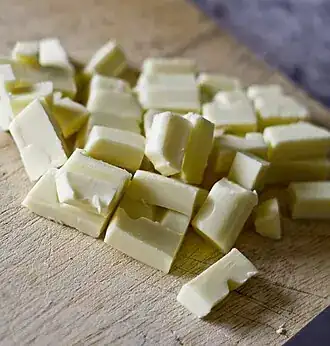
White chocolate at the Table: The Food Behind the Name