Use the regional background below as a starting point for exploring the food, rather than expecting one dish to represent every household. Food traditions differ within a country and continue to change through travel, migration, and everyday cooking.
In this story
OverviewAgriculture and foodsNational dishesMuesliRöstiRestaurants and haute cuisineBeveragesOverview
Swiss cuisine is an ensemble of national, regional, and local dishes, consisting of the ingredients, recipes, and cooking techniques developed in Switzerland or assimilated from other cultures, particularly neighboring countries. The diversity and comprehensiveness of Swiss gastronomy reflect Swiss linguistic, cultural, and geographical diversity. The climate of Switzerland allows for a large variety of terroirs and, therefore, a wide range of indigenous foods, from simple cereals and vegetables to refined products such as cheese and wine.
Switzerland is historically an agricultural country, with many regions being isolated from each other by the Alps. Therefore, one of the main characteristics of Swiss cuisine is its simplicity, with many dishes made up of few but hearty ingredients, often of dairy origin. Swiss cuisine evolved dramatically during the last centuries. Probably the most significant changes occurred after colonization of the Americas and the introduction of now-widely used ingredients such as potatoes, maize, and cocoa. The increase in purchasing power and a certain homogenization of taste have allowed the emergence of some emblematic national dishes such as fondue and rösti.
The most well-known Swiss products include cheese, meat specialties, wine, and chocolate. Switzerland is particularly renowned for its wide variety of cheeses and cured meats, which reflect the country’s regional traditions. Some traditional Swiss food products are protected by a geographical indication (AOP) and are exported worldwide. Over the centuries, Switzerland has developed a strong food industry, particularly associated with dairy and chocolate production, which plays an important role in the national economy.
Agriculture and foods
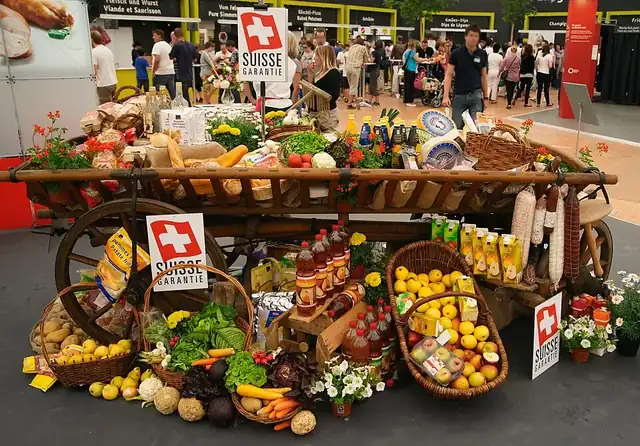
The climatic and cultural diversity of Switzerland is reflected in the diversity of its food products. Various cereals and fruits are cultivated in the lower regions, while the warmest and sunniest areas in the south lend themselves to growing grapes, chestnuts, and even olives. The other most common fruits cultivated in Switzerland are apples, pears, apricots, cherries, plums, and strawberries. The mountainous and coldest areas feature the perhaps most emblematic agricultural practices of Switzerland: dairy farming and alpine transhumance.
Swiss cuisine comprises a variety of staple foods. These typically include bread, potatoes, pasta, rice and polenta. Potatoes are particularly ubiquitous in Swiss cuisine, although this has been only the case since the late 18th century. They are notably used in rösti, a popular dish that is eaten all over Switzerland, and originally a breakfast food. Bread and cereals are eaten on a daily basis in Switzerland. Muesli, which is commonly eaten for breakfast, goes by the name of "Birchermüesli" ("Birchermiesli" in some regions). For breakfast, most Swiss enjoy sliced bread with butter and jam; bread also accompanies most meals. There is a wide variety of breads made in Switzerland, from pain de seigle to Zopf. Tarts and quiches are also traditional Swiss dishes.
Tarts in particular are made with all sorts of toppings, from sweet apple to onion.
National dishes
A few dishes have become emblematic of Swiss cuisine and highly popular throughout the country. All of them have also become popular outside Switzerland's borders.
Muesli
Muesli, known in Switzerland as Birchermüesli, is a breakfast or snack consisting of cereal (oat) flakes, chopped fruit and milk. There are many ways of making a muesli, for example with honey, yoghurt and nuts. Muesli was created by the Swiss nutritionist Max Bircher-Benner in the early 20th century. His 'apple diet dish', developed as part of a raw food diet, was originally served to sanatorium patients as an easily digestible evening meal. After the Second World War, muesli became very popular throughout Switzerland thanks to home cooking courses and being served to the armed forces. Nowadays muesli is a staple in Western breakfast culture and is especially popular among athletes as a nutritional supplement.
Rösti
Rösti is a kind of fried potato cake served as a main course or side dish. As a main dish, rösti is usually accompanied with cheese, onions and cold meat or eggs. This dish, originally from Zürich, was first simply made by frying grated raw potatoes in a pan. It has then spread towards Bern where it is made with boiled potatoes instead. This is where it took the name Rösti. There are many variants in Switzerland and outside the borders. This culinary specialty gives its name to the Röstigraben, which designates the cultural differences between the German- and French-speaking parts of the country.
Restaurants and haute cuisine
A large variety of restaurants can be found in Switzerland. The Stube, Stübli or Stiva (German and Romansh), Brasserie (French) and Osteria (Italian) typically serve simple and traditional dishes. This is even more the case in mountain restaurants or mountain huts.
A unique type of restaurant is found in Ticino: the Grotto. Grottoes are rustic eateries, offering traditional food, such as polenta. Authentic grottoes are old wine caves re-functioned into restaurants. Due to their nature they are mostly found in or around forests and built against a rocky background. Typically, the facade is built from granite blocks and the outside tables and benches are made of the same stone as well. Grottoes are popular with locals and tourists alike, especially during the hot summer months.
Beverages
Wine is produced in many regions of Switzerland, particularly the Valais, the Vaud, the Geneva, the Ticino, the Neuchâtel and the Zürich cantons. Wine economy notably shaped the landscapes of Valais and the Lavaux, which have the most extensive terraced vineyards. Riesling X Sylvaner is a common white wine produced in German-speaking parts of the country, while Chasselas is the most common white wine in the French-speaking parts of the country, where it can also be known as Fendant (in the Valais) and Perlan (in Geneva). Pinot noir is the most popular red grape in both the French-speaking and the German-speaking part, while this position is held by Merlot in the Italian-speaking part.
Beer is second to wine in terms of consumption among Swiss. The country has a long tradition of brewing, with significant domestic beer production and a growing craft brewing sector. Most contemporary large-scale breweries are in German-speaking Switzerland. The Feldschlösschen brewery in Rheinfelden dwarfs all others in the country in terms of output. Calanda brewery in Chur is the largest in Graubünden. Zürich hosts the country's largest beer festival annually, and has a number of microbreweries.
More to savor

Austrian Napkin Dumpling (Serviettenknödel)

Salată de Boeuf (Romanian Beef Salad)
At the Polish Table: The Food Behind a Shared Meal