Use the regional background below as a starting point for exploring the food, rather than expecting one dish to represent every household. Food traditions differ within a country and continue to change through travel, migration, and everyday cooking.
Overview
Austrian cuisine consists of many different local or regional cuisines. In addition to Viennese cuisine, which is predominantly based on the cooking traditions of the Habsburg Empire, there are independent regional traditions in all the states of Austria.
The Austrian cuisine shares similarities with its neighboring countries in Central Europe, but particularly with the cuisines of Hungary (with which it was aligned as part of the Austro-Hungarian Empire), Bavaria, Bohemia and Northern Italy. Internationally, it is particularly well-known for its pastries, such as Kaiserschmarrn and apple strudel, and for meat-based dishes such as the Wiener schnitzel.
Mealtimes
Breakfast is of the "continental" type, usually consisting of bread rolls with either jam or cold meats and cheese, accompanied by coffee, tea or juice. The midday meal was traditionally the main meal of the day, but in modern times, as Austrians work longer hours further from home, this is no longer the case. The main meal is now often eaten in the evening.
A mid-morning or mid-afternoon snack of a slice of bread topped with cheese or ham is referred to as a Jause; a more substantial version akin to a British "ploughman's lunch" is called a Brettljause after the wooden board on which it is traditionally served.
Popular dishes of Vienna
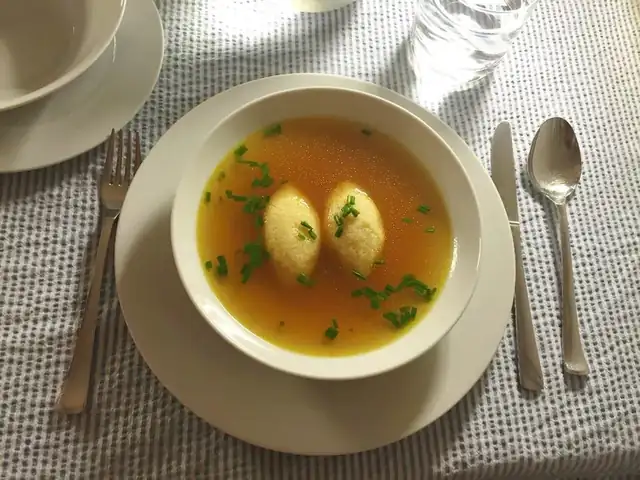
Rindsuppe (beef soup), a clear soup with golden colour
Tafelspitz, beef boiled in broth (soup), often served with apple and horseradish and chives sauce
Gulasch (goulash), a hotpot similar to Hungarian pörkölt. Austrian goulash is often eaten with rolls, bread or dumplings (Semmelknödel).
Beuschel, a ragout containing lungs and heart
Liptauer, a spicy cheese spread, eaten on a slice of bread
Selchfleisch, meat that is smoked, then cooked, served with Sauerkraut and dumplings
Powidl, a thick sweet jam made from plums
Apfelstrudel, apple strudel
Topfenstrudel, cream cheese strudel
Millirahmstrudel, milk-cream strudel
Palatschinken, pancakes similar to French crêpes, filled with jam and sprinkled with sugar or other toppings. They are also served in savoury versions, such as with spinach and cheese.
Meat
The most popular meats in Austria are beef, pork, chicken, turkey and goose. The prominent Wiener schnitzel is traditionally made of veal. Pork in particular is used extensively, with many dishes using offal and parts such as the snout and trotters.
Austrian butchers use a number of special cuts of meat, including Tafelspitz (beef), and Fledermaus (pork). Fledermaus (German for 'bat') is a cut of pork from the ham bone that resembles the winged animal. It is described as "very juicy, somewhat fatty, and crossed by tendons"; the latter makes it suitable for steaming, braising or frying after tenderization in a marinade.
Austrian cuisine has many different sausages, like Frankfurter, Käsekrainer, Debreziner (originating from Debrecen in Hungary), Burenwurst, Blunzn (made with pig blood) and Grüne Würstl (green sausages). Green means raw in this context—the sausages are air-dried and are consumed boiled. Bacon in Austria is called Speck, and can be smoked, raw, salted, or spiced, among other preparations. Bacon is used in many traditional recipes as a salty spice. Leberkäse is a loaf of corned beef, pork and bacon; it contains neither liver nor cheese despite the name. Vanillerostbraten is a garlicky beef dish.
Desserts
Austrian desserts are usually slightly less complicated than the elaborate cakes described above. The most famous of these is the Apfelstrudel (apple strudel), layers of thin pastry surrounding a filling of apple, usually with cinnamon and raisins. Other strudels are also popular, such as those filled with sweetened curd cheese called Topfen, sour cherry (Weichselstrudel), and sweet cherry and poppy seed (Mohnstrudel).
Another favourite is Kaiserschmarr'n, a rich fluffy sweet thick pancake made with raisins and other fruits, broken into pieces and served with a fruit compote (traditionally made of plums called Zwetschkenröster ) for dipping, while a speciality of Salzburg is the meringue-like "Salzburger Nocken". The Danish pastry is said to originate from Vienna and in Denmark is called wienerbrød (Viennese bread). The Danish pastry uses a dough in the classic cuisine referred to as "Viennese dough", made of thin layers of butter and flour dough, imported to Denmark by Austrian bakers hired during a strike among the workers in Danish bakeries in 1850.
Viennese nougat is a softer form of the brown kind of nougat common in Central and Northern Europe. As "Wiener nougat", a form of it—now made with palm oil instead of the original cocoa butter—is mass-produced by the confectionery company Fazer in Finland, where it has become a common Christmas treat.
Coffee
Austria is credited in popular legend with introducing coffee to Europe after bags of coffee beans were left behind by the retreating Turkish army after the Battle of Vienna in 1683. Although the first coffeehouses had appeared in Europe some years earlier, the Viennese café tradition became an important part of the city's identity.
Coffee is served in a variety of styles, particularly in the Viennese coffee houses. An Austrian Mokka or kleiner Schwarzer is similar to espresso, but is extracted more slowly. Other styles are prepared from the Mokka:
großer Schwarzer – a double Mokka
kleiner Brauner or großer Brauner – single or double Mokka plus milk
Verlängerter – "lengthened" (i.e., diluted) Mokka with more water plus milk
Melange – half Mokka, half heated milk, often topped with foamed milk
Franziskaner – Melange topped with whipped cream and foamed milk
Kapuziner – kleiner Schwarzer plus whipped cream
Einspänner – großer Schwarzer topped with whipped cream
Wiener Eiskaffee – iced Mokka with vanilla ice cream, topped with whipped cream
Italian styles such as cappuccino, espresso and latte are also commonly served.
Traditionally, coffee is served with a glass of still water.
Snack food
For food consumed in between meals there are many types of open sandwiches called "belegte Brote", or different kinds of sausage with mustard, ketchup and bread, as well as sliced sausage, Leberkäse rolls or Schnitzelsemmeln (rolls filled with schnitzel).
Traditionally one can get a Wurstsemmel (a roll filled, usually, with Extrawurst, a special kind of thinly sliced sausage, often with a slice of cheese and a pickle or cornichon) at a butcher or at the delicatessen counter in a supermarket.
There are also other common yet informal delicacies that are typical of Austrian food. For example, the Bosna or Bosner (a spiced bratwurst in a hot dog roll), is an integral part of the menu at Austria's typical fast-food restaurant, the sausage stand (Würstelstand). Most Austrian sausages contain pork.
More to savor

Austrian Napkin Dumpling (Serviettenknödel)
Sachertorte (Duramecho Version)
A Taste of Switzerland: Regional Food Beyond the Postcard