This longer reference provides the background behind the topic. Read it alongside the recipe collection when you want to connect an ingredient or food idea with a dish to prepare.
Overview
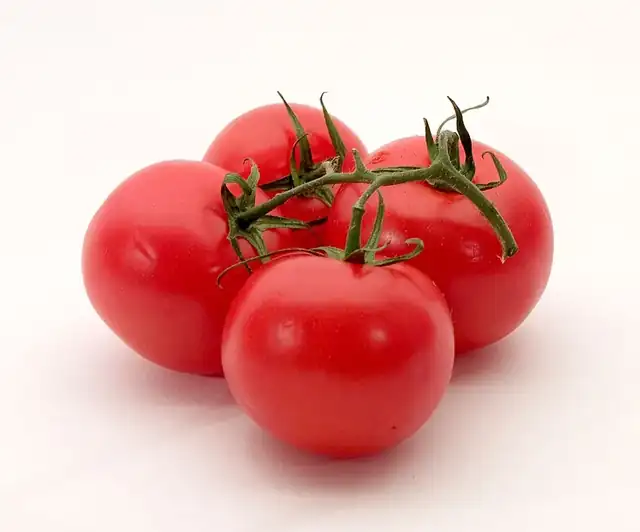
The tomato (; Solanum lycopersicum) is a plant whose fruit is an edible berry that is eaten as a vegetable. The tomato is a member of the nightshade family that includes tobacco, potato, and chili peppers. It originated from western South America, and may have been domesticated there, in Mexico, or in Central America. The Spanish introduced tomatoes to Eurasia in the Columbian exchange in the 16th century.
Tomato plants are vines, largely annual, and vulnerable to frost, though sometimes living longer in greenhouses. The flowers can self-fertilize. Modern varieties have been bred to ripen uniformly red, in a process that has impaired the fruit's sweetness and flavor. There are thousands of cultivars, varying in size, color, shape, and flavor. Tomatoes are attacked by many insect pests and nematodes and are subject to diseases caused by viruses, mildew, and blight fungi.
The tomato has a strong savory umami flavor and is an important ingredient in cuisines around the world. Tomatoes are widely used in sauces for pasta and pizza, in soups such as gazpacho and tomato soup, in salads and condiments like salsa and ketchup, and in various curries. Tomatoes are also consumed as juice and in beverages such as the Bloody Mary cocktail.
Pronunciation
The usual pronunciations of tomato are (in North American English) and (in British English). The word's dual pronunciations were immortalized in Ira and George Gershwin's 1937 song "Let's Call the Whole Thing Off" ("You like and I like / You like and I like ").
Mesoamerica
By 500 BCE, it was already being cultivated in southern Mexico and probably other areas. A large, lumpy variety of tomato, a mutation from a smoother, smaller fruit, originated in Mesoamerica, and may be the direct ancestor of some modern cultivated tomatoes.
The Aztecs raised several varieties of tomato, with red tomatoes called xitomatl. Bernardino de Sahagún reported seeing a great variety of tomatoes in the Aztec market at Tenochtitlán (Mexico City): "large tomatoes, small tomatoes, leaf tomatoes, sweet tomatoes, large serpent tomatoes, nipple-shaped tomatoes", and tomatoes of all colors from the brightest red to the deepest yellow. Sahagún mentioned Aztecs cooking various sauces, some with tomatoes of different sizes, serving them in city markets: "foods sauces, hot sauces; ... with tomatoes, ... sauce of large tomatoes, sauce of ordinary tomatoes, ..."
Fruit and seed
The fruit develops from the ovary of the plant after fertilization, its flesh comprising the pericarp walls. The fruit contains locules, hollow spaces full of seeds. These vary among cultivated varieties. Some smaller varieties have two locules; globe-shaped varieties typically have three to five; beefsteak tomatoes have a great number of small locules; and plum tomatoes have very few, very small locules. The fruit contains lycopene that produces a red colour when ripe to attract animals that eat and disperse them elsewhere. However, not all tomatoes have same levels of lycopene; so not all of them have the same red colour when they ripe. Yellow tomatoes have levels of delta-carotene and lutein higher than lycopene, orange tomatoes have higher levels of beta-carotene and prolycopene.
For propagation, the seeds need to come from a mature fruit, and must be lightly fermented to remove the gelatinous outer coating and then dried before use. The tomato has a mutualistic relationship with arbuscular mycorrhizal fungi such as Rhizophagus irregularis. Scientists use the tomato as a model species for investigating such symbioses.
Production
In 2023, world production of tomatoes was 192 million tonnes, led by China with 36% of the total, followed by India, Turkey, and the United States as secondary producers (table).
Culinary
Tomatoes, with their umami flavor, are extensively used in Mediterranean cuisine as a key ingredient in pizza and many pasta sauces. Tomatoes are used in Spanish gazpacho and Catalan pa amb tomàquet. The tomato is a crucial and ubiquitous part of Middle Eastern cuisine, served fresh in salads (e.g., Arab salad, Israeli salad, Shirazi salad and Turkish salad), grilled with kebabs and other dishes, made into sauces, and so on.
Tomatoes were gradually incorporated into Indian curry dishes after Europeans introduced them. A Kashmiri curry, rogan josh, often contains tomato; it may originally have been colored red with chili pepper, and tomatoes may characterize the Punjabi version of the dish. The modern British curry tikka masala often has a tomato and cream sauce.
Fruit or vegetable
Although the tomato is cooked and eaten as a vegetable, botanically, a tomato is a fruit, specifically a berry, consisting of the ovary, together with its seeds, of a flowering plant. The issue has led to legal dispute in the United States. In 1887, U.S. tariff laws that imposed a duty on vegetables, but not on fruit, caused the tomato's status to become a matter of legal importance. In Nix v. Hedden, the U.S. Supreme Court settled the controversy on 10 May 1893, by declaring that for the purposes of the Tariff of 1883 only, the tomato is a vegetable, based on the popular definition that classifies vegetables by use—they are generally served with dinner and not dessert.
More to savor

Chicken Vindaloo

Chicken Tikka Masala
A Closer Look at Chia seed: From Ingredient to Meal