This longer reference provides the background behind the topic. Read it alongside the recipe collection when you want to connect an ingredient or food idea with a dish to prepare.
In this story
OverviewDescriptionExternal phylogenyMaize and teosinteSpreading to the northProductionCulinaryOverview
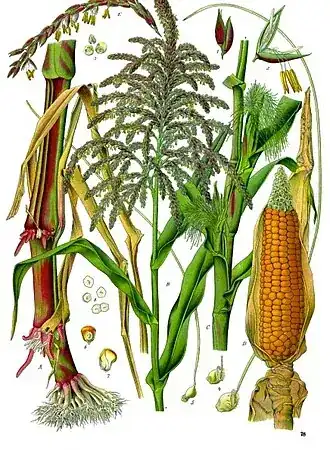
Maize (Zea mays), also known as corn, is a tall stout grass that produces cereal grain. The leafy stalk of the plant gives rise to male inflorescences or tassels which produce pollen, and female inflorescences called ears. The ears yield grain, known as kernels or seeds. In modern commercial varieties, these are usually yellow or white; other varieties can be of many colors. Maize was domesticated by indigenous peoples in southern Mexico about 9,000 years ago from wild teosinte. Native Americans planted it alongside beans and squashes in the Three Sisters polyculture.
Maize relies on humans for its propagation. Since the Columbian exchange, it has become a staple food in many parts of the world, with the total production of maize surpassing that of wheat and rice. Much maize is used for animal feed, whether as grain (fodder) or as the whole plant, which can either be baled as forage or made into the more palatable silage. Sugar-rich varieties called sweet corn are grown for human consumption, while field corn varieties are used for animal feed, for uses such as cornmeal or masa, corn starch, corn syrup, pressing into corn oil, alcoholic beverages like bourbon whiskey, and as chemical feedstocks including ethanol and other biofuels.
Maize is cultivated throughout the world; a greater weight of maize is produced each year than any other grain. In 2020, world production was 1.1 billion tonnes. It is afflicted by many pests and diseases; two major insect pests, European corn borer and corn rootworms, have each caused annual losses of a billion dollars in the United States. Modern plant breeding has greatly increased output and qualities such as nutrition, drought tolerance, and tolerance of pests and diseases. Much maize is now genetically modified.
Description
Maize is a tall annual grass with a single stem, ranging in height from 1.2 to 4 m. The long narrow leaves arise from the nodes or joints, alternately on opposite sides on the stalk. Maize is monoecious, with separate male and female flowers on the same plant. At the top of the stem is the tassel, an inflorescence of male flowers; their anthers release pollen, which is dispersed by wind. The female inflorescence, some way down the stem from the tassel, is first seen as a silk, a bundle of soft tubular hairs, one for the carpel in each female flower, which develops into a kernel (often called a seed. Botanically, as in all grasses, it is a fruit, fused with the seed coat to form a caryopsis) when it is pollinated.
A whole female inflorescence develops into an ear or corncob, enveloped by multiple leafy layers or husks. The is the leaf most closely associated with a particular developing ear. This leaf and those above it contribute over three quarters of the carbohydrate (starch) that fills the grain.
External phylogeny
The maize genus Zea is relatively closely related to sorghum, both being in the PACMAD clade of Old World grasses, and much more distantly to rice and wheat, which are in the other major group of grasses, the BOP clade. It is closely related to Tripsacum, gamagrass.
Maize and teosinte
Maize is the domesticated variant of the four species of teosintes, which are its crop wild relatives. Teosinte was likely used by hunter-gatherers because it added security to their food supply, being that it was adaptable to changes in climate and environment.
The teosinte origin theory was proposed by the Russian botanist Nikolai Ivanovich Vavilov in 1931, and the American Nobel Prize-winner George Beadle in 1932. The two plants have dissimilar appearance, maize having a single tall stalk with multiple leaves and teosinte being a short, bushy plant. The difference between the two is largely controlled by differences in just two genes, called grassy tillers-1 (gt1) and teosinte branched-1 (tb1). In the late 1930s, Paul Mangelsdorf suggested that domesticated maize was the result of a hybridization event between an unknown wild maize and a species of Tripsacum, a related genus; this has been refuted by modern genetic testing.
Spreading to the north
Around 4,500 years ago, maize began to spread to the north. Maize was first cultivated at several sites in New Mexico and Arizona about 4,100 years ago. During the first millennium AD, maize cultivation spread more widely in the areas north. In particular, the large-scale adoption of maize agriculture and consumption in eastern North America took place about A.D. 900. Native Americans cleared large forest and grassland areas for the new crop. The rise in maize cultivation 500 to 1,000 years ago in what is now the southeastern U.S. corresponded with a decline of freshwater mussels, which are very sensitive to environmental changes.
Production
Maize is widely cultivated throughout the world, and a greater weight of maize is produced each year than any other grain. In 2020, total world production was 1.16 billion tonnes, led by the U.S. with 31.0% of the total (table). China produced 22.4% of the global total.
In August 2026, corn futures reached their highest level since July 2023, with prices rising amid expectations of tighter U.S. supplies and strong global demand. The U.S. Department of Agriculture's August 2026 World Agricultural Supply and Demand Estimates report lowered its U.S. corn yield forecast to 180.7 bushels per acre.
Culinary
Maize and cornmeal (ground dried maize) constitute a staple food in many regions of the world. Maize is used to produce the food ingredient cornstarch. Maize starch can be hydrolyzed and enzymatically treated to produce high fructose corn syrup, a sweetener. Maize may be fermented and distilled to produce Bourbon whiskey. Corn oil is extracted from the germ of the grain.
In prehistoric times, Mesoamerican women used a metate quern to grind maize into cornmeal. Nursing mothers also used maize as a weaning gruel for their children. After ceramic vessels were invented, the Olmec people began to cook maize together with beans, improving the nutritional value of the staple meal. Although maize naturally contains niacin, an important nutrient, it is not bioavailable without the process of nixtamalization. The Maya used nixtamal meal to make porridges and tamales.
Maize is a staple of Mexican cuisine. Masa (nixtamal) is the main ingredient for tortillas, atole and many other dishes of Central American cuisine. It is the main ingredient of corn tortilla, tamales, atole and the dishes based on these.
The corn smut fungus, known as huitlacoche, which grows on maize, is a Mexican delicacy.
More to savor

Chicken Vindaloo
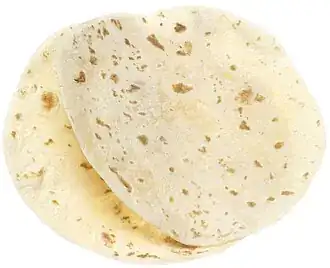
Homemade Wheat Tortillas
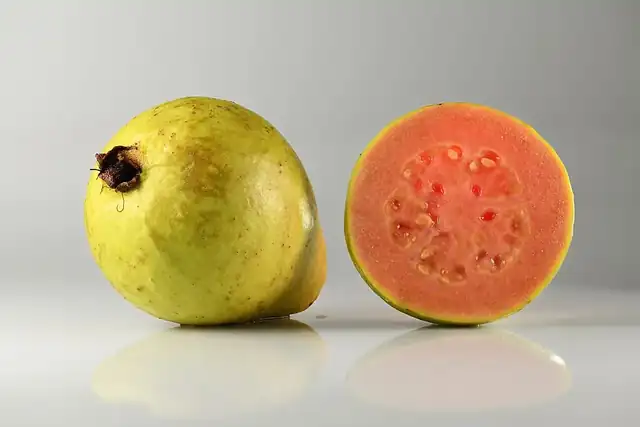
Beyond the Shopping List: The Story of Guava