This longer reference provides the background behind the topic. Read it alongside the recipe collection when you want to connect an ingredient or food idea with a dish to prepare.
In this story
OverviewVanilla orchidCultivarsPropagation, preparation and type of stockNonplant vanilla flavoringSweatingProductionOverview
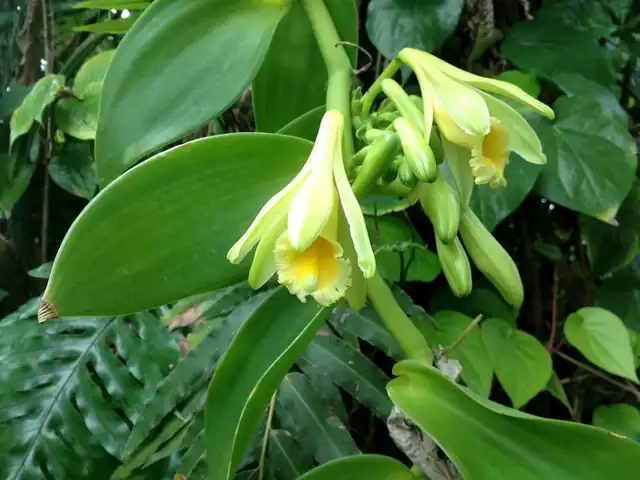
Vanilla is a spice derived from orchids of the genus Vanilla, primarily obtained from the seed pods of the flat-leaved Mexican and Central American vanilla (V. planifolia).
Vanilla is not autogamous, so pollination is required to produce the pods. In 1837, the Belgian botanist Charles François Antoine Morren discovered this and pioneered a method of artificially pollinating the plant. The method proved financially unworkable and was not deployed commercially. In 1841, Edmond Albius, a 12-year-old enslaved child who lived on the French island of Réunion in the Indian Ocean, discovered that the plant could be hand-pollinated. Hand-pollination allowed global cultivation of the plant. The noted French botanist and plant collector Jean Michel Claude Richard falsely claimed to have discovered the technique three or four years earlier. By the end of the 20th century, Albius was considered the true discoverer.
Three major species of vanilla currently are grown globally, all derived from a species originally found in Mesoamerica, including parts of modern-day Mexico. They are V. planifolia (syn. V. fragrans), grown on Madagascar, Réunion, and other tropical areas along the Indian Ocean; V. × tahitensis, grown in the South Pacific; and V. pompona, found in the West Indies, Central America, and South America. The majority of the world's vanilla is the V. planifolia species, more commonly known as Bourbon vanilla (after the former name of Réunion, Île Bourbon) or Madagascar vanilla, which is produced in Madagascar and neighboring islands in the southwestern Indian Ocean, and in Indonesia. Madagascar's and Indonesia's cultivations produce two-thirds of the world's supply of vanilla.
Vanilla orchid
The main species of vanilla cultivated is V. planifolia. Although it is native to Mesoamerica and South America, it is now widely grown throughout the tropics. Indonesia and Madagascar are the world's largest producers. Additional sources include V. pompona and V. tahitiensis (grown in Niue and Tahiti), although the vanillin content of these species is much less than V. planifolia.
Vanilla grows as a vine, climbing up an existing tree (also called a tutor), pole, or other support. It can be grown in a wood (on trees), in a plantation (on trees or poles), or in a "shader", in increasing orders of productivity. Its growth environment is referred to as its terroir, and includes not only the adjacent plants, but also the climate, geography, and local geology. Left alone, it will grow as high as possible on the support, with few flowers. Every year, growers fold the higher parts of the plant downward so the plant stays at heights accessible by a standing human. This also greatly stimulates flowering.
The distinctively flavored compounds are found in the fruit, which results from the pollination of the flower. These seed pods are roughly 1/3 in by 6 in, and brownish red to black when ripe. Inside of these pods is an oily liquid full of tiny seeds. One flower produces one fruit. V. planifolia flowers are hermaphroditic: they carry both male (anther) and female (stigma) organs. However, self-pollination is made difficult by the rostellum which separates those organs.
Cultivars
Bourbon vanilla or Bourbon-Madagascar vanilla, produced from V. planifolia plants introduced from the Americas, is from Indian Ocean islands such as Madagascar, the Comoros, Mauritius and Réunion, formerly named the Île Bourbon. It is also used to describe the distinctive vanilla flavor derived from V. planifolia grown successfully in tropical countries such as India. However, there is no Bourbon whiskey in Bourbon vanilla extract, despite common confusion about this.
Mexican vanilla, made from the native V. planifolia, is produced in much less quantity and marketed as the vanilla from the land of its origin.
Propagation, preparation and type of stock
Dissemination of vanilla can be achieved either by stem cutting or by tissue culture. For stem cutting, a progeny garden needs to be established. All plants need to grow under 50% shade, as well as the rest of the crop. Mulching the trenches with coconut husk and micro irrigation provide an ideal microclimate for vegetative growth. Cuttings between 60 and 120 cm should be selected for planting in the field or greenhouse. Cuttings below 60 to 120 cm need to be rooted and raised in a separate nursery before planting. Planting material should always come from unflowered portions of the vine. Wilting of the cuttings before planting provides better conditions for root initiation and establishment.
Before planting the cuttings, trees to support the vine must be planted at least three months before sowing the cuttings. Pits of 30 × 30 × 30 cm are dug 30 cm away from the tree and filled with farm yard manure (vermicompost), sand and top soil mixed well. An average of 2000 cuttings can be planted per hectare (2.5 acres). One important consideration is that when planting the cuttings from the base, four leaves should be pruned and the pruned basal point must be pressed into the soil in a way such that the nodes are in close contact with the soil, and are placed at a depth of 15 to 20 cm. The top portion of the cutting is tied to the tree using natural fibers such as banana or hemp.
Nonplant vanilla flavoring
In the United States, castoreum, the exudate from the castor sacs of mature beavers, has been approved by the Food and Drug Administration as a food additive, often referenced simply as a "natural flavoring" in the product's list of ingredients. It is used in both food and beverages, especially as vanilla and raspberry flavoring, with a total annual US production of less than 300 lb. It is also used to flavor some cigarettes and in perfume-making, and is used by fur trappers as a scent lure.
Sweating
Sweating is a hydrolytic and oxidative process. Traditionally, it consists of keeping fruits, for 7 to 10 days, densely stacked and insulated in wool or other cloth. This retains a temperature of 45 - 65 C and high humidity. Daily exposure to the sun may also be used, or dipping the fruits in hot water. The fruits are brown and have attained much of the characteristic vanilla flavor and aroma by the end of this process, but still retain a 60–70% moisture content by weight.
Production
In 2023, world production of raw vanilla was 7,433 tonnes, led by Madagascar with 42% of the total and Indonesia with 25% (table).
More to savor

Chicken Vindaloo
Machacado con Huevo (Eggs with Shredded Beef)
Dragon fruit at the Table: The Food Behind the Name