This longer reference provides the background behind the topic. Read it alongside the recipe collection when you want to connect an ingredient or food idea with a dish to prepare.
Overview
Guava , also known as the 'guava-pear' in various regions, is a common tropical fruit cultivated in many tropical and subtropical regions. The common guava Psidium guajava (lemon guava, apple guava) is a small tree in the myrtle family (Myrtaceae), native to Mexico, Central America, the Caribbean and northern South America. Botanically, guavas are berries.
The name guava is also given to some other species in the genus Psidium, such as strawberry guava (Psidium cattleyanum) and to the pineapple guava, Feijoa sellowiana. In 2024, the world production of guavas (data combined with mangos and mangosteens) was 62 million tonnes, led by India having 45% of the total.
Types
The most frequently eaten species, and the one often simply referred to as "the guava", is the apple guava (Psidium guajava). Guavas are typical Myrtoideae, with tough dark heavy leaves that are opposite, simple, elliptic to ovate, and 5 – 15 cm long. The flowers are white, with five petals and numerous stamens. The fruits are many-seeded berries.
Ecology
Psidium species are eaten by the caterpillars of some Lepidoptera, mainly moths like the Ello Sphinx (Erinnyis ello), Eupseudosoma aberrans, E. involutum, and Hypercompe icasia. Mites, like Pronematus pruni and Tydeus munsteri, are known to be crop pests of the apple guava (P. guajava) and perhaps other species. The bacterium Erwinia psidii causes rot diseases of the apple guava.
The fruit is cultivated and favored by humans, and many other animals such as birds consume it, readily dispersing the seeds in their droppings. In Hawaii, strawberry guava (P. littorale) has become an aggressive invasive species threatening extinction to more than 100 other plant species. By contrast, several guava species have become rare due to habitat destruction and at least one (Jamaican guava, P. dumetorum) is already extinct.
Guava wood is used for meat smoking in Hawaii, and is used at barbecue competitions across the United States. In Cuba and Mexico, the leaves are used in barbecues.
Fruit
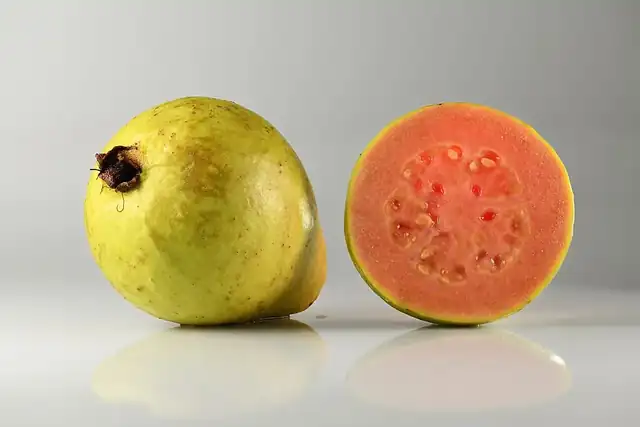
Guava fruits, usually 4 to 12 cm long, are round or oval depending on the species. They have a pronounced and typical fragrance, similar to lemon rind but less sharp. The outer skin may be rough, often with a bitter taste, or soft and sweet. Varying between species, the skin can be any thickness, is usually green before maturity, but may be yellow, maroon, or green when ripe. The pulp inside may be sweet or sour and off-white ("white" guavas) to deep pink ("red" guavas). The seeds in the central pulp vary in number and hardness, depending on species.
Production
In 2024, world production of guavas was 62 million tonnes, led by India with 45% of the total (table; mangoes and mangosteens included). Secondary producers were Indonesia and China.
Culinary
In Mexico and other Latin American countries, the beverage agua fresca is often made with guava. The entire fruit is a key ingredient in punch, and the juice is often used in culinary sauces (hot or cold), ales, candies, dried snacks, fruit bars, and desserts, or dipped in chamoy. Pulque de guayaba ("guayaba" is Spanish for guava) is a common alcoholic beverage in these regions.
In many countries, guava is eaten raw, typically cut into quarters or eaten like an apple; it is also eaten with a pinch of salt and pepper, cayenne powder or a mix of spices (masala). In the Philippines, ripe guava is used in cooking sinigang. Guava is a snack in Cuba as pastelitos de guayaba; and in Taiwan, sold on many street corners and night markets during hot weather, accompanied by packets of dried plum powder mixed with sugar and salt for dipping. In east Asia, guava is commonly eaten with sweet and sour dried plum powder mixtures. Guava juice is consumed in many countries. The fruit is also often included in fruit salads.
Because of its high level of pectin, guavas are extensively used to make candies, preserves, jellies, jams, and marmalades (such as Brazilian goiabada and Colombian and Venezuelan bocadillo), and as a marmalade jam served on toast.
Red guavas can be used as the base of salted products such as sauces, substituting for tomatoes, especially to minimize the acidity. A drink may be made from an infusion of guava fruits and leaves, which in Brazil is called chá-de-goiabeira, i.e., "tea" of guava tree leaves.
Seed oil
Guava seed oil may be used for culinary or cosmetics products. It is rich in linoleic acid.
Folk medicine
Since the 1950s, guavas – particularly the leaves – have been studied for their constituents, potential biological properties and history in folk medicine.
Parasites
Guavas are one of the most common hosts for fruit flies like A. suspensa, which lay their eggs in overripe or spoiled guavas. The larvae of these flies then consume the fruit until they can proceed into the pupa stage. This parasitism has led to millions in economic losses for nations in Central America.
Fungal pathogens, Neopestalotiopsis and Pestalotiopsis species are causal agents of guava scab in Colombia.
More to savor

Chicken Vindaloo
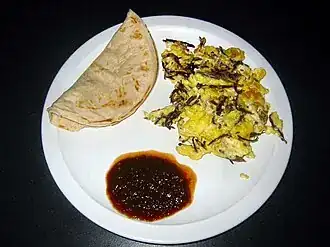
Machacado con Huevo (Eggs with Shredded Beef)
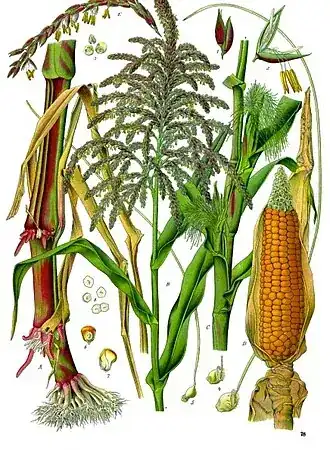
Beyond the Shopping List: The Story of Maize