Use the regional background below as a starting point for exploring the food, rather than expecting one dish to represent every household. Food traditions differ within a country and continue to change through travel, migration, and everyday cooking.
In this story
OverviewRegional cuisinesFood in relation to lifestyleTypical Vietnamese family mealRoyal cuisineFood colouringsFermented meat dishesOverview
Vietnamese cuisine encompasses the foods and beverages originated from Vietnam. Meals feature a combination of five fundamental tastes (ngũ vị): sweet, salty, bitter, sour, and spicy. The distinctive nature of each dish reflects one or more elements (such as nutrients and colors), which are also based around a five-pronged philosophy. Vietnamese recipes use ingredients like lemongrass, ginger, mint, Vietnamese mint, brown sugar, long coriander, Saigon cinnamon, bird's eye chili, soy sauce, lime, and Thai basil leaves. Traditional Vietnamese cooking has often been characterised as using fresh ingredients, not using much dairy or oil, having interesting textures, and making use of herbs and vegetables. The cuisine is also low in sugar and is almost always naturally gluten-free, as many of the dishes are rice-based instead of wheat-based, made with rice noodles, bánh tráng rice paper wrappers and rice flour.
Regional cuisines
The mainstream culinary traditions in all three regions of Vietnam share some fundamental features:
Freshness of food: Most meats are only briefly cooked. Vegetables are eaten fresh; if they are cooked, they are boiled or only briefly stir-fried.
Presence of herbs and vegetables: Herbs and vegetables are essential to many Vietnamese dishes and are often abundantly used.
Variety and harmony of textures: Crisp with soft, watery with crunchy, delicate with rough.
Broths or soup-based dishes are common in all three regions.
Presentation: The condiments accompanying Vietnamese meals are usually colorful and arranged in eye-pleasing manners.
Food in relation to lifestyle
Vietnamese cuisine is reflective of the Vietnamese lifestyle, from the preparation to how the food is served. Going through long phases of war and political conflict, as well as cultural shifts, many Vietnamese people have been living in poverty. Therefore, the ingredients for Vietnamese food are often very inexpensive. Nonetheless, the way they are cooked together to create a yin–yang balance makes the food simple in appearance but rich in flavor.
Because of economic conditions, maximizing the use of ingredients to save money has become a tradition in Vietnamese cooking. In earlier decades, and even nowadays in rural areas, every part of a cow is used, from the muscle meat to the intestines. The higher quality cuts from farmed animals (cows, pigs) would be cooked in stir-fry dishes and soups, while the secondary cuts would be used in blood sausages or for preparing broth. The same goes for vegetables like scallions: the leafy part is diced into small bits which are used to add flavor to the food while the crunchy stalk and roots are replanted.
Nước mắm (fish sauce) is the most commonly used condiment in Vietnamese cooking. It is made from fermented raw fish and is served with most of the Vietnamese dishes. A traditional southern Vietnamese meal usually includes cơm trắng (plain white rice), cá kho tộ (catfish in a clay pot), canh chua cá lóc (sour soup with snakehead fish), and it would be incomplete without fish sauce served as a condiment. Cooking and then serving fish in the same clay pot has been proven to be an ancient tradition.
The foods from each region in Vietnam carry their distinctive and unique characteristics that reflect the geographical and living conditions of the people there. The traditional southern Vietnamese meal is made up of fresh ingredients that the fertile Mekong Delta could provide, such as cá lóc, and a wide range of tropical fruit like mangosteen, mango, and dragon fruit. The southern-style diet includes vegetables, fish and tropical fruits as the main ingredients.
Central Vietnam is the region in which food is prepared with the strongest, boldest flavors. The coastline around the central Vietnam area is known for its salt and fish sauce industries; these two condiments are central to their daily diets.
Northern Vietnamese cuisine has a strong Chinese influence, and its most famous dish is phở. Owing to the notable differences in climate and lifestyles throughout the three main regions of Vietnam, the foods vary. Northern Vietnamese cooking is the least bold and spicy in flavor compared to the foods from central and southern Vietnam.
Typical Vietnamese family meal
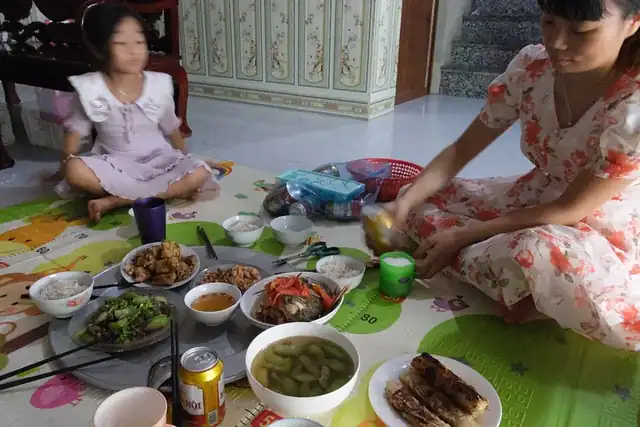
Daily meals of Vietnamese people are quite different from Vietnamese foods served in restaurants or stalls. A typical meal for the average Vietnamese family would include:
Cơm trắng: parboiled white rice
Món mặn or main dishes to eat with rice: fish/seafood, meat, tofu (grilled, boiled, steamed, stewed or stir-fried with vegetables)
Rau: sauteed, boiled or raw fresh green vegetables
Canh: (a clear broth with vegetables and often meat or seafood) or other kinds of soup
Nước chấm: dipping sauces and condiments depending on the main dishes, such as pure fish sauce, ginger fish sauce, tamarind fish sauce, soy sauce, muối tiêu chanh (salt and pepper with lime juice) or muối ớt (salt and chili)
Royal cuisine
In the Nguyễn dynasty, the 50 best chefs from all over the kingdom were selected for the Thượng Thiện board to serve the king. There were three meals per day—12 dishes at breakfast and 66 dishes for lunch and dinner (including 50 main dishes and 16 sweets). An essential dish was bird's nest soup (tổ yến). Other dishes included shark fin (vi cá), abalone (bào ngư), deer's tendon (gân nai), bears' hands (tay gấu), and rhinoceros' skin (da tê giác). Water had to come from the Hàm Long well, the Báo Quốc pagoda, the Cam Lồ well (near the base of Thúy Vân mountain), or from the source of the Hương River. Rice was the de variety from the An Cựu imperial rice field. Phước Tích clay pots for cooking rice were used only a single time before disposal. No one was allowed to have any contact with the cooked dishes except for the cooks and Thượng Thiện board members.
The dishes were first served to eunuchs, then the king's wives, after which they were offered to the king. The king enjoyed meals (ngự thiện) alone in a comfortable, music-filled space.
Food colourings
Traditionally, the colouring of Vietnamese food comes from natural ingredients; however, today there is an increase in the use of artificial food dye agents for food colouring, in Vietnam.
Red – usually from beetroot or by frying annatto seeds to make oil (dầu điều)
Orange – usually used for sticky rice, comes from gac
Yellow – from turmeric
Green – from the pandan leaf or katuk
Purple – from the magenta plant (lá cẩm)
Fermented meat dishes
Nem chua, a Vietnamese fermented meat served as is or fried, is made from pork meat, coated by fried rice (thính gạo), mixed with pork skin and then wrapped in country gooseberry leaves (lá chùm ruột) or Erythrina orientalis leaves (lá vông nem). The preservation process takes about three to five days.
More to savor
Stuffed Duck Breast with Cabbage and Dumplings

Koko da Kosai (Fermented Corn Porridge and Bean Fritters)
At the Polish Table: The Food Behind a Shared Meal