Use the regional background below as a starting point for exploring the food, rather than expecting one dish to represent every household. Food traditions differ within a country and continue to change through travel, migration, and everyday cooking.
In this story
OverviewFood cultureSingapore food internationallyTypes of foodSeafoodDrinks and beveragesSingaporean dishes uncommon in SingaporeOverview
Singaporean cuisine is derived from several ethnic groups in Singapore and has developed through centuries of political, economic, and social changes in the cosmopolitan city-state.
Influences include the cuisines of the Malays/Indonesians, Chinese and the Indians as well as, Peranakan and Western traditions (particularly English and Portuguese-influenced Eurasian, known as Kristang). The cuisine has a medium spiciness range, mostly due to historical immigrant influence from South Asia and the Malay Archipelago. More modern influences from neighbouring regions such as Japan, Korea and Thailand are also present.
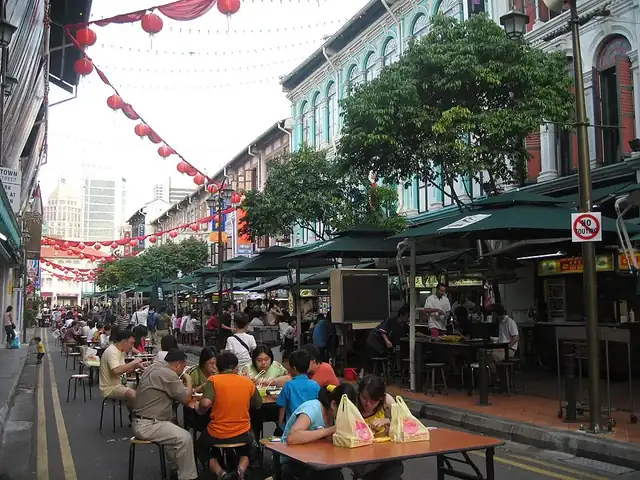
In Singapore, food is viewed as crucial to its national identity and a unifying cultural thread. Singaporean literature declares eating a national pastime and food a national obsession. Food is a frequent topic of conversation among Singaporeans. Religious dietary strictures do exist; Muslims do not eat pork, Hindus and Buddhists do not eat beef. There is also a significant group of vegetarians/vegans, who are mainly Buddhist or Hindu. People from different communities often eat together, while being mindful of each other's culture and choosing food that is acceptable for all.
In addition to venues serving traditional Singaporean food, restaurants serving cuisine from a diverse range of countries worldwide are also common in Singapore.
Food culture
A common greeting for many Singaporean comes in the form of the question "Have you eaten?", and its equivalent in various Chinese languages. It is one way of expressing a greeting to another person. It is also possible to assume that this is how Singaporeans think about meals and food. Since Singapore is a multicultural nation, there is a diverse range of people who might have different and restricted diets, such as Muslims and Hindus. Since Singapore is influenced by many different regions, religions, and cultures, there are also many events or anniversaries. During the Lunar New Year, people eat nian gao, which is originally from China, and is traditionally eaten around the Chinese New Year.
It is an extension of Malay cuisine but influenced by the Chinese and Indians – not to mention the Arabs, British and other immigrants who have contributed to making Singapore one of the world's most important trading ports.
Singapore food internationally
Singaporean food is a significant cultural attraction for tourists and visitors. Some Singaporean dishes have become internationally known. In 2011, four Singaporean dishes were included in the list of 'World's 50 Most Delicious Foods (Readers' Pick)' – a worldwide online poll by 35,000 people held by CNN International. They are Hainanese chicken rice (13th), chili crab (29th), Katong laksa (44th) and roti prata (45th).
Anthony Bourdain brought international attention to Sin Huat Eating House in Geylang after visiting the restaurant during his television series A Cook's Tour (TV series). During the visit, Bourdain ate the restaurant's crab bee hoon and praised the dish. In a subsequent interview, when asked about the best thing he had eaten in Singapore, Bourdain said that he loved the crab bee hoon at Sin Huat Eating House. Bourdain also included Sin Huat Eating House in his Men's Health article 13 Places to Eat Before You Die, recommending its crab bee hoon.
Anthony Bourdain also brought international attention to local food available in hawker centres on his show, No Reservations. He featured Tian Tian Chicken Rice and Maxwell Food Centre on the programme. Bourdain also publicly spoke about hoping to feature four Singaporean dishes in his upcoming food hall in New York City.
Gordon Ramsay participated in a 'Hawker Heroes Challenge' held in Singapore in 2013, in which each competitor made three dishes. Ramsay's chili crab was voted the best, but he lost on the other two dishes to Ryan Koh (representing 328 Katong Laksa) and Foo Kui Lian (representing Tian Tian Chicken Rice).
Singaporean cuisine has been promoted as a tourist attraction by the Singapore Tourism Board. The Singapore Food Festival, held every year in July, is a celebration of Singapore's cuisine. The Overseas Singaporean Unit also organises Singapore Day in major cities around the world as a platform for Singaporeans living abroad. One of Singapore Day's major draws is the local Singaporean hawker food, which is prepared on-site by well-known hawkers specially flown in for the event.
Types of food
Singaporean food can be divided into six types: meat, seafood, rice, noodles, dessert and snacks.
Singapore is especially renowned for its seafood. Chilli crab and black pepper crab are two quintessential dishes that dominate the scene and are greatly recommended to tourists. Another favourite is sambal stingray.
In the meat category, Hainanese chicken rice is the most popular dish. Essentially, it is rice cooked with chicken fat, served with steamed chicken, accompanied with chilli sauce and cucumbers.
Three noodle dishes stand out in Singapore cuisine. "Hokkien prawn mee" comprises fried egg noodles and Rice noodles with prawns, sliced pork, Fishcake and squid. It is stir-fried with a broth usually made from prawns. "Nyonya laksa" is composed of rice noodles served in a coconut prawn broth. "Char kway teow" is stir-fried rice noodles with prawns, Chinese sausage, Bean sprout, Lard and cockles.
In the dessert category, tau-suan is one of many types of desserts commonly found in hawker centres around Singapore. Tāu-suàn (split mung bean soup), is a dessert of Teochew origin. It is a sweet and starchy soup made from split mung beans, usually eaten with youtiao.
Seafood
Singaporeans also eat a wide variety of seafood including fish, squid (known as sotong in Malay), stingray, crab, lobster, clams, and oysters.
Well-known seafood dishes include:
Black pepper crab, hard-shell crabs cooked in a black pepper sauce. Salted egg crab and buttermilk crab are also common
Chilli crab, hard-shell crabs cooked in chilli sauce, usually served with man tou, or deep-fried buns
Drinks and beverages
Popular Singaporean drinks include:
Bandung, rose syrup with evaporated milk.
Beer in Singapore
Chin chow drink , grass jelly made into a sweet beverage.
Singaporean dishes uncommon in Singapore
Singapore-style noodles , an American Chinese dish featuring fried rice vermicelli flavoured with yellow curry powder which can also be commonly found in Hong Kong, is not found in Singapore. The close relative to this dish is fried bee hoon (thin rice noodles).
Singapore fried kway tiao , a dish featuring fried thick, flat rice noodles flavoured with dark soy sauce commonly available in some Chinese restaurants in Canada and the United States, is also not a Singaporean dish. The dish most resembling it is char kway teow.
More to savor

Koko da Kosai (Fermented Corn Porridge and Bean Fritters)
Boeuf Bourguignon
A Taste of Vietnam: Exploring the Foods Behind a Meal