This longer reference provides the background behind the topic. Read it alongside the recipe collection when you want to connect an ingredient or food idea with a dish to prepare.
Overview
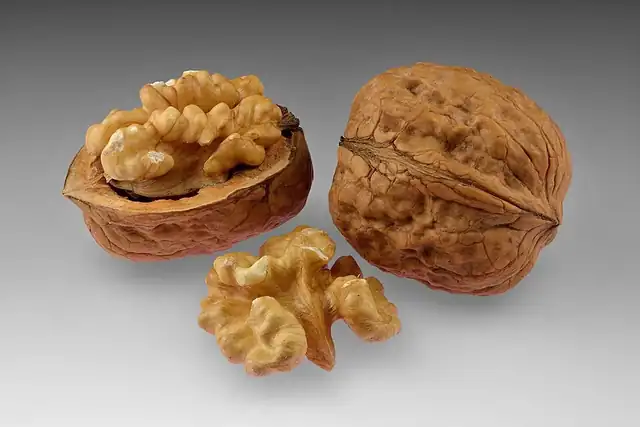
A walnut is the edible seed of any tree of the genus Juglans (family Juglandaceae), most often the Persian or English walnut, Juglans regia. They are accessory fruit because the outer covering of the fruit is technically an involucre and thus not morphologically part of the carpel; this means it cannot be a drupe but is instead a drupe-like nut.
After full ripening, the shell is discarded, and the kernel is eaten. Nuts of the eastern black walnut (Juglans nigra) and butternuts (Juglans cinerea) are less commonly consumed.
Description
Walnuts are the round, single-seed stone fruits of the walnut tree. They ripen between September and November in the northern hemisphere. The brown, wrinkly walnut shell is enclosed in a husk. Shells of walnuts commercially available usually have two segments (but three- or four-segment shells can also form). During the ripening process, the husk becomes brittle and the shell hard. The shell encloses the kernel or meat, which is usually in two halves separated by a membranous partition. The seed kernels – commonly available as shelled walnuts – are enclosed in a brown seed coat which contains antioxidants. The antioxidants protect the oil-rich seed from atmospheric oxygen, preventing rancidity.
Walnut trees are late to grow leaves, typically not doing so until more than halfway through the spring.
Chemistry
Walnut hulls contain diverse phytochemicals, such as polyphenols, that stain hands and can cause skin irritation. Seven phenolic compounds, including ferulic acid, vanillic acid, coumaric acid, syringic acid, myricetin, and juglone, were identified in walnut husks; juglone had concentrations of 2–4% fresh weight.
Walnuts also contain the ellagitannin, pedunculagin. Regiolone has been isolated with juglone, betulinic acid and sitosterol from the stem bark of J. regia.
Species
The three species of walnuts most commonly grown for their seeds are the Persian (or English) walnut (J. regia), originating from Iran, the black walnut (J. nigra) – native to eastern North America – and the Japanese walnut, also known as the heartnut (J. ailantifolia). Other species include J. californica, the California black walnut (often used as a rootstock for commercial propagation of J. regia), J. cinerea (butternuts), and J. major, the Arizona walnut. Other sources list J. californica californica as native to southern California, and Juglans californica hindsii, or just J. hindsii, as native to northern California; in at least one case, these are given as "geographic variants" instead of subspecies (Botanica).
Numerous walnut cultivars have been developed commercially, which are nearly all hybrids of the Persian walnut.
Storage
Walnuts, like other tree nuts, must be processed and stored properly. Poor storage makes walnuts susceptible to insect and fungal mould infestations; the latter produces aflatoxin – a potent carcinogen. A batch that contains mold-infested walnuts should be entirely discarded.
The ideal temperature for the extended storage of walnuts is -3 to 0 C with low humidity for industrial and home storage. However, such refrigeration technologies are unavailable in developing countries where walnuts are produced in large quantities; walnuts are best stored below 25 C with low humidity. Temperatures above 30 C and humidity levels above 70 percent can lead to rapid and high spoilage losses. Above 75 percent humidity threshold, fungal moulds that release aflatoxin can form.
Production
In 2023, world production of walnuts (in shell) was four million tonnes, with China contributing 35% of the total (table). Other significant producers (in the order of decreasing harvest) were the United States, Iran, and Turkey. The Livermore cultivar is a red-kernel English walnut developed in California and marketed as a specialty variety.
Research
A 2020 systematic review assessing the effect of walnut supplementation on blood pressure found insufficient evidence to support walnut consumption as a blood pressure-lowering strategy.
As of 2021, the relationship between walnut consumption and cognitive health is inconclusive.
Culinary
Walnut meats are available in two forms: in their shells or de-shelled. Due to processing, the meats may be whole, halved, or in smaller portions. All walnuts can be eaten on their own (raw, toasted, or pickled), or as part of a mix such as muesli, or as an ingredient of a dish: e.g. walnut soup, walnut pie, walnut coffee cake, banana cake, brownie, fudge. Walnuts are often candied or pickled. Pickled walnuts that are the whole fruit can be savory or sweet depending on the preserving solution.
Walnuts may be used as an ingredient in other foodstuffs. Walnut is an important ingredient in baklava, Circassian chicken, potica (a traditional festive pastry from Slovenia), satsivi (chicken in walnut sauce), tarator (a summer soup in Bulgarian cuisine), and poultry or meat ball stew from Iranian cuisine.
Walnuts are also popular as an ice cream topping, and walnut pieces are used as a garnish on some foods.
Nocino is a liqueur made from unripe green walnuts steeped in alcohol with syrup added.
Walnut oil is available commercially and is chiefly used as a food ingredient, particularly in salad dressings. It has a low smoke point, which limits its use for frying.
More to savor

Chicken Vindaloo

Koko da Kosai (Fermented Corn Porridge and Bean Fritters)
Cucumber in the Kitchen: Exploring an Everyday Ingredient