This longer reference provides the background behind the topic. Read it alongside the recipe collection when you want to connect an ingredient or food idea with a dish to prepare.
Overview
The watermelon (Citrullus lanatus) is a species of flowering plant in the family Cucurbitaceae. It is a scrambling and trailing vine-like plant cultivated worldwide.
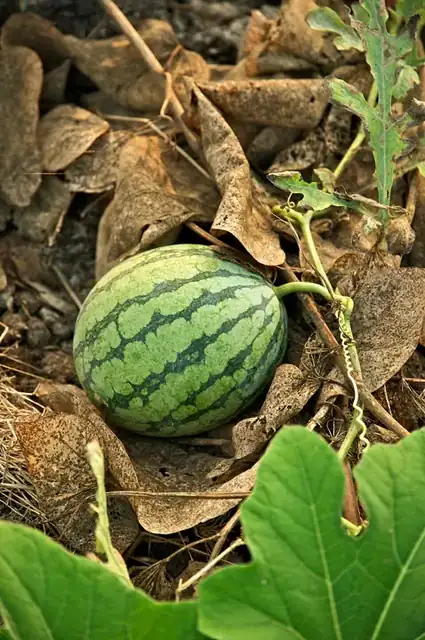
Watermelons are grown in tropical to temperate regions for its large edible berry having a firm rind and no internal divisions; botanically, it is a pepo. The sweet, juicy flesh is usually deep red to pink, with many seeds that are black when mature and white when immature. Seedless varieties exist. The fruit can be eaten raw or pickled, and the rind is edible after cooking. It may also be consumed as a juice or an ingredient in mixed beverages.
The modern watermelon originated in Sudan where it was first domesticated and cultivated. Kordofan melons are the closest relatives and may be progenitors of modern, cultivated watermelons. Wild watermelon seeds were found in Uan Muhuggiag, a prehistoric site in Libya that dates to approximately 3500 BC. Watermelons were domesticated in Sudan and cultivated in Egypt by 2000 BC. Hebrew texts from early in the Christian era place watermelon with other sweet table fruits, and dessert watermelons spread across the Mediterranean world during Roman antiquity.
Considerable breeding effort has developed disease-resistant varieties. Many cultivars are available that produce mature fruit within 100 days of planting. In 2024, China produced 60% of the world's watermelons.
Description
The watermelon is an annual that has a prostrate or climbing habit. Stems are up to 3 m long and new growth has yellow or brown hairs. Leaves are 60 to 200 mm long and 40 to 150 mm wide. These usually have three lobes that are lobed or doubly lobed. Young growth is densely woolly with yellowish-brown hairs which disappear as the plant ages. Like all but one species in the genus Citrullus, watermelon has branching tendrils. Plants have unisexual male or female flowers that are white or yellow and borne on 40 mm hairy stalks. Each flower grows singly in the leaf axils, and the species' sexual system, with male and female flowers produced on each plant, is monoecious. The male flowers predominate at the beginning of the season; the female flowers, which develop later, have inferior ovaries.
The styles are united into a single column.
The large fruit is a kind of modified berry called a pepo with a thick rind and fleshy center (mesocarp and endocarp). Wild plants have fruits up to 20 cm in diameter, while cultivated varieties may exceed 60 cm. The rind of the fruit is mid- to dark green and usually mottled or striped, and the flesh, containing numerous seeds spread throughout the inside, can be red or pink (most commonly), orange, yellow, green or white.
A bitter watermelon, C. amarus, has become naturalized in semiarid regions of several continents, and is designated as a "pest plant" in parts of Western Australia where they are called "pig melon".
Production
In 2024, world production of watermelons was 105 million tonnes, led by China (mainland) accounting for 60% of the total (table). Secondary producers were India, Turkey, Algeria, and Brazil.
Varieties
Various cultivar groups exist:
Varieties
The more than 1,200 cultivars of watermelon range in weight from less than 1 kg to more than 90 kg; the flesh can be red, pink, orange, yellow or white.
The 'Carolina Cross' produced the current world record for heaviest watermelon, weighing 159 kg. It has green skin, red flesh and commonly produces fruit between 65 and 150 lb. It takes about 90 days from planting to harvest.
The 'Golden Midget' has a golden rind and pink flesh when ripe, and takes 70 days from planting to harvest.
The 'Orangeglo' has a very sweet orange flesh, and is a large, oblong fruit weighing 9 – 14 kg. It has a light green rind with jagged dark green stripes. It takes about 90–100 days from planting to harvest.
The 'Moon and Stars' variety was created in 1926. The rind is purple/black and has many small yellow circles (stars) and one or two large yellow circles (moon). The melon weighs 9 – 23 kg. The flesh is pink or red and has brown seeds. The foliage is also spotted. The time from planting to harvest is about 90 days.
Variety improvement
Charles Fredrick Andrus, a horticulturist at the USDA Vegetable Breeding Laboratory in Charleston, South Carolina, set out to produce a disease-resistant and wilt-resistant watermelon. The result, in 1954, was "that gray melon from Charleston". Its oblong shape and hard rind made it easy to stack and ship. Its adaptability meant it could be grown over a wide geographical area. It produced high yields and was resistant to the most serious watermelon diseases: anthracnose and fusarium wilt.
Others were also working on disease-resistant cultivars; J. M. Crall at the University of Florida produced 'Jubilee' in 1963 and C. V. Hall of Kansas State University produced 'Crimson Sweet' the following year. These are no longer grown to any great extent, but their lineage has been further developed into hybrid varieties with higher yields, better flesh quality and attractive appearance. Another objective of plant breeders has been the elimination of the seeds which occur scattered throughout the flesh. This has been achieved through the use of triploid varieties, but these are sterile, and the cost of producing the seed by crossing a tetraploid parent with a normal diploid parent is high.
As of 2017, farmers in approximately 44 states in the United States grew watermelon commercially, producing more than $500 million worth of the fruit annually. Georgia, Florida, Texas, California and Arizona are the United States' largest watermelon producers, with Florida producing more watermelon than any other state. This now-common fruit is often large enough that groceries often sell half or quarter melons. Some smaller, spherical varieties of watermelon—both red- and yellow-fleshed—are sometimes called "icebox melons". The largest recorded fruit was grown in Tennessee in 2013 and weighed 159 kg.
Culinary
Watermelon is a sweet summer fruit served freshly sliced, diced in mixed fruit salads, or as juice. Watermelon juice can be blended with other fruit juices or made into wine.
The seeds have a nutty flavor and can be dried and roasted, or ground into flour. Watermelon rinds are eaten pickled, stir-fried or stewed.
Citrullis lanatus, variety caffer, grows wild in the Kalahari Desert. The fruits are used by the San people and wild animals for both water and nourishment, allowing survival on a diet of tsamma for six weeks.
More to savor

Chicken Vindaloo
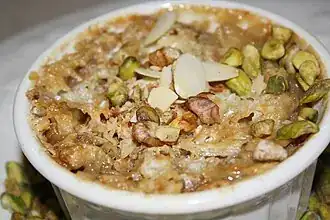
Puff Pastry with Nuts and Whipped Cream (Om Ali)
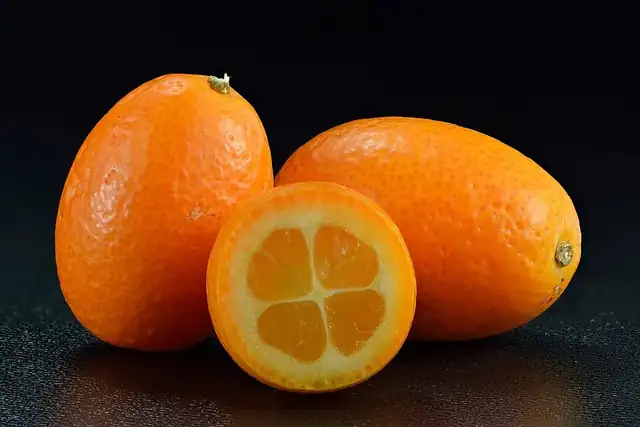
Kumquat at the Table: The Food Behind the Name