This longer reference provides the background behind the topic. Read it alongside the recipe collection when you want to connect an ingredient or food idea with a dish to prepare.
Overview
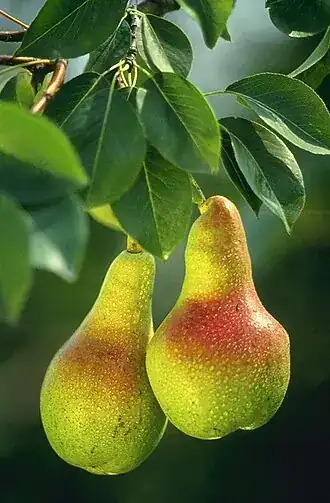
Pears are a genus of trees, Pyrus , in the family Rosaceae, that bear an edible apple-like fruit of the same name. Several species of pears are cultivated for their fruit and juices, while others are grown as ornamental flowering trees.
Pear trees are mostly medium to small-sized, though some grow as shrubs. They grow in temperate regions, being native to Asia and distributed across Europe and the mountains of North Africa. The wood of pear trees is a preferred material in the manufacture of high-quality woodwind instruments and furniture.
About 3,000 varieties of pears are grown worldwide, varying in both shape and taste. In 2024, world production of the fruit was about 28 million tonnes, led by China with 76% of the total. The fruit is consumed fresh, canned, as juice, dried, or fermented as perry.
Description
Pears are mostly small or medium-sized trees; a few of the species are shrubby, and some are thorny. The leaves are alternately arranged, simple, 2 – 12 cm long, glossy green on some species, densely silvery-hairy in some others; leaf shape varies from broad oval to narrow lanceolate. Most pears are deciduous, but one or two species in Southeast Asia are evergreen. Some pears are cold-hardy, withstanding temperatures as low as −25 to -40 C in winter, but many grown for agriculture are vulnerable to cold damage. Evergreen species only tolerate temperatures down to about -12 C.
The flowers are white, rarely tinted yellow or pink, 2 – 4 cm diameter, and have five petals, five sepals, and numerous stamens. Like that of the related apple, the pear fruit is a pome, in most wild species 1 – 4 cm diameter, but in some cultivated forms up to 18 cm long and 9 cm broad. The shape varies in most species from oblate or globose, to the classic pyriform 'pear shape' of the European pear with an elongated basal portion and a bulbous end.
The fruit is a pseudofruit composed of the greatly swollen receptacle or upper end of the flower stalk (the so-called calyx tube). Enclosed within its cellular flesh is the true fruit: 2–5 'cartilaginous' carpels, known colloquially as the "core". Pears and apples cannot always be distinguished by the form of the fruit; some cultivated pears look very much like some apples, e.g. the nashi pear.
Species and selected hybrids
Subgenus Pyrus
Pyrus acutiserrata
Pyrus armeniacifolia—apricot-leaved pear
Pyrus asiae-mediae
Pyrus austriaca
Pyrus × babadagensis
Pyrus × bardoensis
Pyrus boissieriana
Pyrus bourgaeana—Iberian pear
Pyrus browiczii
Pyrus cajon
Pyrus castribonensis
Pyrus chosrovica
Pyrus ciancioi—Ciancio's pear
Pyrus communis—European pear
Pyrus communis subsp. communis—European pear (cultivars include Beurre d'Anjou, Bartlett and Beurre Bosc)
Pyrus communis subsp. caucasica (syn. Pyrus caucasica)
Pyrus communis subsp. pyraster (syn. Pyrus pyraster)
Pyrus complexa
Pyrus cordata—Plymouth pear
Pyrus cordifolia
Pyrus costata
Pyrus daralagezi
Pyrus demetrii
Pyrus elaeagrifolia—oleaster-leaved pear
Pyrus elata
Pyrus eldarica
Pyrus fedorovii
Pyrus ferganensis
Pyrus georgica
Pyrus gergerana—Gergeranian pear
Pyrus glabra
Pyrus grossheimii
Pyrus hajastani
Pyrus hakkiarica
Pyrus hyrcana
Pyrus jacquemontiana
Pyrus × jordanovii
Pyrus ketzkhovelii
Pyrus mazanderanica
Pyrus medvedevii
Pyrus megrica
Pyrus × michauxii
Pyrus neoserrulata
Pyrus nivalis—snow pear
Pyrus nutans
Pyrus oxyprion
Pyrus pedrottiana
Pyrus raddeana
Pyrus regelii
Pyrus sachokiana
Pyrus salicifolia—willow-leaved pear
Pyrus sicanorum
Pyrus × sinkiangensis—thought to be an interspecific hybrid between P. ×bretschneideri and Pyrus communis
Pyrus sogdiana
Pyrus sosnovskyi
Pyrus spinosa—Almond-leaved pear
Pyrus syriaca—Syrian pear
Pyrus tadshikistanica
Pyrus takhtadzhianii
Pyrus tamamschiannae
Pyrus terpoi
Pyrus theodorovii
Pyrus turcomanica
Pyrus tuskaulensis
Pyrus vallis-demonis
Pyrus × vavilovii
Pyrus voronovii
Pyrus vsevolodovii
Pyrus yaltirikii
Pyrus zangezura
Subgenus Pashia
Pyrus betulifolia—birchleaf pear
Pyrus × bretschneideri—Chinese white pear; also classified as a subspecies of Pyrus pyrifolia
Pyrus calleryana—Callery pear
Pyrus hopeiensis
Pyrus korshinskyi
Pyrus pashia—Afghan pear
Pyrus × phaeocarpa
Pyrus pseudopashia
Pyrus pyrifolia—Nashi pear, Sha Li; tree species native to China, Japan, and Korea, also known as the Asian pear
Pyrus trilocularis
Pyrus ussuriensis—Siberian pear (also known as the Ussurian pear, Harbin pear, or Manchurian pear)
Pyrus xerophila
Not classified
Pyrus alpinotaiwaniana
Together with the genus Crataegus, Pyrus forms the graft-chimaera + Pyrocrataegus.
Cultivars
The following cultivars have gained the Royal Horticultural Society's Award of Garden Merit:
'Beth'
'Beurré Hardy'
'Beurré Superfin'
'Concorde'
'Conference'
'Doyenné du Comice'
'Joséphine de Malines'
The purely decorative cultivar P. salicifolia 'Pendula', with pendulous branches and silvery leaves, has also won the award.
Production
In 2024, world production of pears was 27.6 million tonnes, led by China with 76% of the total (table). About 48% of the Southern Hemisphere's pears are produced in the Patagonian valley of Río Negro in Argentina.
Storage
Pears may be stored at room temperature until ripe. Pears are ripe when the flesh around the stem gives to gentle pressure. Ripe pears are optimally stored refrigerated, uncovered in a single layer, where they have a shelf life of 2 to 3 days. Pears ripen at room temperature. Ripening is accelerated by the gas ethylene, a plant hormone. If pears are placed next to bananas in a fruit bowl, the ethylene emitted by the banana causes the pears to ripen. According to Pear Bureau Northwest, most varieties show little colour change as they ripen (though the skin on Bartlett pears changes from green to yellow).
Cooking
Pears are eaten fresh, canned, as juice, and dried. The juice can also be used in jellies and jams, usually in combination with other fruits, including berries. Fermented pear juice is called perry or pear cider and is made in a way that is similar to how cider is made from apples. Perry can be distilled to produce an eau de vie de poire, a colourless, unsweetened fruit brandy.
Pear purée is used to manufacture snack foods such as Fruit by the Foot and Fruit Roll-Ups.
The culinary or cooking pear is green but dry and hard, and only edible after several hours of cooking. Two Dutch cultivars are Gieser Wildeman (a sweet variety) and Saint Remy (slightly sour).
More to savor

Chicken Vindaloo
Quinoa Vegetable Slaw With Peanut Dressing (Gluten-Free)
Lychee in the Kitchen: Exploring an Everyday Ingredient