This longer reference provides the background behind the topic. Read it alongside the recipe collection when you want to connect an ingredient or food idea with a dish to prepare.
In this story
OverviewDescriptionSpeciesDistribution and habitatEcologyConservationPotential adverse effectsOverview
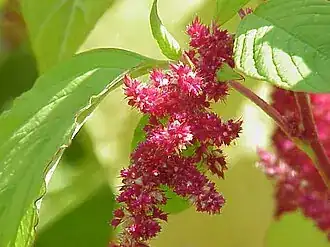
Amaranthus is a genus of plants commonly known as amaranths. Some species are known by variants of the common name "pigweed". Some members are annual and others are perennial. The plant can grow from 3 to 8 ft tall with a succulent, hollow stem. Parts of the plant vary from green to reddish. Catkin-like cymes of densely packed flowers grow in the summer or fall.
There are 75 recognized species in the genus, some monoecious and some dioecious. The name amaranth was originally applied to the closely related genus Celosia. Amaranthus is cosmopolitan in tropical regions. Some species are cultivated as leaf vegetables, pseudocereals (with amaranth grain being collected), and ornamental plants.
Description
Amaranth is a herbaceous plant or shrub that is either annual or perennial across the genus. The plant has a primary root with deeper spreading secondary fibrous root structures. Amaranths contain concentric rings of vascular bundles and fix carbon efficiently with a C4 photosynthetic pathway. Amaranth can grow from 3 to 8 ft tall with a cylindrical, succulent, fibrous stem that is hollow with grooves and bracteoles when mature varies in flower, leaf, and stem color with a range of striking pigments from the spectrum of maroon to crimson. The leaves are approximately 6.5-15 cm and of oval or elliptical shape that are either opposite or alternate across species, although most are whole and simple with entire margins.
Catkin-like cymes of densely packed flowers grow in the summer or fall. The inflorescences are in the form a large panicle that varies from terminal to axial, color, and sex. The tassel of fluorescence is either erect or bent and varies in width and length between species. The flowers are radially symmetric and either bisexual or unisexual with very small, bristly perianth and pointy bracts. The flowers vary interspecifically from the presence of 3 or 5 tepals and stamens, whereas a 7-porate pollen grain structure remains consistent across the family.
Species in this genus are either monoecious (e.g. A. hybridus) or dioecious (e.g. A. palmeri). The fruits are in the form of capsules referred to as a unilocular pixdio that opens at maturity. The top (operculum) of the capsule releases the urn that contains the seed. The seeds are circular, 1 to 1.5 millimeters in diameter and range in color with a shiny, smooth seed coat. The panicle is harvested 200 days after cultivation with approximately 1,000 to 3,000 seeds harvested per gram.
Species
Species include:
Amaranthus acanthochiton – greenstripe
Amaranthus acutilobus – a synonym of Amaranthus viridis
Amaranthus albus – white pigweed, tumble pigweed
Amaranthus anderssonii
Amaranthus arenicola – sandhill amaranth
Amaranthus australis – southern amaranth
Amaranthus bigelovii – Bigelow's amaranth
Amaranthus blitoides – mat amaranth, prostrate amaranth, prostrate pigweed
Amaranthus blitum – purple amaranth
†Amaranthus brownii – Brown's amaranth
Amaranthus californicus – California amaranth, California pigweed
Amaranthus cannabinus – tidal-marsh amaranth
Amaranthus caudatus – love-lies-bleeding, pendant amaranth, tassel flower, quilete
Amaranthus chihuahuensis – Chihuahuan amaranth
Amaranthus crassipes – spreading amaranth
Amaranthus crispus – crispleaf amaranth
Amaranthus cruentus – purple amaranth, red amaranth, Mexican grain amaranth
Amaranthus deflexus – large-fruit amaranth
Amaranthus dubius – spleen amaranth, khada sag
Amaranthus fimbriatus – fringed amaranth, fringed pigweed
Amaranthus floridanus – Florida amaranth
Amaranthus furcatus
Amaranthus graecizans
Amaranthus grandiflorus
Amaranthus greggii – Gregg's amaranth
Amaranthus hybridus – smooth amaranth, smooth pigweed, red amaranth
Amaranthus hypochondriacus – Prince-of-Wales feather, prince's feather
Amaranthus interruptus – Australian amaranth
Amaranthus minimus
Amaranthus mitchellii
Amaranthus muricatus – African amaranth
Amaranthus obcordatus – Trans-Pecos amaranth
Amaranthus palmeri – Palmer's amaranth, Palmer pigweed, careless weed
Amaranthus polygonoides – tropical amaranth
Amaranthus powellii – green amaranth, Powell amaranth, Powell pigweed
Amaranthus pringlei – Pringle's amaranth
Amaranthus pumilus – seaside amaranth
Amaranthus quitensis - Mucronate Amaranth
Amaranthus retroflexus – red-root amaranth, redroot pigweed, common amaranth
Amaranthus saradhiana - purpal stem amaranth, green leaf amaranth
Amaranthus scleranthoides – variously Amaranthus sclerantoides
Amaranthus scleropoides – bone-bract amaranth
Amaranthus spinosus – spiny amaranth, prickly amaranth, thorny amaranth
Amaranthus standleyanus
Amaranthus thunbergii – Thunberg's amaranth
Amaranthus torreyi – Torrey's amaranth
Amaranthus tricolor – Joseph's-coat
Amaranthus tuberculatus – rough-fruit amaranth, tall waterhemp
Amaranthus viridis – slender amaranth, green amaranth
Amaranthus watsonii – Watson's amaranth
Amaranthus wrightii – Wright's amaranth
Distribution and habitat
The genus most likely originated in Central America. The native range of the genus is cosmopolitan in tropical regions. It is found in elevations ranging from lowlands to mountain ranges such as the Himalayas.
Ecology
Amaranth weed species have an extended period of germination, rapid growth, and high rates of seed production. Farmers have considered them problematic since the mid-1990s, partially due to the reduction in tillage and herbicide use, as well as the evolution of herbicide resistance in several species. In the United States and Canada, nine species of Amaranthus are considered invasive and noxious weeds: A. albus, A. blitoides, A. hybridus, A. palmeri, A. powellii, A. retroflexus, A. spinosus, A. tuberculatus, and A. viridis.
A new herbicide-resistant strain of A. palmeri has appeared; it is glyphosate-resistant and so cannot be killed by herbicides using the chemical. Also, this plant can survive in tough conditions. A. palmeri (Palmer amaranth) causes the greatest reduction in soybean yields and has the potential to reduce yields by 17–68% in field experiments. According to one source, A. palmeri is among the "top five most troublesome weeds" in the southeast of the U.S. and has already evolved resistances to dinitroaniline herbicides and acetolactate synthase inhibitors. This makes the proper identification of Amaranthus species at the seedling stage essential for agriculturalists. Proper weed control needs to be applied before the species successfully colonizes in the crop field and causes significant yield reductions.
An evolutionary lineage of around 90 species within the genus has acquired the carbon fixation pathway, which increases their photosynthetic efficiency. This probably occurred in the Miocene.
Amaranths are recorded as food plants for some Lepidoptera (butterfly and moth) species including the nutmeg moth and various case-bearer moths of the genus Coleophora: C. amaranthella, C. enchorda (feeds exclusively on Amaranthus), C. immortalis (feeds exclusively on Amaranthus), C. lineapulvella, and C. versurella (recorded on A. spinosus).
Conservation
Amaranthus pumilus (seabeach amaranth) has been listed as an endangered species in the U.S. since 1993.
Potential adverse effects
Amaranth grain contains phytochemicals that are not defined as nutrients and may be antinutrient factors, such as polyphenols, saponins, tannins, and oxalates. These compounds are reduced in content and antinutrient effect by cooking.
The stalks may have sharp spines that need to be removed before consumption.
More to savor

Chicken Vindaloo
Homemade Wheat Tortillas
Cassava at the Table: The Food Behind the Name