This longer reference provides the background behind the topic. Read it alongside the recipe collection when you want to connect an ingredient or food idea with a dish to prepare.
Overview
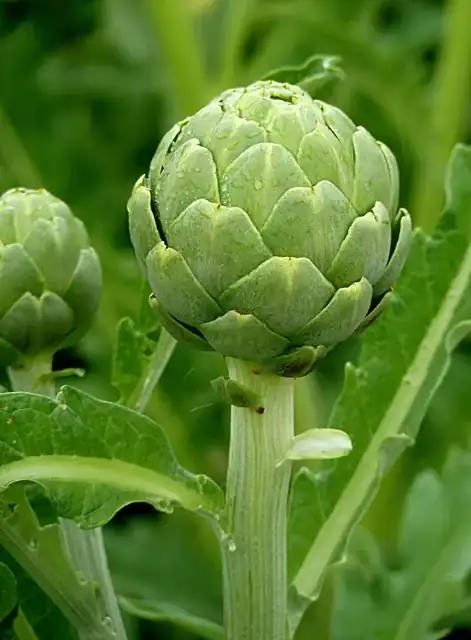
The artichoke (Cynara cardunculus var. scolymus) is a variety of a species of thistle cultivated as food.
The edible portion of the plant consists of the flower buds before the flowers come into bloom. The budding artichoke flower-head is a cluster of many budding small flowers (an inflorescence), together with many bracts, on an edible base. Once the buds bloom, the structure changes to a coarse, barely edible form. Another variety of the same species is the cardoon, a perennial plant native to the Mediterranean region. Both wild forms and cultivated varieties (cultivars) exist.
Description
This vegetable grows to 1.4-2 m tall, with arching, deeply lobed, silvery, glaucous-green leaves 50-83 cm long. The flowers develop in a large head from an edible bud about 8-15 cm diameter with numerous triangular scales; the individual florets are purple. The edible portions of the buds consist primarily of the fleshy lower portions of the involucral bracts and the base, known as the heart; the mass of immature florets in the center of the bud is called the choke or beard (which is inedible in older, larger flowers), and the bottom of the heart from which all leaves and choke have been removed.
Name
The English word artichoke was borrowed in the sixteenth century from the northern Italian word articiocco (the standard modern Italian being carciofo). The Italian term was itself borrowed either from Spanish alcarchofa (today usually alcachofa) or directly from the source of the Spanish word—medieval Andalusi Arabic الخرشوفة (al-kharshūfa, including the Arabic definite article al). The Arabic form kharshūfa is still used in Maghrebi Arabic today, while other variants in Arabic include kharshafa, and Modern Standard Arabic khurshūfa. These Arabic forms derive from classical Arabic حرشفة (harshafa) singular word of the plural حراشف (ḥarashef) meaning "scale". Other languages which derive their word for the artichoke from Arabic include Israeli Hebrew, which has the word חֻרְשָׁף (khursháf). The original Hebrew name (see :he:ארטישוק) is קינרס kinars, which is found in the Mishna.
During the sixteenth century the artichoke began to appear in French as carchofas, from the Italian carciofo.
Despite being borrowed from Arabic, European terms for the artichoke have in turn influenced Arabic in their own right. For example, the modern Levantine Arabic term for artichoke is أرضي شوكي (ʔarḍī shawkī). This literally means 'earthy thorny', and is an Arabicisation (through phono-semantic matching) of the English word artichoke or other European terms like it.
As in the case of Levantine Arabic ʔarḍī shawkī, names for the artichoke have frequently changed form due to folk etymology and phono-semantic matching. The Italian form articiocco seems to have been adapted to correspond to Italian arci- ('arch-, chief') and ciocco ('stump'). Forms of the French word artichaut (which also derives from Arabic, possibly via Spanish) have over the years included artichaud (corresponding to chaud, 'warm') and artihault (corresponding to haut, 'height'). Forms found in English have included hartichoak, corresponding to heart and choke, which were likely associated with the belief that the inedible centre of the vegetable could choke its eaters or that the plant can take over a garden, choking out other plants.
Ecology
Artichokes are affected by fungal pathogens including Verticillium dahliae and Rhizoctonia solani.
Soil solarization has been successful in other crop-fungus pathosystems and is evaluated for suppression of V. dahliae and R. solani by Guerrero et al. 2019.
Production
In 2024, world production of artichokes was 1.7 million tonnes, led by Egypt with 601,272 tonnes and Italy with 373,960 tonnes.
Culinary
Large globe artichokes are frequently prepared by removing all but 5 - 10 mm or so of the stem. To remove thorns, which may interfere with eating, around a quarter of each scale may be cut off. To cook, the artichoke is simmered for 15 to 30 minutes, or steamed for 30–40 minutes (less for small ones). A cooked, unseasoned artichoke has a delicate flavor.
Salt may be added to the water if boiling artichokes. Covered artichokes, in particular those that have been cut, may turn brown due to the enzymatic browning and chlorophyll oxidation. Placing them in water slightly acidified with vinegar or lemon juice can prevent the discoloration.
Leaves are often removed one at a time, and the fleshy base eaten, often with vinaigrette, hollandaise, vinegar, butter, mayonnaise, aioli, lemon juice, or other sauces. The fibrous upper part of each leaf is usually discarded. The heart is eaten when the inedible choke has been peeled away from the base and discarded. Thin leaves covering the choke are also edible. The heart may be completely stripped of leaves and choke and eaten as a delicacy, stuffed with several types of ingredients, or chopped to include in dishes.
In Italy, artichoke hearts in oil are the usual vegetable for the "spring" section of the "four seasons" pizza (alongside tomatoes and basil for summer, mushrooms for autumn, and prosciutto and olives for winter).
A recipe well known in Rome is Jewish-style artichokes, which are deep-fried whole. The softer parts of artichokes are also eaten raw, one leaf at a time dipped in vinegar and olive oil, or thinly sliced and dressed with lemon and olive oil.
There are many stuffed artichoke recipes. A common Italian stuffing uses a mixture of bread crumbs, garlic, oregano, parsley, grated cheese, prosciutto, and sausage. A bit of the mixture is then pushed into the spaces at the base of each leaf and into the center before boiling or steaming.
In Spain, younger, smaller, and more tender artichokes are used. They can be sprinkled with olive oil and left in hot ashes in a barbecue, sautéed in olive oil with garlic, with rice as a paella, or sautéed and combined with eggs in a tortilla (frittata).
The Greek anginares alla Polita ("artichokes city-style", referring to the city of Constantinople) is a hearty, savory stew made with artichoke hearts, potatoes, and carrots, and is flavored with onion, lemon, and dill. The island of Tinos, or the villages of Iria and Kantia in the Peloponnese, still very much celebrate their local production, including with a day of the artichoke or an artichoke festival.
Herbal tea
Artichokes also may be made into a herbal tea. The infusion is consumed particularly among the Vietnamese. An artichoke-based herbal tea called Ceai de Anghinare is made in Romania. The flower portion is put into water and consumed as a herbal tea in Mexico. It has a slightly bitter, woody taste.
More to savor

Chicken Vindaloo
Tofu Scramble I
Barley in the Kitchen: Exploring an Everyday Ingredient