This longer reference provides the background behind the topic. Read it alongside the recipe collection when you want to connect an ingredient or food idea with a dish to prepare.
In this story
OverviewDescriptionExternal phylogenyDomesticationProductionPreparationBeer, whisky, and soft drinksOverview
Barley (Hordeum vulgare), a member of the grass family, is a major cereal grain grown in temperate climates globally. One of the first cultivated grains, it was domesticated in the Fertile Crescent around 9000 BC, giving it nonshattering spikelets and making it much easier to harvest. Its use then spread throughout Eurasia by 2000 BC. Barley prefers relatively low temperatures and well-drained soil to grow. It is relatively tolerant of drought and soil salinity, but is less winter-hardy than wheat or rye. Wild barley may refer to H. vulgare ssp. spontaneum, but may also refer to other species in the genus Hordeum.
In 2023, barley was fourth among grains in quantity produced, 146 million tonnes, behind maize, rice, and wheat. Globally, 70% of barley production is used as animal feed, while 30% is used as a source of fermentable material for beer, or further distilled into whisky, and as a component of various foods. It is used in soups and stews and in barley bread of various cultures. Barley grains are commonly made into malt using a traditional and ancient method of preparation. In English folklore, John Barleycorn personifies the grain and the alcoholic beverages made from it. English pub names such as The Barley Mow allude to its role in the production of beer.
Description
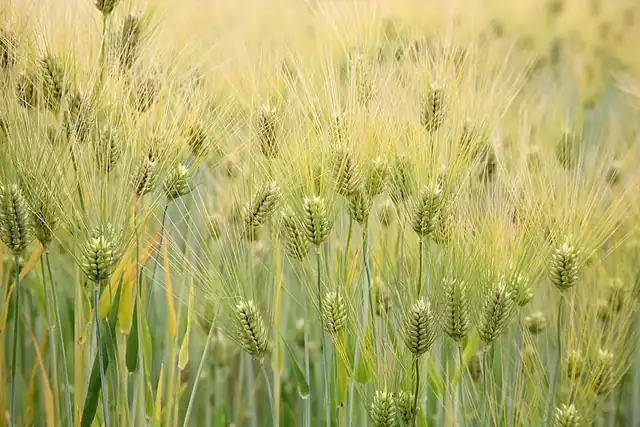
Barley is a cereal, a member of the grass family with edible grains. Its flowers are clusters of spikelets arranged in a distinctive herringbone pattern. Each spikelet has a long thin awn (to 160 mm long), making the ears look tufted. The spikelets are in clusters of three. In six-row barley, all three spikelets in each cluster are fertile; in two-row barley, only the central one is fertile. It is a self-pollinating, diploid species with 14 chromosomes.
The genome of barley was sequenced in 2012 by the International Barley Genome Sequencing Consortium and the UK Barley Sequencing Consortium. The genome is organised into seven pairs of nuclear chromosomes (recommended designations: 1H, 2H, 3H, 4H, 5H, 6H and 7H), and one mitochondrial and one chloroplast chromosome, with a total of 5000 Mbp. Details of the genome are freely available in several barley databases.
External phylogeny
The barley genus Hordeum is relatively closely related to wheat and rye within the Triticeae, and more distantly to rice within the BOP clade of grasses (Poaceae). The phylogeny of the Triticeae is complicated by hybridization between species, so there is a network of relationships rather than a simple inheritance-based tree.
Domestication
Barley was one of the first grains to be domesticated in the Fertile Crescent, an area of relatively abundant water in Western Asia, around 9,000 BC. Wild barley (H. vulgare ssp. spontaneum) ranges from North Africa and Crete in the west to Tibet in the east. A study of genome-wide diversity markers found Tibet to be an additional center of domestication of cultivated barley. The earliest archaeological evidence of the consumption of wild barley, Hordeum spontaneum, comes from the Epipaleolithic at Ohalo II at the southern end of the Sea of Galilee, where grinding stones with traces of starch were found. The remains were dated to about 23,000 BC.
The earliest evidence for the domestication of barley, in the form of cultivars that cannot reproduce without human assistance, comes from Mesopotamia, specifically the Jarmo region of modern-day Iraq, around 9,000–7,000 BC.
Production
In 2024, world production of barley was 142 million tonnes, led by Russia with 12% of the total (table). Australia, Germany, and France were secondary producers.
Worldwide barley production in 2023 was fourth among grains, following maize (1.2 billion tonnes), rice (800 million tonnes), and wheat (799 million tonnes).
Preparation
Hulled barley (or covered barley) is eaten after removing the inedible, fibrous, outer husk or hull. Once removed, it is called dehulled barley (or pot barley or scotch barley). Pearl barley (or pearled barley) is dehulled to remove most of the bran, and polished. Barley meal, a wholemeal barley flour lighter than wheat meal but darker in colour, is used in gruel. This gruel is known as سويق : sawīq in the Arab world.
With a long history of cultivation in the Middle East, barley is used in a wide range of traditional Arabic, Assyrian, Israelite, Kurdish, and Persian foodstuffs including keşkek, kashk, and murri. Barley soup is traditionally eaten during Ramadan in Saudi Arabia. Cholent or hamin (in Hebrew) is a traditional Jewish stew often eaten on the Sabbath, in numerous recipes by both Mizrahi and Ashkenazi Jews; its original form was a barley porridge.
In Eastern and Central Europe, barley is used in soups and stews such as ričet. In Africa, where it is a traditional food plant, it has the potential to improve nutrition, boost food security, foster rural development, and support sustainable landcare.
The six-row variety bere is cultivated in Orkney, Shetland, Caithness and the Western Isles of the Scottish Highlands and Islands. When milled into beremeal, it is used locally in bread, biscuits, and the traditional beremeal bannock.
In Japanese cuisine, barley is mixed with rice and steamed as mugimeshi. The naval surgeon Takaki Kanehiro introduced it into institutional cooking to combat beriberi, endemic in the armed forces in the 19th century. It became standard prison fare, and remains a staple in the Japan Self-Defense Forces.
Beer, whisky, and soft drinks
Barley, made into malt, is a key ingredient in beer and whisky production. Two-row barley is traditionally used in German and English beers. Six-row barley was traditionally used in US beers, but both varieties are in common usage now. Distilled from green beer, Scottish and Irish whisky are made primarily from barley. About 25% of American barley is used for malting, for which barley is the best-suited grain. Accordingly, barley is often assessed by its malting enzyme content. Barley wine is a style of strong beer from the English brewing tradition. An 18th-century alcoholic drink of the same name was made by boiling barley in water, then mixing the barley water with white wine, borage, lemon and sugar. In the 19th century, a different barley wine was prepared from recipes of ancient Greek origin.
Nonalcoholic drinks such as barley water and roasted barley tea have been made by boiling barley in water. In Italy, roasted barley is sometimes used as coffee substitute, caffè d'orzo (barley coffee).
More to savor

Chicken Vindaloo

Tofu Scramble I
Artichoke in the Kitchen: Exploring an Everyday Ingredient