A drink can be an everyday routine, something shared with company, or a way to explore a food tradition. The background below looks more closely at the preparation and story behind the cup or glass.
Overview
Black tea (also literally translated as red tea from various East Asian languages) is a type of tea that is more oxidized than oolong, yellow, white, and green teas. Black tea is generally stronger in flavour than other teas. All five types are made from leaves of the shrub (or small tree) Camellia sinensis, though Camellia taliensis is also rarely used.
Two principal varieties of the species are used – the small-leaved Chinese variety plant (C. sinensis var. sinensis), used for most other types of teas, and the large-leaved Assamese plant (C. sinensis var. assamica), which was traditionally mainly used for black tea, although in recent years some green and white teas have been produced.
First originating in China, the beverage's name there is hong cha ("red tea") due to the colour of the oxidized leaves when processed appropriately. Today, the drink is widespread throughout East and Southeast Asia, both in consumption and harvesting, including in China, Indonesia, Japan, Korea, and Singapore. Similar variants are also available in South Asian countries.
While green tea usually loses its flavour within a year, black tea retains its flavour for several years. For this reason, it has long been an article of trade, and compressed bricks of black tea even served as a form of de facto currency in Mongolia, Tibet, and Siberia well into the 19th century.
Varieties and names
Unblended black teas are often named after the region in which they are produced. Different regions are known for producing teas with characteristic flavours.
Blends
Many finished black teas consist of blends of various varieties of black tea. In addition, black tea is often blended with various other plants or flavourings in order to obtain a beverage.
Manufacture
After the harvest, the leaves are first withered by blowing air on them.
Then black teas are processed in either of two ways, CTC (crush, tear, curl) or orthodox. The CTC method produces leaves of fannings or dust grades that are commonly used in tea bags but also produces higher (broken leaf) grades such as BOP CTC and GFBOP CTC (see gradings below for more details). This method is efficient and effective for producing a better quality product from medium and lower quality leaves of consistently dark color. Orthodox processing is done either by machines or by hand. Hand processing is used for high quality teas. While the methods employed in orthodox processing differ by tea type, this style of processing results in the high quality loose tea sought by many connoisseurs. The tea leaves are allowed to completely oxidize.
Orthodox The withered tea leaves are heavily rolled either by hand or mechanically through the use of a cylindrical rolling table or a rotovane. The rolling table consists of a ridged table-top moving in an eccentric manner to a large hopper of tea leaves, in which the leaves are pressed down onto the table-top. The process produces a mixture of whole and broken leaves and particles which are then sorted, oxidized and dried. The rotorvane (rotovane), created by Ian McTear in 1957 can be used to replicate the orthodox process.
Tea grading
Black tea is usually graded on one of four scales of quality. Whole-leaf teas are the highest quality, with the best whole-leaf teas graded as "orange pekoe". After the whole-leaf teas, the scale degrades to broken leaves, fannings, then dusts. Whole-leaf teas are produced with little or no alteration to the tea leaf. This results in a finished product with a coarser texture than that of bagged teas. Whole-leaf teas are widely considered the most valuable, especially if they contain leaf tips. Broken leaves are commonly sold as medium-grade loose teas.
Smaller broken varieties may be included in tea bags. Fannings are usually small particles of tea left over from the production of larger tea varieties, but are occasionally manufactured specifically for use in bagged teas. Dusts are the finest particles of tea left over from production of the above varieties, and are often used for tea bags with very fast and harsh brews. Fannings and dusts are useful in bagged teas because the greater surface area of the many particles allows for a fast, complete diffusion of the tea into the water. Fannings and dusts usually have a darker colour, lack of sweetness, and stronger flavour when brewed.
Brewing
Generally, one uses 0.08 ounces (2.26 g) of tea per 8 usoz of water. Unlike green teas, which turn bitter when brewed at higher temperatures, black tea should be steeped in water brought up to 90-98 C for 3–5min.
Whole-leaf black teas, and black teas to be served with milk or lemon, should be steeped four to five minutes. The more delicate black teas, such as Darjeeling, should be steeped for three to four minutes. The same holds for broken leaf teas, which have more surface area and need less brewing time than whole leaves. Longer steeping times makes the tea bitter (at this point, it is referred to as being "stewed" in the UK). When the tea has brewed long enough to suit the drinker's taste, it should be strained before it is served.
A cold vessel lowers the steep temperature; to avoid this, the brewing vessel is rinsed with water at a temperature of at least 90 °C (194 °F) before brewing.
The ISO Standard 3103 defines how to brew tea for sensory testing. This standard is not meant to define the proper method for brewing tea intended for general consumption, but rather to document a tea brewing procedure where meaningful sensory comparisons can be made. This mix is thus more than twice as concentrated for normal consumption.
ISO 3103 black tea brewing
Brew temperature 90–95 °C
100ml water
2g of tea
Composition and research
Black tea contains 2 to 4 percent caffeine. The caffeine content of tea is affected by factors such as processing and brewing time. Typically, an 8 USfloz cup of black tea without sweeteners or additives contains 47 mg of caffeine, and negligible quantities of calories and micronutrients.
The visible film often formed on black tea consists of oxidized polyphenols and calcium carbonate, and is therefore more pronounced for tea brewed with hard water.
Black teas from Camellia sinensis contain flavonoids, which are under preliminary research for their potential to affect blood pressure and blood lipids as risk factors for cardiovascular disease. Long-term consumption of black tea only slightly lowered systolic and diastolic blood pressures (about 1–2mmHg).
More to savor
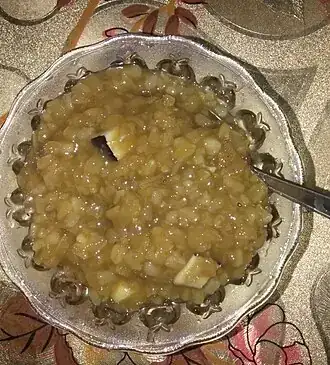
Sylheti Rice Pudding
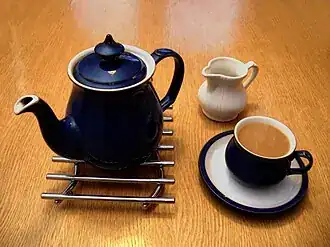
A Nice Cup of Tea
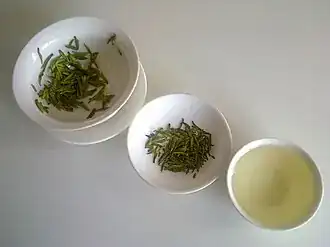
Green Tea: A Different Path from Leaf to Cup