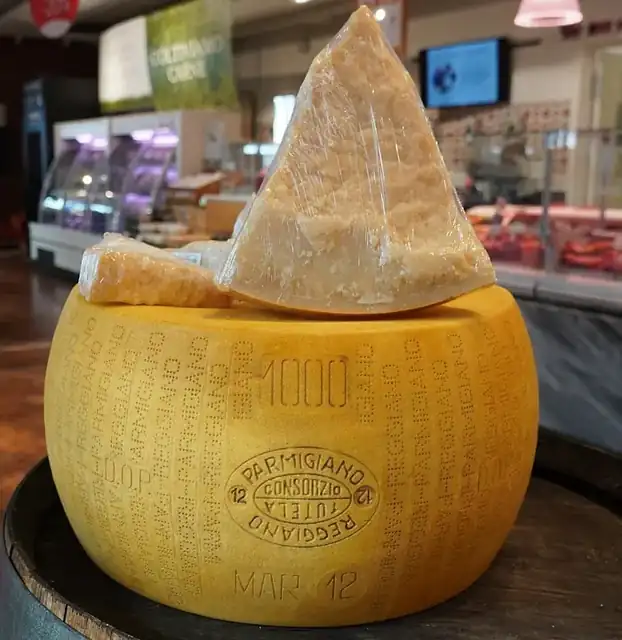
This longer reference provides the background behind the topic. Read it alongside the recipe collection when you want to connect an ingredient or food idea with a dish to prepare.
In this story
OverviewEuropean protectionTraditional balsamic vinegarBalsamic vinegar of ModenaItalian condimenti that used the term balsamicComparisonTraditional processesOverview
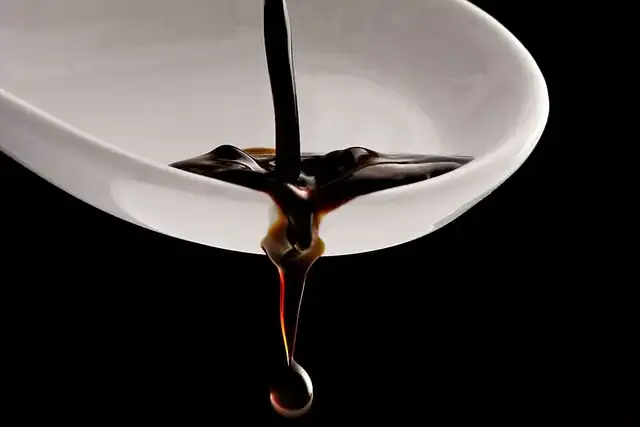
Balsamic vinegar (aceto balsamico) is a dark, concentrated, pungent, intensely flavoured vinegar made wholly or partially from grape must, which is freshly crushed grape juice with all the skins, seeds, and stems. It has been used over centuries in Mediterranean cuisines of Southern Europe. Three types of balsamic vinegar are "protected" as traditional vinegars in Europe.
Originating in Emilia-Romagna and considered a staple condiment in Italian cuisine, balsamic vinegar adds sweet tangy flavor in preparation of seafood, meat marinades, roasted vegetables, and as salad dressing.
European protection
The term aceto balsamico is unregulated, but there are three protected types of balsamic vinegar:
Aceto Balsamico Tradizionale di Modena PDO (traditional balsamic vinegar of Modena)
Aceto Balsamico Tradizionale di Reggio Emilia PDO (traditional balsamic vinegar of Reggio Emilia)
Aceto Balsamico di Modena PGI (balsamic vinegar of Modena)
Traditional balsamic vinegar
Only two locations produce balsamic vinegar protected by legal status: Modena and neighbouring Reggio Emilia. Balsamic vinegar in these places is subject to a denominazione di origine controllata (a designation often used for wine) which requires production in these regions. The original standard defining traditional balsamic vinegar, aceto balsamico tradizionale, was created in 1986. In 2000, criteria were established for protected designation of origin, a European Union standard.
True balsamic vinegar is made from a reduction of pressed Trebbiano di Castelvetro grapes. The resulting thick syrup, sapa or saba, is subsequently aged in a battery of several barrels of successively smaller sizes.
The casks are made of different woods such as chestnut, cherry, oak, mulberry, ash, and juniper. True balsamic vinegar is rich, glossy, deep brown, and has a complex flavour that balances the natural sweet and sour elements of the cooked grape juice with hints of wood from the casks.
Reggio Emilia designates the different ages of their balsamic vinegar (aceto balsamico tradizionale di Reggio Emilia) by label colour. A red label means the vinegar has been aged for at least 12 years, a silver label that the vinegar has aged for at least 18 years, and a gold label designates that the vinegar has aged for 25 years or more.
Modena uses a different system to indicate the age of its balsamic vinegars (aceto balsamico tradizionale di Modena). A white-coloured cap means the vinegar has aged for at least 12 years and a gold cap bearing the designation extravecchio ('extra-old') shows the vinegar has aged for 25 years or more.
Balsamic vinegar of Modena
These commercial-grade products imitate the traditional product. The current standard is found as part of the register of PGI productions, under the name Balsamic Vinegar of Modena (aceto balsamico di Modena). It was added to the PGI list in 2009.
They are made of as little as 20% grape must (and not necessarily from Modena or Reggio Emilia), with the addition of wine vinegar (at least 10%), and caramel (at most 2%) to stabilize the color. PGI status requires a minimum aging period of two months in wooden barrels, rising to three years when labelled as invecchiato ('aged'). The standard mandates a number of acceptable cultivars (Lambrusco, Sangiovese, Trebbiano, Albana, Ancellotta, Fortana, Montuni) for making grape must. The must can either be cooked or concentrated some other way. Vinegar that has been aged for at least 10 years also needs to be included in the product, though there is no minimum amount prescribed.
As the manufacturing process is highly industrialized, the output of a medium-sized producer may be hundreds of litres per day.
Italian condimenti that used the term balsamic
Condimento ('dressing') balsamic vinegars may be labeled as condimento balsamico, salsa balsamica or salsa di mosto cotto. For those products, there is a risk of creating confusion among consumers looking for the original Balsamic Vinegar of Modena PGI, the two different Traditional Balsamic Vinegar of Modena PDO, and Traditional Balsamic Vinegar of Reggio Emilia PDO.
Condimento balsamic vinegar may be made in any of the following ways:
Made by producers of both Balsamic Vinegar of Modena PGI or Traditional Balsamic Vinegar of Modena/Reggio Emilia PDO, by using the PGI or PDO as an ingredient. For those products, the use of the PGI and PDO as an ingredient must be clearly reported, i.e. "glaze with Aceto Balsamico di Modena IGP". The Consortium must approve the label and the use of the PGI's/PDO's name.
A common product is a "balsamic glaze", with added sweetener and thickener to artificially simulate the sweetness and thickness of the aged aceto balsamico tradizionale di Modena.
Comparison
From a legal point of view, TBV is categorized as a "food condiment", while BVM is a "wine vinegar". BVM can be produced without a lengthy aging period, whereas TBV gains its particular features during a long aging period fixed by law at no less than 12 years. TBV is the only condiment in the world produced starting from cooked grape musts without the addition of other substances, whereas BVM is a blend of concentrated grape musts, wine vinegars, and caramel (optional).
Note: there is no standard for condimenti thickened to emulate TBV. As a result, the characteristics provided here are typical rather than required.
Traditional processes
Traditional balsamic vinegar is produced from the juice of just-harvested white grapes, typically, Trebbiano grapes, boiled down to reach a minimum sugar concentration of 30% (brix) or more in the must, which is then fermented with a slow ageing process which further concentrates the flavours. The flavour intensifies over the years, with the vinegar being stored in wooden casks, becoming sweet, viscous, and very concentrated. During this period, a portion evaporates: it is said that this is the "angels' share", a term also used in the production of bourbon whiskey, Scotch whisky, wine, and other alcoholic beverages.
None of the product may be withdrawn until the end of the minimum aging period of 12 years. At the end of the aging period (12, 18 or 25 years), a small portion is drawn from the smallest cask, and each cask is then topped up with the contents of the preceding (next larger) cask. Freshly reduced cooked must is added to the largest cask, and in every subsequent year, the drawing and topping up process is repeated. This process, in which the product is distributed from the oldest cask and then refilled from the next oldest vintage cask, is called solera or in perpetuum.
More to savor

Chicken Vindaloo
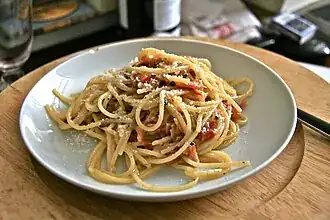
Spaghetti alla Carbonara
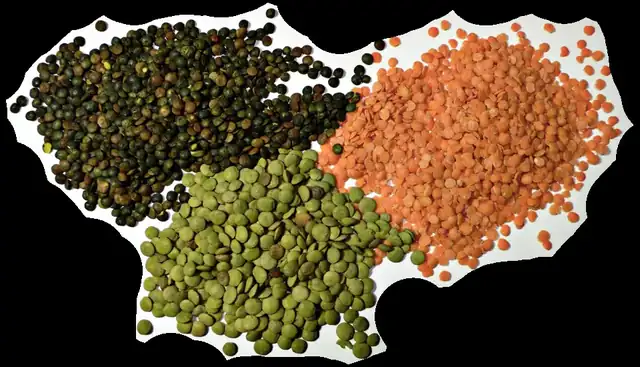
Lentil at the Table: The Food Behind the Name