This longer reference provides the background behind the topic. Read it alongside the recipe collection when you want to connect an ingredient or food idea with a dish to prepare.
Overview
The lentil (Vicia lens or Lens culinaris) is an annual legume grown for its lens-shaped edible seeds or pulses, also called lentils. It is about 40 cm tall, and the seeds grow in pods, usually with two seeds in each.
Lentil seeds are used around the world for culinary purposes, most commonly in stews or soups. In cuisines of the Indian subcontinent, where lentils (also called masoor) are a staple, split lentils (often with their hulls removed) known as dal are often cooked into a thick curry that is usually eaten with rice or roti.
Types
Lentils may be classified for market based on an array of seed qualities. These qualities may include the size, shape ("round" or "lens"), seed coat colour and pattern, seed coat thickness, and internal cotyledon colour. The parameters for market type or classification name may also vary according to region. Additionally, when sold, lentils may be further classified according to whether they are hulled (seed coat removed) or unhulled, and if hulled, whether the cotyledon inside is split or left whole.
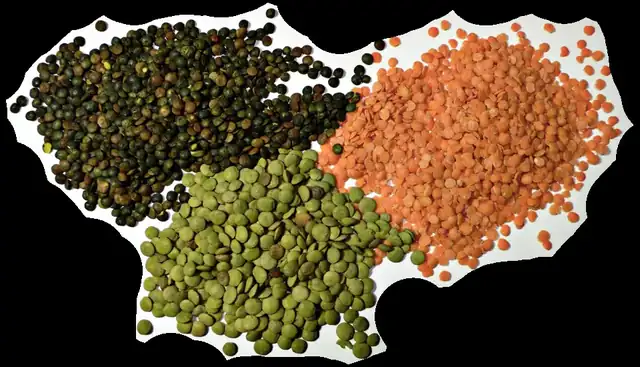
Lentil seed coat colour can be broadly grouped into tan, grey, green, brown, clear or black, the first four of which will slowly turn brown over time. Black seed coat, which can present solid black (almost purple) or slightly patchy, acts like a pattern, masking the base colour (tan, grey, green or brown) beneath, while clear coats lack pigmentation altogether. Seed coat colour is also influenced by the colour of the cotyledon, though this does not usually affect market classification.
Seed coat patterning is usually selected against in most market types with the exception of Puy or "French green" lentil, which has "marbled" patterning. As well as "marbled" (which comes in two genetic variants termed Marbled-1 and Marbled-2), coats may be "spotted", "dotted", "mottled", or show complex/mixed patterns. Seed coat colour is determined by the genotype of the seed parent, rather than the genetics of the plant the seed will become.
Common cotyledon colours are an orange-red colour and a light yellow, usually just called "red" (occasionally "orange") and "yellow" respectively. Three other colours, a brown-yellow, a light green, and a dark green have also been documented.
Red lentil
Red lentil varieties are defined by their red cotyledon, and moderate to thin seed coat. Red lentil varieties tend to be smaller than those of their green/brown counterparts, with large red lentil varieties meeting a similar size to small green lentil varieties. As the seed coat of red lentils is often removed, colour and pattern aren't usually selected for, though in recent years Australian red lentil varieties have been standardised for grey seed coats to allow for cultivars to be mixed. Australia is the largest producer of red lentils.
Specialty types
Black lentil
Beluga Black: The commercial/trade name of cultivar "Indianhead", named for the "Indian Head" research station in Canada where they were first selected for trial. These are one of the smallest cultivars and bead-like and almost spherical, with yellow cotyledon and black seed coat. While Beluga lentil was originally grown as a fodder crop, it became something of a designer food in the 1990s, and was given the name it is now known by for its resemblance to beluga caviar. This variety holds its form well when cooked, owing to thick seed coat, and is widely used in breeding program as a source of disease resistance.
Mt. Byron Black: Almost as small as Beluga lentil, Mt. Byron Black are a cultivar with black seed coat and red cotyledons.
Regional types
Puy lentils (var. puyensis): Small blue-green lentil with mottling, originating from France with a Protected Designation of Origin name. Lentils of this type, when grown outside of France, are often referred to as "French Green" lentils.
Alb-Leisa three traditional genotypes of lentils native to the Swabian Jura (Alps) in Germany and protected by the producers' association Öko-Erzeugergemeinschaft Alb-Leisa (engl. "Eco-producer association Alb-Leisa")
Other
Production
In 2023, world production of dry lentils was 7 million tonnes, led by Australia, Canada, and India, which together accounted for 72% of the total (table).
Culinary use
Lentils can be eaten soaked, germinated, fried, baked or boiled – the most common preparation method. The seeds require a cooking time of 10 to 40 minutes, depending on the variety; small varieties with the husk removed, such as the common red lentil, require shorter cooking times (and unlike most legumes don't require soaking). Most varieties have a distinctive, earthy flavour. Lentils with husks remain whole with moderate cooking, while those without husks tend to disintegrate into a thick purée, which may enable various dishes. The composition of lentils leads to a high emulsifying capacity which can be even increased by dough fermentation in bread making.
Lentil dishes
Lentils are used worldwide in many different dishes. Lentil dishes are most widespread throughout South Asia, the Mediterranean regions, West Asia, and Latin America.
In the Indian subcontinent, Fiji, Mauritius, Singapore and the Caribbean, lentil curry is part of the everyday diet, eaten with both rice and roti. Boiled lentils and lentil stock are used to thicken most vegetarian curries. They are also used as stuffing in dal parathas and puri for breakfast or snacks. Lentils are also used in many regional varieties of sweets. Lentil flour is used to prepare several different bread varieties, such as papadam.
They are frequently combined with rice, which has a similar cooking time. A lentil and rice dish is referred to in Levantine countries as mujaddara or mejadra. In Iran, rice and lentil is served with fried raisin; this dish is called lentil rice (adas polo). Rice and lentils are also cooked together in khichdi, a common dish in the Indian subcontinent (India and Pakistan); another dish, kushari, made in Egypt, is considered a national dish.
Lentils and pasta are another common combination in Middle Eastern cuisine, found in countries like Israel, Palestine, Syria, Egypt, Lebanon, among others.
Lentils are used to prepare an inexpensive and nutritious soup throughout Europe and North and South America, sometimes combined with chicken or pork. In Western countries, cooked lentils are often used in salads. In Italy, the traditional dish for New Year's Eve is Cotechino served with lentils.
Lentils are commonly eaten in Ethiopia in a stew-like dish called misir, or misir wot, one of the dishes people eat with Ethiopia's national food, injera flatbread.
More to savor

Chicken Vindaloo

Samosa
Bay leaf at the Table: The Food Behind the Name