This longer reference provides the background behind the topic. Read it alongside the recipe collection when you want to connect an ingredient or food idea with a dish to prepare.
In this story
OverviewDefinitionsProductionConsumptionNon-European Parmesan cheeseNon-European productionSimilar cheesesOverview
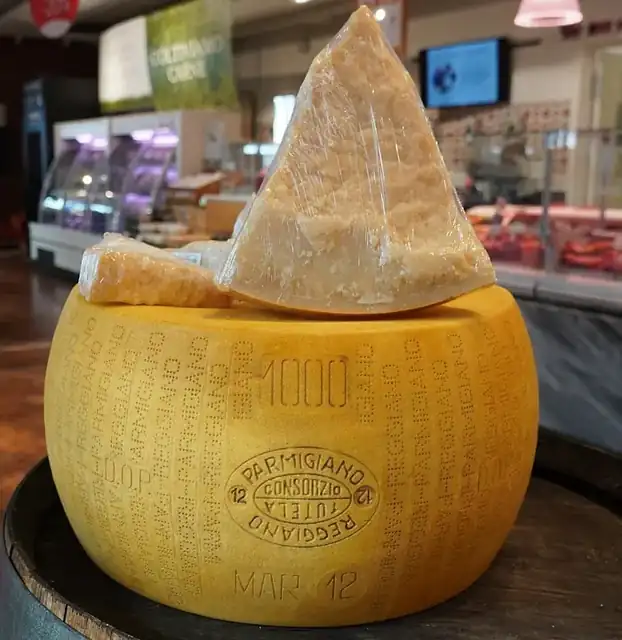
Parmesan (Parmigiano Reggiano) is an Italian hard, granular cheese produced from cow's milk and aged at least 12 months. It is a grana-type cheese, along with Grana Padano, the historic Granone Lodigiano, and others.
The term Parmesan may refer to either Parmigiano Reggiano or, when outside the European Union and Lisbon Agreement countries, a locally produced imitation.
Parmigiano Reggiano is named after two of the areas which produce it, the Italian provinces of Parma and Reggio Emilia (Parmigiano is the Italian adjective for the city and province of Parma and Reggiano is the adjective for the province of Reggio Emilia); it is also produced in the part of Bologna west of the River Reno and in Modena (all of the above being located in the Emilia-Romagna region), as well as in the part of Mantua (Lombardy) on the south bank of the River Po.
The names Parmigiano Reggiano and Parmesan are protected designations of origin (PDO) for cheeses produced in these provinces under Italian and European law. Outside the EU, the name Parmesan is legally used for imitations, with only the full Italian name unambiguously referring to PDO Parmigiano Reggiano. A 2021 press release by the Italian farmer-rancher association Coldiretti reported that, in the United States, 90% of "Italian sounding" cheese sold as parmesan, mozzarella, grana, and gorgonzola was produced domestically.
Definitions
The name Parmigiano is legally protected in the European Union and, in Italy, exclusive control is exercised over the cheese's production and sale by The Consortium of Parmigiano Reggiano, which was created by a governmental decree. Each wheel must meet strict criteria early in the aging process, when the cheese is still soft and creamy, to merit the official seal and be placed in storage for aging.
Because it is widely imitated, Parmigiano Reggiano has become an increasingly regulated product, and in 1955 it became what is known as a certified name (which is not the same as a brand name). In 2008, an EU court determined that the name Parmesan in Europe only refers to Parmigiano Reggiano and cannot be used for imitation Parmesan. Thus, in the European Union, Parmigiano Reggiano is a protected designation of origin (PDO); legally, the name refers exclusively to the Parmigiano Reggiano PDO cheese manufactured in a limited area in northern Italy.
Special seals identify the product as authentic, with the identification number of the dairy, the production month and year, a code identifying the individual wheel, and stamps regarding the length of aging.
Production
Parmigiano Reggiano is made from unpasteurised cow's milk. The whole milk of the morning milking is mixed with the naturally skimmed milk of the previous evening's milking, resulting in a part skim mixture. This mixture is pumped into copper-lined vats, which heat evenly and contribute copper ions to the mix.
Starter whey (containing a mixture of certain thermophilic lactic acid bacteria) is added, and the temperature is raised to 33 - 35 C. Calf rennet is added, and the mixture is left to curdle for 10–12 minutes. The curd is then broken up mechanically into small pieces (around the size of rice grains). The temperature is then raised to 55 C with careful control by the cheese-maker. The curd is left to settle for 45–60 minutes. The compacted curd is collected in a piece of muslin before being divided in two and placed in molds. There are 1100 L of milk per vat, producing two cheeses each. The curd making up each wheel at this point weighs around 45 kg. The remaining whey in the vat was traditionally used to feed the pigs from which prosciutto di Parma was produced.
The barns for these animals were usually just a few metres away from the cheese production rooms.
The cheese is put into a stainless steel, round form that is pulled tight with a spring-powered buckle so the cheese retains its wheel shape. After a day or two, the buckle is released and a plastic belt imprinted numerous times with the Parmigiano Reggiano name, the plant's number, and month and year of production is put around the cheese, and the metal form is buckled tight again. The imprints take hold on the rind of the cheese in about a day and the wheel is then put into a brine bath to absorb salt for 20–25 days. After brining, the wheels are then transferred to the aging rooms in the plant for 12 months. Each cheese is placed on wooden shelves that can be 24 cheeses high by 90 cheeses long or 2,160 total wheels per aisle.
Consumption
Parmigiano Reggiano is commonly grated over pasta dishes, stirred into soups and risottos, and eaten on its own. It is often shaved or grated over other dishes such as salads. Slivers and chunks of the hardest parts of the crust are sometimes simmered in soups, broths, and sauces to add flavor. They can also be broiled and eaten as a snack if they have no wax on them, or infused in olive oil or used in a steamer basket while steaming vegetables.
Non-European Parmesan cheese
Parmesan cheese made outside of the European Union is a family of hard-grating cheeses made from cow's milk and inspired by the original Italian cheese. They are generally pale yellow in color and usually used grated on dishes such as American pizza and Caesar salad. Some American generic "Parmesan" is sold already grated and has been aged for less than 12 months.
In many areas outside Europe the name Parmesan has become genericised and may denote any of several hard Italian-style grating types of cheese. These cheeses, chiefly from the US and Argentina, are often sold under names intended to evoke the original, such as Parmesan, Parmigiana, Parmesana, Parmabon, Real Parma, Parmezan, or Parmezano.
Non-European production
Parmesan cheese is defined differently in various jurisdictions outside of Europe.
In the United States, the Code of Federal Regulations includes a Standard of Identity for "Parmesan and Reggiano cheese". This defines both aspects of the production process and of the final result. In particular, Parmesan must be made of cow's milk, cured for 10 months or more, contain no more than 32% water, and have no less than 32% milkfat in its solids.
The Canadian regulation similarly includes moisture and fat levels, but has no restriction on aging time.
Similar cheeses
Parmesan is the best-known of the grana-type cheeses, but there are others.
More to savor

Chicken Vindaloo
Spaghetti alla Puttanesca
Zucchini at the Table: The Food Behind the Name