This longer reference provides the background behind the topic. Read it alongside the recipe collection when you want to connect an ingredient or food idea with a dish to prepare.
Overview
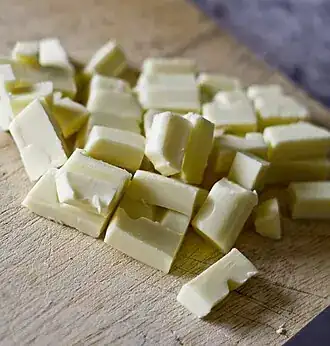
White chocolate is chocolate made from cocoa butter, sugar, and milk solids. It is ivory in color and lacks the dark appearance of most other types of chocolate because it does not contain the non-fat solid components of cocoa (cocoa powder). Due to this omission, as well as its sweetness and the occasional use of additives, some consumers do not consider white chocolate to be real chocolate.
Of the three traditional types of chocolate (the others being milk and dark), white chocolate is the least popular. Its taste and texture are divisive: admirers praise its texture as creamy, while detractors criticize its flavor as cloying and bland. White chocolate is sold in a variety of forms, including bars, chips, and coatings for nuts. It is common for manufacturers to pair white chocolate with other flavors, such as matcha or berries. White chocolate has a shorter shelf life than milk and dark chocolate, and easily picks up odors from the environment.
White chocolate is made industrially in a five-step process. First, the ingredients are mixed to form a paste. Next, the paste is refined, reducing the particle size to a powder. It is then agitated for several hours (a process known as conching), after which further processing standardizes its viscosity and taste. Finally, the chocolate is tempered by heating, cooling, and then reheating, which improves the product's appearance, stability, and snap.
In the United States
Hebert Candies says that they introduced white chocolate to the United States for the first time in 1956. However, it did not become popular until the 1980s, after a white chocolate mousse served by chef Michel Fitoussi in New York City in 1977 started a white chocolate fad. Imports from Europe rose; the chocolate was marketed as European and considered trendy. Pastry chefs used the product's plasticity to build decorations for cakes. White chocolate versions of desserts like truffles, cheesecakes, brownies and chocolate chip cookies were made, even as the mousse remained the most popular. In desserts, it was often paired with berries to balance the richness of the chocolate.
White chocolate was made and mass-distributed in the United States for the first time in 1984, when Nestlé released Alpine White, a white chocolate bar containing almonds, which they promoted to the "female indulgence" market. Growth in white chocolate consumption was driven by the product's uniqueness and perceptions that it was "lighter and more delicate" than other types of chocolate, a desirable quality for customers who felt they needed a respite from the rich chocolate desserts that had been popular. Further growth came from the popularity of white chocolate macadamia cookies produced by Mrs. Fields. During this period, some consumers believed that because of its light color, white chocolate contained fewer calories and fats than darker chocolates.
Ingredients
In cocoa beans, cocoa butter and cocoa powder (the non-fat component) appear in roughly equal proportions. During manufacturing, cocoa solids are separated from ground cocoa beans, known as cocoa liquor, leaving behind the cocoa butter. White chocolate uses only the cocoa butter. As pure pressed cocoa butter has a flavor that can be unpleasant, before it is used it is partly deodorized using either solvents or steam distillation under vacuum. The butter is not fully deodorized, as it then would lose all its cocoa flavor. Less deodorized cocoa butters are used in dark chocolate, where the flavor is considered by manufacturers to be more desirable, while white chocolates use more deodorized cocoa butter.
Some craft chocolate makers have eschewed deodorizing cocoa butter when producing white chocolate, a practice popularized by the Venezuelan chocolate maker Chocolates El Rey.
Process
The basic process of making white chocolate involves mixing, refining, conching, standardizing and tempering.
In the mixing phase, cocoa butter is combined with sugar, milk solids, emulsifiers and flavorings. These ingredients are mixed until a rough paste is formed. The paste enters a refining machine, which passes the mass through large steel rollers set to varying widths, turning it into a dry powder. The product is then transferred to a conching machine. These machines mix and knead the chocolate, changing the flavor and texture. White chocolate is conched between 40 and(-), the lowest temperature of the traditional types of chocolates; conching at higher temperatures can add undesirable flavors to the chocolate, caused by the Maillard reaction. After conching, the viscosity and taste of the mixture is standardized by adding flavorings, emulsifiers or cocoa butter. This is necessary if manufacturers want to use automatic molding or enrobing equipment.
Characteristics
White chocolate has an ivory color and can smell of biscuit, vanilla or caramel, although it can easily pick up undesirable environmental smells, leading to aromas of rancidity or cheese. White chocolate made from nondeodorized cocoa butter retains the aroma of chocolate, but has an unappealing taste to most consumers. Cocoa butter can contribute a yellow color to white chocolate, which some consumers consider undesirable. Milk fats contribute to white chocolate's flavor in three ways: they add a milky taste to the final chocolate, help diffuse other flavors, making them easier to perceive, and finally they serve as flavor precursors (ingredients that produce new flavors as they are processed). A metallic taste is a common undesirable flavor in some white chocolates. Cardboard or paper flavors can also be present, caused by exposure to oxygen.
There is some evidence that white chocolate cannot eliminate chocolate cravings.
Uses
White chocolate is used in a range of confections, including chocolate bars and panned (coated) chocolate products, such as panned nuts. These are produced using enrobing, molding and panning techniques. Other applications of white chocolate include fèves, pistoles, chocolate chips, rochers and gianduja. White chocolate has a more muted taste than other chocolates and as a result is more frequently produced in combination with other flavors. Chocolate liqueurs are occasionally made from white chocolate, and have a flavor of anise.
Market
White chocolate is less popular than both milk and dark chocolate. Consumption is highly concentrated in a few countries: market research by Euromonitor in 2014 found almost half of the US$1.5billion market for white chocolate was consumed in Brazil, the UK and the US. White chocolate is particularly popular in Brazil, only milk chocolate is more popular, and as of 2014 Brazilian white chocolate consumption made up over 20% of the global market.
More to savor

Chicken Vindaloo
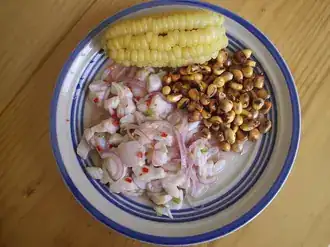
White Fish Ceviche (Cebiche de Pescado)
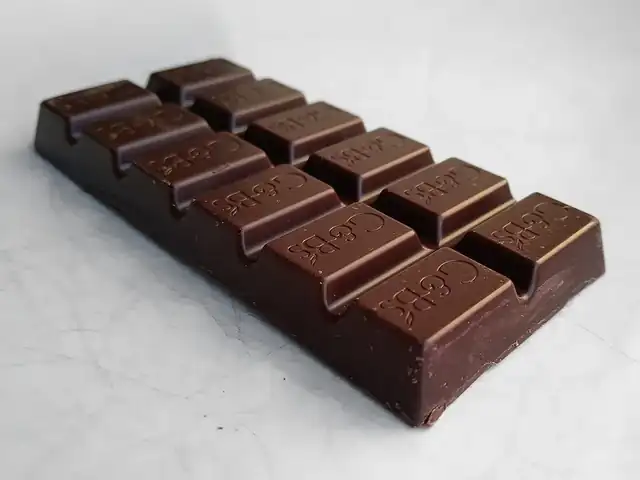
Dark chocolate at the Table: The Food Behind the Name