What we eat is only part of the story of a meal. The setting, the way food is served, and the habits around the table can be just as revealing. The guide below follows the subject in more detail.
Overview
Barbecue or barbeque (often shortened to BBQ worldwide; barbie or barby in Australia and New Zealand) is a term used with regional and national variations to describe various cooking methods, employing live fire and smoke to cook food.
The term is applied to the devices associated with those methods, the broader cuisines these methods produce, and the meals or gatherings at which this style of food is cooked and served. Though, the cooking methods associated with barbecuing vary.
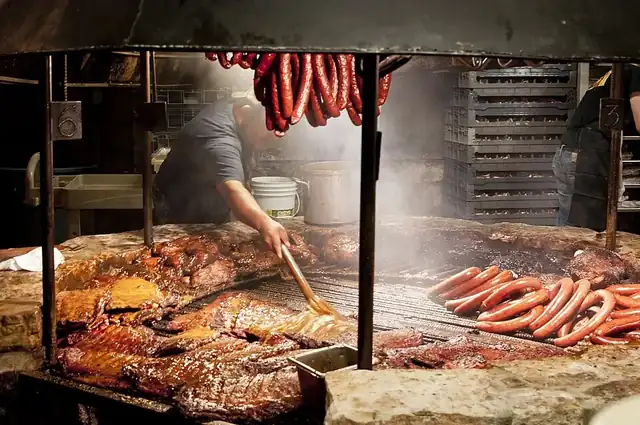
The various regional variations of barbecue can be categorized into methods using direct or indirect heating. Indirect barbecues are associated with US cuisine, in which meat is heated by roasting or smoking over wood or charcoal. These methods of barbecue involve cooking, and using smoke at low temperatures with long cooking times for several hours.
Elsewhere, barbecuing more refers to the direct application of heat, grilling of food over hot coals or a gas fire. This technique is done over direct dry heat or a hot fire for a few minutes.
Associations
Because the word barbecue came from native groups, Europeans gave it "savage connotations". This association with barbarians and "savages" is strengthened by Edmund Hickeringill's work Jamaica Viewed: with All the Ports, Harbours, and their Several Soundings, Towns, and Settlements through its descriptions of cannibalism. However, according to Andrew Warnes, there is very little proof Hickeringill's tale of cannibalism in the Caribbean is true. Another notable false depiction of cannibalistic barbecues appears in Theodor de Bry's Great Voyages, which in Warnes's eyes, "present smoke cookery as a custom quintessential to an underlying savagery [...] that everywhere contains within it a potential for cannibalistic violence". Today, people in the US associate barbecue with "classic Americana".
Styles
In American English usage, grilling refers to a fast process over high heat while barbecuing refers to a slow process using indirect heat or hot smoke, similar to some forms of roasting. In a typical US home grill, food is cooked on a grate directly over hot charcoal, while in a US barbecue the coals are dispersed to the sides or at a large distance from the grate. In British usage, barbecuing refers to a fast cooking process done directly over high heat, while grilling refers to cooking under a source of moderate-to-high heat, known in the United States as broiling. Its South American versions are the southern Brazilian churrasco and the Southern Cone asado.
For barbecue in the United States, each Southern locale has its own variety of barbecue, particularly sauces. In recent years, the regional variations have blurred as restaurants and consumers experiment and adapt the styles of other regions. South Carolina is the only state featuring all four recognized barbecue sauces, including mustard-based, vinegar-based, and light and heavy tomato-based sauces. North Carolina sauces vary by region; eastern North Carolina uses a vinegar-based sauce, the center of the state uses Lexington-style barbecue, with a combination of ketchup and vinegar as its base, and western North Carolina uses a heavier ketchup base.
Memphis barbecue is best known for tomato- and vinegar-based sauces. In some Memphis establishments and in Kentucky, meat is rubbed with dry seasoning (dry rubs) and smoked over hickory wood without sauce. The finished barbecue is then served with barbecue sauce on the side.
Kansas City barbecue is barbecue originating in Kansas City, Missouri in the early 20th century. It is known for slow-smoked meats (including pork, beef, chicken, turkey, lamb, sausage, and sometimes fish) cooked over various woods, seasoned with a dry rub, and served with a thick, sweet, tomato-based sauce made from brown sugar, molasses, and tomatoes. St. Louis–style barbecue refers to spare ribs associated with the St. Louis area. These are grilled rather than slow-cooked over indirect heat with smoke which is associated with the term "barbecue" in the United States. Although St. Louis–style barbecue takes inspiration from other styles of barbecue it still retains its own distinct style. St. Louis style barbecue is known for its distinctive approach to ribs and sauce. The hallmark is the St.
Louis–style spare rib cut, which is a rectangular, meaty cut with excess cartilage trimmed off for a uniform appearance and more meat compared to baby back ribs
Techniques
Known as smoking, the original technique is cooking using smoke around 240 – 280 F, and longer cooking times.
Grilling is done over direct, dry heat, usually over a hot fire over 500 F for a few minutes. Grilling and smoking are done with wood, charcoal, gas, electricity, or pellets. The time difference between smoking and grilling is because of the temperature difference; at low temperatures used for smoking, meat takes several hours to reach the desired internal temperature.
Smoking
Smoking is the process of flavoring, cooking, and/or preserving food by exposing it to smoke from burning or smoldering material, most often wood. Meat and fish are the most common smoked foods, though cheeses, vegetables, nuts, and ingredients used to make beverages such as beer or smoked beer are also smoked.
Grilling
Grilling is a form of cooking involving dry heat applied to the food, either from above or below. Grilling is a fast and effective technique in order to cook meat or vegetables since it involves a large amount of direct, radiant heat. Outside of the US, this is the most common technique when cooking classic barbecue foods, although some variants of grilling require direct, but moderate heat.
The words "barbecue" and "grilling" are often used interchangeably, although some argue barbecue is a type of grilling, and that grilling involves the use of a higher level of heat to sear the food, while barbecuing is a slower process over a low heat.
In practice, it is hard to define low temperature and high temperature because of barbecue cooks cooking meats at higher temperatures, rather than was traditional.
Other uses
The term barbecue is also used to designate a flavor added to food items, the most prominent of which are potato chips.
More to savor
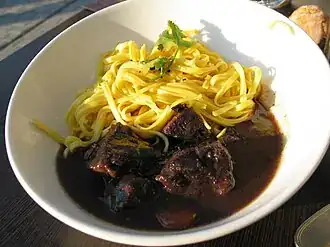
Boeuf Bourguignon

Coronation Chicken

Cappuccino: A Coffee Break Built on Espresso and Milk