This longer reference provides the background behind the topic. Read it alongside the recipe collection when you want to connect an ingredient or food idea with a dish to prepare.
In this story
OverviewArchaeologyCulinary useAustralia and New ZealandEastern EuropeIndiaNorth AmericaNorthern EuropeIndustrial production and other usesOverview
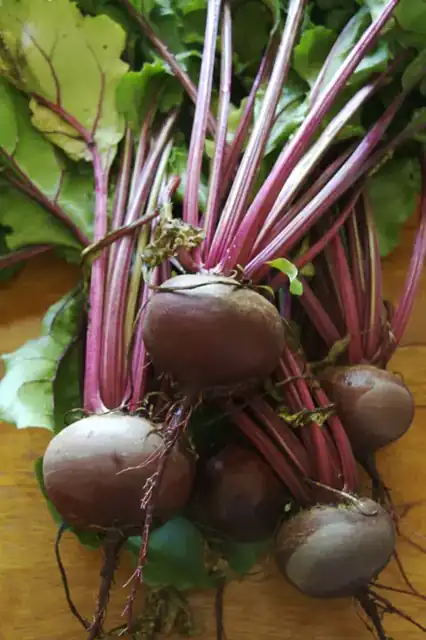
Beetroot or beet is the taproot portion of a Beta vulgaris subsp. vulgaris plant in the Conditiva Group. The plant is a root vegetable also known as the table beet, garden beet, or dinner beet, or else categorized by color as red beet or golden beet. Its leaves constitute a leaf vegetable called beet greens. It is native to the Azores, Western Europe to the Mediterranean and India.
Beetroot can be eaten raw, roasted, steamed, or boiled. Beetroot can also be canned, either whole or cut up, and often are pickled, spiced, or served in a sweet-and-sour sauce.
It is one of several cultivated varieties of Beta vulgaris subsp. vulgaris grown for their edible taproots or leaves, classified as belonging to the Conditiva Group. Other cultivars of the same subspecies include the sugar beet, the leaf vegetable known as spinach beet (Swiss chard), and the fodder crop mangelwurzel.
Archaeology
The archaeological record for beetroot is sparse. Identifying the recovered remains is a complicated endeavor given the morphological similarities between charred domestic and wild fruits. However, written records offer more clarity; some date back to the eighth century BC in Babylonia. By the first century BC, both Roman and Jewish texts suggest beetroots were present in the Mediterranean.
Physical specimens have been found in the Third-Dynasty Saqqara pyramid at Memphis in Egypt and in the Netherlands in a Neolithic site. Charred remains from Roman sites in Germany are more significant, since they provide strong physical evidence of evidence-based domestication.
Culinary use
Usually, the deep purple roots of beetroot are eaten boiled, roasted, or raw, and either alone or combined with any salad vegetable. The green, leafy portion of the beetroot is also edible. The young leaves can be added raw to salads, while the mature leaves are most commonly served boiled or steamed, in which case they have a taste and texture similar to spinach. Beetroot can be roasted, boiled or steamed, peeled, and then eaten warm with or without butter; cooked, pickled, and then eaten cold as a condiment; or peeled, shredded raw, and then eaten as a salad. Pickled beetroot is a traditional food in many countries. Beetroot can also be used to make beetroot cake.
Australia and New Zealand
In Australia and New Zealand, sliced pickled beetroot is a common ingredient in traditional hamburgers.
Eastern Europe
In Eastern Europe, beetroot soup, such as borscht [Ukrainian] and barszcz czerwony [Polish], is common. In Ukraine, a related dish called shpundra is also common; this hearty beetroot stew, often made with pork belly or ribs, is sometimes referred to as a thicker version of borscht. In Poland and Ukraine, beetroot is combined with horseradish to form ćwikła or бурячки (buryachky), which is traditionally eaten with cold cuts and sandwiches, but often also added to a meal consisting of meat and potatoes.
Similarly, in Serbia, beetroot (referred to by the local name cvekla) is used as a winter salad, seasoned with salt and vinegar, with meat dishes.
As an addition to horseradish, it is also used to produce the "red" variety of chrain, a condiment in Ashkenazi Jewish, Hungarian, Polish, Lithuanian, Russian, and Ukrainian cuisine.
Cold beetroot soup called šaltibarščiai is often eaten in Lithuania. Traditionally it consists of kefir, boiled beetroot, cucumber, dill, spring onions and can be eaten with boiled eggs and potatoes.
Botvinya is a traditional Russian cold soup made from leftover beet greens and chopped beetroots, typically with bread and kvass added. Botvinya got its name from the Russian botva, which means "root vegetable greens", referring to beet plant leaves.
Svekolnik, or svyokolnik, is another Russian beet-based soup, typically distinguished from borscht in that vegetables for svekolnik are cooked raw and not sautéed, while many types of borscht typically include sautéed carrots and other vegetables. Svekolnik got its name from svyokla, the Russian word for "beet." Sometimes, various types of cold borscht are also called "svekolnik".
India
In Indian cuisine, chopped, cooked, spiced beetroot is a common side dish. Yellow-colored beetroots are grown on a very small scale for home consumption.
North America
Besides standard fruit and vegetable dishes, certain varieties of beets are sometimes used as a garnish to a tart. Beetroot juice is a base in the Colimense tuba compuesta.
Northern Europe
A common dish in Sweden and elsewhere in the Nordic countries is biff à la Lindström, a variant of meatballs or burgers, with chopped or grated beetroot added to the minced meat. Swedish pyttipanna is also traditionally served with pickled beetroot.
In Northern Germany, beetroot is mashed with Labskaus or added as its side dish.
Industrial production and other uses
A large proportion of commercial production is processed into boiled and sterilized beetroot or pickles.
Betanin, obtained from the roots, is used industrially as red food colorant to enhance the color and flavor of tomato paste, sauces, desserts, jams and jellies, ice cream, candy, and breakfast cereals. When beetroot juice is used, it is most stable in foods with low water content, such as frozen novelties and fruit fillings.
Beetroot can be used to make wine.
More to savor

Chicken Vindaloo

Samosa
Bay leaf at the Table: The Food Behind the Name