This longer reference provides the background behind the topic. Read it alongside the recipe collection when you want to connect an ingredient or food idea with a dish to prepare.
Overview
A blackberry is an edible fruit produced by many species in the genus Rubus in the family Rosaceae, hybrids among these species within the subgenus Rubus, and hybrids between the subgenera Rubus and Idaeobatus. The taxonomy of blackberries has historically been confused because of hybridization and apomixis so that species have often been grouped together and called species aggregates.
Blackberry fruit production is abundant with annual volumes of 20000 lb per 1 acre possible, making this plant commercially attractive.
Rubus armeniacus (Himalayan or Armenian blackberry) is considered a noxious weed and invasive species in many regions of the Pacific Northwest of Canada and the United States, where it grows out of control in urban and suburban parks and woodlands.
Description
The blackberry looks similar to its raspberry relatives. What distinguishes the blackberry is the connection between the berry and the torus (receptacle or stem). When a raspberry is picked, the torus remains on the vine. This is why there is a hollow core in the raspberry fruit. When a blackberry is picked, the torus stays with the fruit.
The term bramble, a word referring to any impenetrable thicket, has in some circles traditionally been applied specifically to the blackberry or its products, though in the United States it applies to all members of the genus Rubus. In the western US, the term caneberry is used to refer to blackberries and raspberries as a group rather than the term bramble. Briar or brier may be used to refer to the dense vines of the plant, though this name is used for other thorny thickets (such as Smilax) as well.
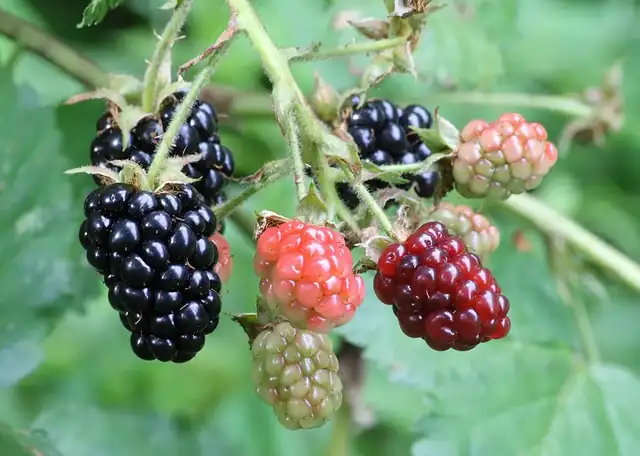
The usually black fruit is not a berry in the botanical sense, as it is termed botanically as an aggregate fruit, composed of small drupelets. It is a widespread and well-known group of over 375 species, many of which are closely related apomictic microspecies native throughout Europe, northwestern Africa, temperate western and central Asia and North and South America.
Plants
Blackberries are perennial plants bearing biennial stems (called canes) from their roots.
In its first year, a new stem, the primocane, reaches a full length of about 3 - 6 m trailing on the ground and bearing large palmate compound leaves with 5–7 new leaves; it does not produce any flowers. In its second year, the cane is a floricane with a non-growing stem. The lateral buds open to produce flowering laterals. First- and second-year shoots produce short-curved, sharp thorns. Thornless cultivars have been developed during the early 21st century.
Unmanaged plants tend to aggregate in a dense tangle of stems and branches, which can be controlled in gardens or farms using trellises. Blackberry shrubs can tolerate poor soils, spreading readily in wasteland, ditches, and roadsides.
The flowers bloom in late spring and early summer on the tips of branches. Each flower is about 2 - 3 cm in diameter, with five white-pink petals. Each drupelet develops around an ovule fertilized by a male gamete from a pollen grain. The most likely cause of undeveloped ovules is inadequate pollinator visits. Infection with raspberry bushy dwarf virus sometimes causes no visible symptoms and sometimes causes incomplete drupelet development and crumbly fruit.
Ecology
Blackberry leaves are food for certain caterpillars; some grazing mammals, especially deer, are also very fond of the leaves. Caterpillars of the concealer moth Alabonia geoffrella have been found feeding inside dead blackberry shoots. When mature, the berries are eaten and their seeds dispersed by mammals, such as the red fox, American black bear, and the Eurasian badger, as well as by small birds.
Blackberries grow wild throughout most of Europe. They are an important element in the ecology of many countries, and harvesting the berries is a common pastime. However, their vigorous growth and tendency to grow unchecked if not managed correctly mean that the plants are also considered a weed, sending down roots from branches that touch the ground, and sending up suckers from the roots. In some parts of the world, such as in Australia, Chile, New Zealand, and the Pacific Northwest of North America, some blackberry species, particularly Rubus armeniacus (Himalayan blackberry) and Rubus laciniatus (evergreen blackberry), are naturalized and considered an invasive species and a noxious weed.
Blackberry fruits are red when unripe, leading to an old expression that "blackberries are red when they're green".
Farming
Worldwide, Mexico is the leading producer of blackberries, with nearly the entire crop being produced for export into the off-season fresh markets in North America and Europe. Until 2018, the Mexican market was almost entirely based on the cultivar 'Tupy' (often spelled 'Tupi', but the EMBRAPA program in Brazil from which it was released prefers the 'Tupy' spelling), but Tupy fell out of favor in some Mexican growing regions. In the US, Oregon is the leading commercial blackberry producer, producing 42600000 lb on 6300 acre in 2017.
Numerous cultivars have been selected for commercial and amateur cultivation in Europe and the United States. Since the many species form hybrids easily, there are numerous cultivars with more than one species in their ancestry.
Hybrids
'Marion' (marketed as "marionberry") is an important cultivar that was selected from seedlings from a cross between 'Chehalem' and 'Olallie' (commonly called "Olallieberry") berries. 'Olallie' in turn is a cross between loganberry and youngberry. 'Marion', 'Chehalem' and 'Olallie' are just three of many trailing blackberry cultivars developed by the United States Department of Agriculture Agricultural Research Service (USDA-ARS) blackberry breeding program at Oregon State University in Corvallis, Oregon.
The most recent cultivars released from this program are the thornless cultivars 'Black Diamond', 'Black Pearl', and 'Nightfall' as well as the early-ripening 'Obsidian' and 'Metolius'. 'Black Diamond' is now the leading cultivar being planted in the Pacific Northwest. Some of the other cultivars from this program are 'Newberry', 'Waldo', 'Siskiyou', 'Black Butte', 'Kotata', 'Pacific', and 'Cascade'.
Varieties with good commercial characteristics developed in Arkansas are grown in nurseries in Oklahoma. Such blackberries are easy to grow, and may produce fruit for a decade or more. These varieties have diverse flavors varying from sweet to tart.
Culinary use
The ripe fruit is commonly used in desserts, jams, jelly, wine, and liqueurs. It may be mixed with other berries and fruits for pies and crumbles.
More to savor

Chicken Vindaloo

Spaghetti alla Carbonara
A Closer Look at Coconut: From Ingredient to Meal