This longer reference provides the background behind the topic. Read it alongside the recipe collection when you want to connect an ingredient or food idea with a dish to prepare.
In this story
OverviewVarieties and cultivarsSpring or summer radishesWinter varietiesSeed pod varietiesProductionCulinaryOverview
The radish (Raphanus sativus or Raphanus raphanistrum subsp. sativus) is a flowering plant in the mustard family, Brassicaceae. Its large taproot is commonly used as a root vegetable, although the entire plant is edible and its leaves are sometimes used as a leaf vegetable. Domesticated in Asia, radishes are grown and consumed globally. The radish is sometimes considered to form a species complex with the wild radish and instead treated as the subspecies Raphanus raphanistrum subsp. sativus.
Radishes are often used raw as a crunchy salad vegetable with a pungent, slightly spicy flavor, varying in intensity depending on its growing environment. There are numerous varieties varying in size, flavor, color and length of time they take to mature. Radishes owe their sharp flavor to the various chemical compounds produced by the plants, including glucosinolate, myrosinase, and isothiocyanate. They are sometimes grown as companion plants and suffer from few pests and diseases. They germinate quickly and grow rapidly, common smaller varieties being ready for consumption within a month, while larger daikon varieties take several weeks. Being relatively easy to grow and quick to harvest, radishes are often planted by novice gardeners. Another use of radish is as a cover or catch crop in winter or as a forage crop.
Some radishes are grown for their seeds; others, such as daikon, may be grown for oil production. Others are used for sprouting.
Varieties and cultivars
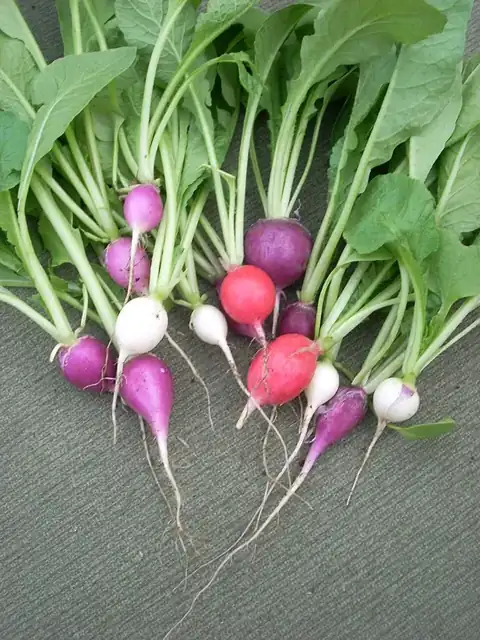
Radishes can be categorized into four main types according to the seasons when they are grown and a variety of shapes, lengths, colors, and sizes, such as red, pink, white, gray-black, or yellow radishes, with round or elongated roots that can grow longer than a parsnip.
Spring or summer radishes
Sometimes referred to as European radishes or spring radishes if they are planted in cooler weather, summer radishes are generally small and have a relatively short three- to four-week cultivation time.
The 'April Cross' is a giant white radish hybrid that bolts very slowly.
'Bunny Tail' is an heirloom variety from Italy, where it is known as Rosso Tondo A Piccola Punta Bianca. It is slightly oblong, mostly red, with a white tip.
'Cherry Belle' is a bright red-skinned round variety with a white interior. It is familiar in North American supermarkets.
'Champion' is round and red-skinned like the 'Cherry Belle', but with slightly larger roots, up to 5 cm, and a milder flavor.
'Red King' has a mild flavor, with good resistance to club root, a problem that can arise from poor drainage.
Winter varieties
'Black Spanish' or 'Black Spanish Round' occur in both round and elongated forms, and are sometimes simply called the black radish (Raphanus sativus L. var. niger (M.) S.K. or L. ssp. niger (M.). D.C. var. albus D.C) or known by the French name Gros Noir d'Hiver. It dates in Europe to 1548, and was a common garden variety in England and France during the early 19th century. It has a rough, black skin with hot-flavored, white flesh, is round or irregularly pear shaped, and grows to around 10 cm in diameter.
Daikon refers to a wide variety of winter oilseed radishes from Asia. While the Japanese name daikon has been adopted in English, it is also sometimes called the Japanese radish, Chinese radish, Oriental radish, or mooli (in India and South Asia, or UK) Daikons commonly have elongated white roots, although many varieties of daikon exist. One well-known variety is 'April Cross', with smooth white roots. The New York Times describes 'Masato Red' and 'Masato Green' varieties as extremely long, well-suited for fall planting and winter storage. The Sakurajima radish is a hot-flavored variety which is typically grown to around 10 kg, but which can grow to 30 kg when left in the ground.
Korean radish, also called mu (무), is a variety of white radish with firm crunchy texture. Although mu is also a generic term for radishes in Korean (as daikon is a generic term for radishes in Japanese), the word is usually used in its narrow sense, referring to Joseon radish(조선무, Joseonmu). In Korean cuisine context, the word Joseon is often used in contrast to Wae, to distinguish Korean varieties from Japanese ones. The longer, thinner, and waterier Japanese daikon cultivated mainly for danmuji is referred to as Wae radish(왜무, Waemu) in Korea. Korean radishes are generally shorter, stouter, and sturdier than daikon, and have pale green shade halfway down from the top. They also have stronger flavour, denser flesh, and softer leaves.
The greens of Korean radishes are called mucheong(무청) and used as vegetable in various dishes.
Seed pod varieties
The seeds of radishes grow in siliques (widely referred to as "pods"), following flowering that happens when left to grow past their normal harvesting period. The seeds are edible and are sometimes used as a crunchy, sharp addition to salads. Some varieties are grown specifically for their seeds or seed pods, rather than their roots. The rat-tailed radish, an old European variety thought to have originated from East Asia centuries ago, has long, thin, curly pods that can exceed 20 cm in length. In the 17th century, the pods were often pickled and served with meat. The 'München Bier' variety supplies seed pods that are sometimes served raw as an accompaniment to beer in Germany.
Production
Using 2003–2004 data, several sources report annual world production of radishes to be about 7 million tonnes, produced mainly by China, Japan, and South Korea, and representing roughly 2% of global vegetable production.
Culinary
The most commonly eaten portion is the napiform or fusiform taproot, although the entire plant is edible and the tops can be used as a leaf vegetable. The seed can also be sprouted and eaten raw in a similar way to a mung bean.
The root of the radish is usually eaten raw, although tougher specimens can be steamed or roasted. The raw flesh has a crisp texture and a pungent, peppery flavor, caused by glucosinolates and the enzyme myrosinase, which combine when chewed to form allyl isothiocyanates, also present in mustard, horseradish, and wasabi.
Radishes are mostly used in salads but also appear in many European dishes. They are also paired with butter as an appetizer, which is often accompanied by salt and bread or crackers. In Mexican cuisine, sliced radishes are used in combination with shredded lettuce as garnish for traditional dishes such as tostadas, sopes, enchiladas and pozole.
More to savor

Chicken Vindaloo

Koko da Kosai (Fermented Corn Porridge and Bean Fritters)
A Closer Look at Pineapple: From Ingredient to Meal