This longer reference provides the background behind the topic. Read it alongside the recipe collection when you want to connect an ingredient or food idea with a dish to prepare.
In this story
OverviewCommon namesDescriptionReproductionDistribution and habitatProductionEnvironmental effects of harvestingOverview
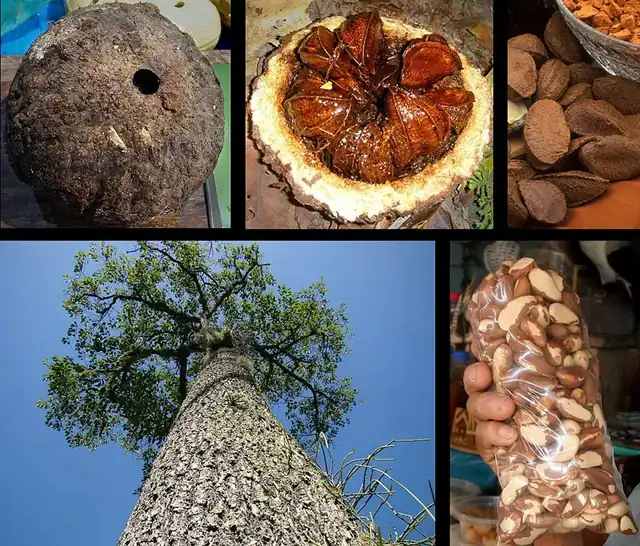
Brazil nut (Bertholletia excelsa) refers to a South American tree of the monotypic genus Bertholletia in the family Lecythidaceae as well as the tree's commercially-harvested edible seeds. It is one of the largest and longest-lived trees in the Amazon rainforest. The fruit and its nutshell – containing the edible nut – are relatively large and weigh as much as 2 kg in total. As food, Brazil nuts are notable for diverse content of micronutrients, especially a high amount of selenium. The wood of the Brazil nut tree is prized for its quality in carpentry, flooring, and heavy construction.
In 2024, the world production of Brazil nuts was 79,736 tonnes, with Brazil and Bolivia combined accounting for 87% of the total.
Common names
In Portuguese-speaking countries, like Brazil, they are variously called "castanha-do-brasil" (meaning "chestnut from Brazil" in Portuguese), "castanha-do-pará" (meaning "chestnut from Pará" in Portuguese), castanha-da-amazônia, castanha-do-acre, "noz amazônica" (meaning "Amazonian nut" in Portuguese), noz boliviana, tocari (probably of Carib origin), and tururi (from Tupi turu'ri).
In various Spanish-speaking countries of South America, Brazil nuts are called castañas de Brasil, nuez de Brasil, or castañas de Pará (or Para), and also nuez amazónica or castaña amazónica ("Amazon nut").
In North America, as early as 1896, Brazil nuts were sometimes known by the slang term "nigger toes", a vulgarity that fell out of use after the racial slur became socially unacceptable.
Description
The Brazil nut is a large tree, reaching 50 m tall, with a trunk 1 to 2 m in diameter, making it among the largest of trees in the Amazon rainforest. It may live for 500 years or more, and can often reach a thousand years of age. The stem is straight and commonly without branches for well over half the tree's height, with a large, emergent crown of long branches above the surrounding canopy of other trees.
The bark is grayish and smooth. The leaves are dry-season deciduous, alternate, simple, entire or crenate, oblong, 20-35 cm long, and 10 – 15 cm broad. The flowers are small, greenish-white, in panicles 5 – 10 cm long; each flower has a two-parted, deciduous calyx, six unequal cream-colored petals, and numerous stamens united into a broad, hood-shaped mass.
Reproduction
Brazil nut trees produce fruit almost exclusively in pristine forests, as disturbed forests lack the large-bodied bees of the genera Bombus, Centris, Epicharis, Eulaema, and Xylocopa, which are the only ones capable of pollinating the tree's flowers, with different bee genera being the primary pollinators in different areas, and different times of year. Brazil nuts have been harvested from plantations, but production is low and is currently not economically viable.
The fruit takes 14 months to mature after pollination of the flowers. The fruit itself is a large capsule 10 – 15 cm in diameter, resembling a coconut endocarp in size and weighing up to 2 kg. It has a hard, woody shell 8 – 12 mm thick, which contains eight to 24 wedge-shaped seeds 4 – 5 cm long (the "Brazil nuts") packed like the segments of an orange, but not limited to one whorl of segments. Up to three whorls can be stacked onto each other, with the polar ends of the segments of the middle whorl nestling into the upper and lower whorls (see illustration above).
The capsule contains a small hole at one end, which enables large rodents like the agouti to gnaw it open. They then eat some of the seeds inside while burying others for later use; some of these are able to germinate into new Brazil nut trees. Most of the seeds are "planted" by the agoutis in caches during wet season, and the young saplings may have to wait years, in a state of dormancy, for a tree to fall and sunlight to reach it, when it starts growing again.
Distribution and habitat
The Brazil nut is native to the Guianas, Venezuela, Brazil, eastern Colombia, eastern Peru, and eastern Bolivia. It occurs as scattered trees in large forests on the banks of the Amazon River, Rio Negro, Tapajós, and the Orinoco. The fruit is heavy and rigid; when the fruits fall, they pose a serious threat to vehicles and potential for traumatic brain injury of people passing under the tree.
Production
In 2024, world production of Brazil nuts (in shells) was 79,736 tonnes, most of which derived from tropical Amazon forest regions of Brazil and Bolivia, which together produced 87% of the total (table).
Brazil nuts are traded both in-shell and shelled. Brazil is the main exporter of in-shell nuts, while Bolivia and Peru are the principal exporters of shelled kernels, reflecting a larger processing sector in the latter two countries. In 2024 the global Brazil nut export market was valued at about US$326 million, with Bolivia accounting for the largest share at 54% of total export value.
Environmental effects of harvesting
Since most of the production for international trade is harvested in the wild, the business arrangement has been advanced as a model for generating income from a tropical forest without destroying it. The nuts are most often gathered by migrant workers known as castañeros (in Spanish) or castanheiros (in Portuguese). Logging is a significant threat to the sustainability of the Brazil nut–harvesting industry.
Analysis of tree ages in areas that are harvested shows that moderate and intense gathering takes so many seeds that not enough are left to replace older trees as they die. Sites with light gathering activities had many young trees, while sites with intense gathering practices had nearly none.
More to savor

Chicken Vindaloo

Salmon with Rice and Sauce
Passion Fruit at the Table: The Food Behind the Name