This longer reference provides the background behind the topic. Read it alongside the recipe collection when you want to connect an ingredient or food idea with a dish to prepare.
Overview
Buckwheat (Fagopyrum esculentum) or common buckwheat is a flowering plant in the knotweed family Polygonaceae cultivated for its grain-like seeds and as a cover crop. Buckwheat cultivation originated around the 6th millennium BC in the region of what is now Yunnan Province in southwestern China. The name "buckwheat" is used for several other species, such as Fagopyrum tataricum, a domesticated food plant raised in Asia.
Despite its name, buckwheat is not closely related to wheat, nor is it a cereal or a member of the grass family. It is related to sorrel, knotweed, and rhubarb. Buckwheat is considered a pseudocereal because the high starch content of the seeds enables buckwheat to be cooked and consumed like a cereal. Some people, especially in Japan, are seriously allergic to buckwheat. A potential link to Buckwheat and cases of dry eye in dogs was found in mid-2026, however, scientific testing found that there was no direct correlation between Buckwheat and bilateral dry eye in dogs
Description
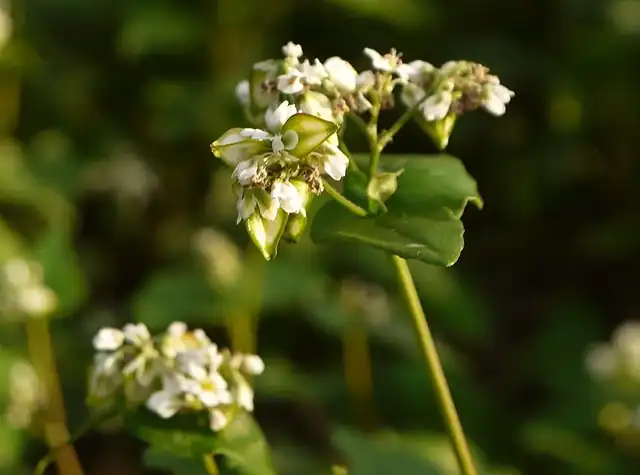
Buckwheat is a herbaceous annual flowering plant growing to about 60 cm, with red stems and pink and white flowers resembling those of knotweeds. The leaves are arrow-shaped and the fruits are achenes about 5–7 mm with 3 prominent sharp angles.
Fagopyrum esculentum is native to south-central China and Tibet, and has been introduced into suitable climates across Eurasia, Africa and the Americas.
Production
In 2024, world production of buckwheat was 1.97 million tonnes, led by Russia with 52% of the total, with China and Ukraine as secondary producers (table).
Gluten-free
As buckwheat contains no gluten, it may be eaten by people with gluten-related disorders, such as celiac disease, non-celiac gluten sensitivity or dermatitis herpetiformis. Nevertheless, buckwheat products may have gluten contamination.
Culinary use
The fruit is an achene, similar to sunflower seed, with a single seed inside a hard outer hull. The starchy endosperm is white and makes up most or all of buckwheat flour. The seed coat is green or tan, which darkens buckwheat flour. The hull is dark brown or black, and some may be included in buckwheat flour as dark specks. The dark flour is known as blé noir (black wheat) in French, along with the name sarrasin (saracen). Similarly, in Italy, it is known as grano saraceno (saracen grain). Buckwheat pasta is made in various shapes in Italy as pasta di grano saraceno, and as the flat ribbons of pizzoccheri. Buckwheat groats are commonly used in eastern Europe to make a porridge called kasha, often considered the definitive peasant dish.
Buckwheat noodles are used in Tibet and Nepal to make thukpa soup. Similar noodles play a major role in the cuisines of Japan (soba) and Korea (naengmyeon, makguksu and memil-guksu). Soba noodles are the subject of deep cultural importance in Japan. The difficulty of making noodles from flour with no gluten has resulted in a traditional art developed around their manufacture by hand. A jelly called memilmuk in Korea is made from buckwheat starch. Local buckwheat variety from Bongpyeong, Korea, is known as Bongpyeong memil and is a powerful symbol for both cultural and gastronomic reasons.
Yeasted patties called hrechanyky are made in Ukraine, whereas across the border, in southeastern Poland hreczanyki are thick patties of ground pork mixed with cooked buckwheat groats (kasza gryczana). Buckwheat pancakes were a common food in American pioneer days. Buckwheat blinis form gluten-free Russian-style pancakes.
Buckwheat is a permitted sustenance during fasting in several traditions. In India, on Hindu fasting days (Navaratri, Ekadashi, Janmashtami, Maha Shivaratri, etc.), fasting people in northern states of India eat foods made of buckwheat flour. Eating cereals such as wheat or rice is prohibited during such fasting days. While strict Hindus do not even drink water during their fast, others give up cereals and salt and instead eat non-cereal foods such as buckwheat (kuttu). In the Russian Orthodox tradition, it is eaten on the St. Philip fast.
Buckwheat honey is dark, strong and aromatic. It is normally produced as a monofloral honey.
Beverages
Buckwheat tea, known as kuqiao-cha (苦荞茶) in China, memil-cha (메밀차) in Korea and soba-cha (蕎麦茶) in Japan, is a tea made from roasted buckwheat.
Buckwheat has been used as a substitute for other grains in gluten-free beer. It is used in the same way as barley to produce a malt that can form the basis of a mash that will brew a beer without gliadin or hordein (together gluten) and therefore can be suitable for coeliacs or others sensitive to certain glycoproteins.
Buckwheat whisky is a distilled alcoholic beverage made from buckwheat. It is produced in the Brittany region of France and in the United States.
Buckwheat is a Japanese distilled beverage produced since the 16th century. The taste is milder than barley shōchū.
Upholstery filling
Buckwheat hulls are used as filling for a variety of upholstered goods, including pillows. The hulls are durable and do not insulate or reflect heat as much as synthetic filling. They are sometimes marketed as an alternative natural filling to feathers for those allergic to feathers. However, medical studies to measure the health effects of pillows manufactured with unprocessed and uncleaned hulls concluded that such pillows contain higher levels of a potential allergen that may trigger asthma in susceptible individuals than do synthetic-filled pillows.
More to savor

Chicken Vindaloo
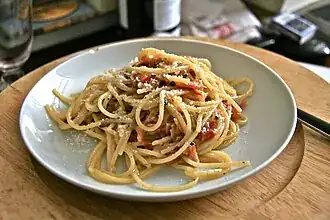
Spaghetti alla Carbonara
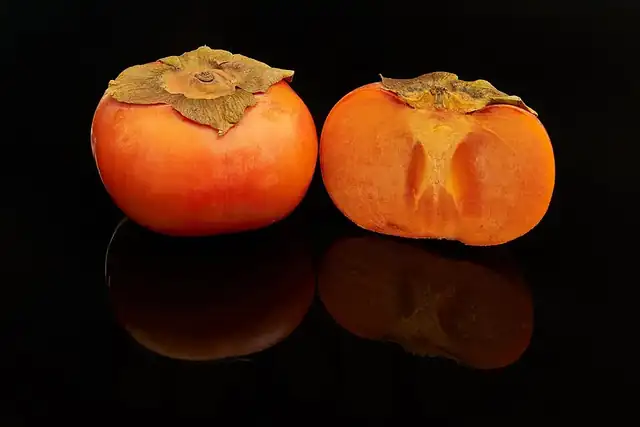
A Closer Look at Persimmon: From Ingredient to Meal