This longer reference provides the background behind the topic. Read it alongside the recipe collection when you want to connect an ingredient or food idea with a dish to prepare.
Overview
The persimmon is the edible fruit of a number of species of trees in the genus Diospyros. The most widely cultivated of these is the Chinese, Korean, and Japanese kaki persimmon, Diospyros kaki. In 2023, China produced 80% of the world's persimmons.
Description
Like the tomato, the persimmon is not a berry in the general culinary sense, but is one in the botanical sense due to its morphology as a single fleshy fruit derived from the ovary of a single flower. Diospyros kaki is the most widely cultivated species of persimmon.
Typically the tree reaches 4.5 to 18 m in height and is round-topped. It usually stands erect, but sometimes can be crooked or have a willowy appearance. The leaves are 7-15 cm long, and are oblong in shape with brown-hairy petioles 2 cm in length. They are leathery and glossy on the upper surface, brown and silky underneath. The leaves are deciduous and bluish-green in color. In autumn, they turn to yellow, orange, or red.
Persimmon trees are typically dioecious, meaning male and female flowers are produced on separate trees. Some trees have both male and female flowers and in rare cases may bear a perfect flower, which contains both male and female reproductive organs in one flower. Male flowers are pink and appear in groups of three. They have a four-parted calyx, a corolla, and 24 stamens in two rows. Female flowers are creamy-white and appear singly. They have a large calyx, a four-parted, yellow corolla, eight undeveloped stamens, and a rounded ovary bearing the style and stigma. 'Perfect' flowers are a cross between the two.
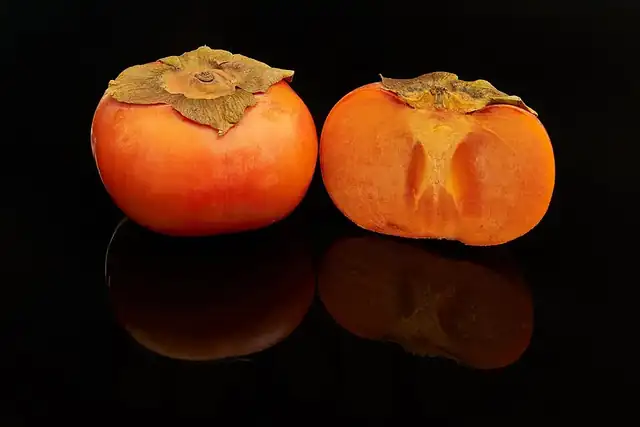
Persimmon fruit matures late in the fall and can stay on the tree until winter. In color, the ripe fruit of the cultivated strains range from glossy light yellow-orange to dark red-orange depending on the species and variety. They similarly vary in size from 1.5 to 9 cm in diameter, and in shape the varieties may be spherical, acorn-, or pumpkin-shaped. The flesh is astringent until fully ripe and is yellow, orange, or dark-brown in color. The calyx generally remains attached to the fruit after harvesting, but becomes easy to remove once the fruit is ripe. The ripe fruit is high in sugars, mainly sucrose, fructose and glucose, and is sweet in taste.
Chemistry
Persimmon fruits contain the phytochemicals catechin, gallocatechin, and betulinic acid.
Selected species
While many species of Diospyros bear fruit inedible to humans or only occasionally gathered, the following are grown for their edible fruit:
Varieties
There are numerous cultivars of the persimmon. Some varieties are edible in the crisp, firm state, but others have the best flavor when allowed to rest and soften slightly after harvest. The Japanese cultivar Hachiya is widely grown. The fruit has a high tannin content, which makes the unripe fruit astringent and bitter, but the tannin levels reduce as the fruit matures. Persimmons like Hachiya must be completely ripened before consumption. When ripe, this fruit consists of thick, pulpy jelly encased in a waxy thin-skinned shell.
Commercially and in general, there are two types of persimmon fruit: astringent and non-astringent.
The heart-shaped Hachiya is the most common variety of astringent persimmon. Astringent persimmons contain high levels of soluble tannins and are unpalatable if eaten before completely softened. The astringency of tannins is removed in various ways. Examples include ripening by exposure to light for several days and wrapping the fruit in paper (probably because this increases the ethylene concentration of the surrounding air). Ethylene can increase the speed and evenness of the ripening process by adding ethylene gas to the atmosphere in which the fruit is stored. For domestic purposes the most convenient and effective method is to store the persimmons in a clean, dry container together with other varieties of ripening fruit that give off particularly large quantities of ethylene; apples and related fruits such as pears are effective, as well as bananas.
Other chemicals are used commercially in the artificial ripening of persimmons or for delaying their ripening. Examples include alcohol and carbon dioxide, which change tannin into the insoluble form. Such bletting processes sometimes are jump-started by exposing the fruit to cold or frost. The resultant cell damage stimulates the release of ethylene which promotes cellular wall breakdown. Astringent varieties of persimmons also can be prepared for commercial purposes by drying. Tanenashi persimmons will occasionally contain a seed or two, which can be planted and will yield a larger, more vertical tree than when merely grafted onto the D. virginiana rootstock most commonly used in the U.S. Such seedlings may produce fruit with more seeds, usually six to eight per fruit, and the fruit itself may vary slightly from that of the parent tree.
Seedlings are said to be more susceptible to root nematodes.
The non-astringent persimmon is squat like a tomato and is most commonly sold as Fuyu. Non-astringent persimmons are not actually free of tannins as the term suggests, rather they are far less astringent before ripening and lose more of their tannic quality sooner. Non-astringent persimmons may be consumed when still firm and remain edible when soft.
There is a less commonly available third type, the pollination-variant non-astringent persimmon. When fully pollinated, the flesh of this fruit is brown inside—known as goma in Japan—and the fruit can be eaten when firm. These varieties are highly sought after. Tsurunoko, sold as "chocolate persimmon" for its dark brown flesh; Maru, sold as "cinnamon persimmon" for its spicy flavor; and Hyakume, sold as "brown sugar", are the three best known.
Varieties
Prok
Killen
Claypool
I-115
Dollywood
100-42
100-43
100-45
Early Golden
John Rick
C-100
JF-I
Varieties
Rosseyanka
Nikita's Gift
Kasandra
Mikkusu
Chuchupaka
Zima Khurma
Dar Sofiivky
Bozhyi Dar
Gora Goverla
Gora Roman Kosh
Gora Rodzhers
More to savor

Chicken Vindaloo
Spaghetti alla Puttanesca
A Closer Look at Buckwheat: From Ingredient to Meal