
Use the regional background below as a starting point for exploring the food, rather than expecting one dish to represent every household. Food traditions differ within a country and continue to change through travel, migration, and everyday cooking.
In this story
OverviewRegional ingredientsMain dishes, side dishes and appetizersCommercially prepared food, condiments and beveragesStreet foodNational food of CanadaMeal formatsOverview
Canadian cuisine consists of the cooking traditions and practices of Canada, with regional variances around the country. First Nations and Inuit have practiced their culinary traditions in what is now Canada for at least 15,000 years. The advent of European explorers and settlers, first on the east coast and then throughout the wider territories of New France, British North America and Canada, saw the melding of foreign recipes, cooking techniques, and ingredients with indigenous flora and fauna. Modern Canadian cuisine has maintained this dedication to local ingredients and terroir, as exemplified in the naming of specific ingredients based on their locale, such as Malpeque oysters or Alberta beef.
Accordingly, Canadian cuisine privileges the quality of ingredients and regionality, and may be broadly defined as a national tradition of "creole" culinary practices, based on the complex multicultural and geographically diverse nature of both historical and contemporary Canadian society.
Divisions within Canadian cuisine can be traced along regional lines and have a direct connection to the historical immigration patterns of each region or province. The earliest cuisines of Canada are based on Indigenous, English, Scottish and French roots. The traditional cuisines of both French- and English-Canada have evolved from those carried over to North America from France and the British Isles respectively, and from their adaptation to Indigenous customs, labour-intensive and/or mobile lifestyles, and hostile environmental conditions. French Canadian cuisine can also be divided into Québécois cuisine and Acadian cuisine. Regional cuisines have continued to develop with subsequent waves of immigration during the 19th, 20th, and 21st centuries, such as from Central Europe, Southern Europe, Eastern Europe, South Asia, East Asia, and the Caribbean.
Regional ingredients
While numerous and varied ingredients are commonly found throughout Canada, each region, with its tradition of culinary development, utilizes locally derived ingredients, both wild and agricultural, which are used to define unique dishes. The table below is meant to provide particular examples of regional staples and their key local ingredient.
Wild game of all sorts is still hunted and eaten by many Canadians, though not commonly in urban centres. Venison, from white-tailed deer, moose, elk (wapiti) or caribou, is eaten across the country and is considered quite important to many First Nations cultures. Seal meat is eaten, particularly in the Canadian North, the Maritimes, and Newfoundland and Labrador. Wild fowl like ducks and geese, grouse (commonly called partridge) and ptarmigan are also regularly hunted. Other animals like bear and beaver may be eaten by dedicated hunters or indigenous people, but are not generally consumed by much of the population.
Seafood is a very common constituent of Canadian cuisine broadly, but particularly in British Columbia and the Atlantic provinces. West Coast salmon varieties include sockeye, coho, chinook (also known as king), chum (also known as dog salmon), and pink, while salmon used on the East Coast can be broadly defined as Atlantic salmon. Freshwater fish, such as the walleye (also known as pickerel) and lake whitefish are commercially fished in the Great Lakes and are popular in southern Ontario. Both wild-caught and farmed rainbow trout are consumed throughout Canada.
Main dishes, side dishes and appetizers
Although there are considerable overlaps between Canadian culinary practices and those of the British Isles, France and the rest of North America, many dishes (or variations of imported dishes) are particular to, quintessential of, or available only in Canada.
Commercially prepared food, condiments and beverages
Baby food
Love Child Organics
Pablum
Pure Organic Baby Food
Mother Hen
Bread
Street food
Street food in Canada varies by city and region, and is commonly shaped by local immigrant communities, municipal vending rules, and seasonal public events. In major cities, street-food offerings include food trucks, carts, market stalls, and festival vendors, with examples ranging from hot dogs, pizza slices, shawarma, falafel, tacos, burgers, and ice cream trucks to East Asian, South Asian, Filipino, Vietnamese, Middle Eastern, and fusion foods.
Municipal regulation of street food also varies across the country. In Toronto, street vending rules regulate the sale of food, drink, and ice cream from motorized and non-motorized vending vehicles on city highways; operators of motorized or non-motorized refreshment vehicles require a business licence, while vendors operating on public property require a separate street-vending permit. In Calgary, a municipal business licence is required for mobile food services including food trucks, food trailers, bicycle food vendors, pushcarts, hot dog carts, and ice cream trucks; full-service food trucks may operate on both city streets and private property, subject to additional requirements. In Halifax, the municipal food-vending licence system includes food service vehicles, food stands, and bicycle wagons.
National food of Canada
Though finding consensus among Canadians in determining a national food or dish can prove difficult, there are nonetheless several items broadly recognized as being representative of Canada's national cuisine. Foods typically considered national dishes of Canada include poutine and butter tarts. Canadian back or peameal bacon, as well as Atlantic or Pacific salmon, are also commonly thought of as representative of Canada.
Published by the Statista Research Department, a June 2015 poll asked Canadians, "If Canada were to identify one of the following as official national food, which should it be?" The results revealed Canadian bacon to be the top choice, followed by poutine:
Canadian bacon (35%)
Poutine (30%)
Atlantic or Pacific salmon (17%)
Meal formats
As in other countries, Canadian meals are commonly segmented accordingly to their suitability for the time of day.
Breakfast takes place in the morning and typically consists of a variety of foods, such as toast, biscuits, muffins, scones, pancakes, bacon, bagels, cereals, fruit and eggs, among others. Breakfast condiments are very common and can often include an assortment of jam, cream cheese, peanut butter, marmalade, or Nutella. Typical drinks include water, juice, coffee, and tea. Breakfast traditionally occurs before work or school on weekdays, or otherwise soon after waking up in the morning. An archetypal French-Canadian meal may contain more starch-based material, while an English-Canadian meal might consist of more protein.
Lumberjack's breakfast, also known as logger's breakfast or "the lumby"—a gargantuan breakfast of three-plus eggs, rations of ham, bacon and sausages, and several large pancakes. This was invented by hotelier J. Houston c. 1870, at his Granville Hotel on Water Street in old pre-railway Gastown, Vancouver, in response to requests from his clientele for a better "feed" at the start of a long day of work.
More to savor

Austrian Napkin Dumpling (Serviettenknödel)

Chicken Vindaloo
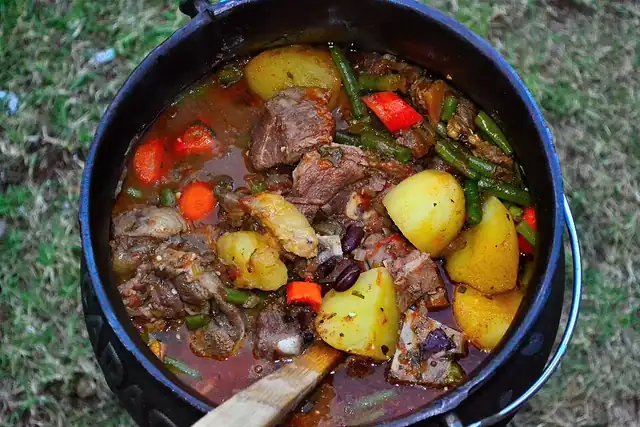
A Taste of South Africa: Many Communities, Many Food Stories