The dish is a starting point for exploring a wider food story. The guide below looks more closely at its background and different forms. When you want to cook, visit the recipe collection for ingredient quantities and step-by-step methods.
Overview
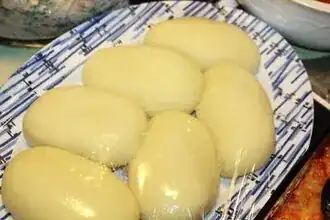
Fufu (or fufuo, foofoo, foufou ) is a pounded meal found in West African cuisine originally made from boiled cassava, plantains, and cocoyam. Fufu's prevalence in West Africa has been noted in local literature, such as Chinua Achebe's Things Fall Apart.
Fufu is a Twi word originating from the Akans in Ghana. However, the word has been expanded to include several variations of the pounded meal found in other African countries including Sierra Leone, Liberia, Ivory Coast, Burkina Faso, Benin, Togo, Nigeria, Cameroon, the Democratic Republic of Congo, the Central African Republic, the Republic of Congo, Angola and Gabon. It also includes variations in the Greater Antilles and Central America, where African culinary influence is high.
In Ghana, Ivory Coast, and Liberia, they use the method of separately mixing and pounding equal portions of boiled cassava with green plantain or cocoyam, or by mixing cassava/plantain/cocoyam flour with water and stirring it on a stove. Its thickness is then adjusted to personal preference, and it is eaten with broth-like soups. Meanwhile, in Nigeria fufu is made solely from fermented cassava, giving it its unique thickness compared to that found elsewhere. It is eaten with a variety of soups (such as Egusi soup and Ogbono soup), vegetables, beef, and fish.
In recent years other flours, such as wheat semolina, maize flour, or mashed plantains may take the place of cassava flour. This is common for those in the diaspora or families that live in urban cities. Families in rural areas with access to farmland still maintain the original recipe of using cassava. Fufu is traditionally eaten with the fingers, and a small ball of it can be dipped into an accompanying soup or sauce.
Names
Angola: funge, fúngi
Benin: santana, foufou
Burkina Faso: tô
Cameroon: couscous, couscous de manioc
Central African Republic: foufou
Congo-Kinshasa and Congo-Brazzaville: fufú, moteke, fufú, luku , bidia
Gabon: foufou
Ghana: fufu, fufuo, sakɔro
Haiti: tomtom
Ivory Coast: foutou, foufou
Liberia: fufu
Mozambique: sadja, sadza, xima
Nigeria: fufu, santana, akpụ, ụtara, loi-loi, swallow, tuk rogo
Sierra Leone: foofoo, foofoo
Togo: foufou
In Africa
Before the Portuguese traders introduced cassava to Africa from Brazil in the 16th century, fufu was mainly made from cocoyam, plantain, and yams. The traditional method of eating fufu is to pinch some of the fufu off in one's right-hand fingers and form it into an easily ingested round ball. The ball is then dipped in the soup before being eaten.
Angola
In Angola, fufu is served as part of the national dish but is called fungi/fungee and is made using cornmeal and okra.
In Cote d'Ivoire
In Côte d'Ivoire, the word foutou is also used. Ivorian foufou is specifically mashed sweet plantains, whereas foutou is a stronger, heavier paste made of various staple foods such as yam, cassava, plantains, taro or a mix of any of those.
In Cameroon
In the French-speaking regions of Cameroon, it is called "couscous" (not to be confused with the North African dish couscous).
In Ghana
It is believed to originate in what is now modern-day Ghana, by the Asante, the Akuapem, the Akyem, the Bono, and the Fante people of the Akan ethnic group of Ghana and now generally accepted across the country. According to historian Miller, "the word Fufu literally means white in Twi." and is likely derived from the whitish colour of the cassava component in Ghanaian fufu. In Ghana, it is made out of pieces of boiled cassava and/or other tubers such as plantain or cocoyam. It is mostly pounded together in a locally made wooden mortar (woduro) using a wooden pestle (woma). In between blows from the pestle, the mixture is turned by hand, and water is gradually added until it becomes a soft, sticky dough.
The mixture is then formed into a rounded slab and served. With the invention of the fufu machine, preparation has become much less labour-intensive. The resulting food is eaten with liquid soups (nkwan) such as light soup (nkrakra nkwan), abenkwan (palm nut soup), nkatenkwan (peanut butter soup), and abunubunu soup. Today, it also features in Beninese cuisine, Cameroonian cuisine, Guinean cuisine, Congolese cuisine, Nigerian cuisine, and Togolese cuisine, where it is eaten with hot pepper soup, okra, or other kinds of stew. Fufu was a major cuisine of the Ashanti Empire. In Ghana, fufu, also known as fufuo, is white and sticky, if plantain is not mixed with the cassava when pounding.
In Nigeria
In Nigeria, fufu or akpu is a popular food made from fresh or fermented cassava. The Nigerian version of fufu differs from that of Ghana's; however, it remains a staple food in both countries. In Nigeria, cassava-based fufu, referred to as akpu (Igbo), is common among various ethnic groups in Nigeria. Its preparation and consumption are deeply embedded in the cultural and culinary practices of these communities. The preparation of Yoruba fufu differs slightly from other ethnic groups. It is made from fermented cassava of which the soft pieces are sieved. The starchy remains are boiled and stirred with a wooden rod until it turns into dough. Akpu, properly punctuated as akpụ in Igbo, is the Igbo word for cassava. Requiring several days to make, akpu is often eaten with egusi soup.
Akpu is traditionally made by peeling and washing raw cassava until it is white. The cassava is soaked in water for 3–4 days to ferment and become soft. It is then filtered with a porous calabash or sieve. Excess water is quickly drained by pouring the wet paste into a sack, upon which is placed a heavy and flat item (e.g., a plank and brick). The paste is then pounded and molded into large balls and simmered for 30–60 seconds, after which it is thoroughly pounded to remove lumps, molded again into smaller balls, boiled for 15–20 minutes, and then pounded until smooth.
More to savor

English Breakfast

Austrian Napkin Dumpling (Serviettenknödel)

A Taste of Canada: Food Traditions Across a Varied Country