Use the regional background below as a starting point for exploring the food, rather than expecting one dish to represent every household. Food traditions differ within a country and continue to change through travel, migration, and everyday cooking.
Overview
South African cuisine draws from the culinary traditions of the various communities that inhabit the country. Among the indigenous peoples of South Africa, the Khoisan foraged over 300 species of edible food plants, such as the rooibos shrub legume, whose culinary value continues to influence South African cuisine. Subsequent encounters with Bantu pastoralists facilitated the emergence of cultivated crops and domestic cattle, which supplemented traditional Khoisan techniques of meat preservation. In addition, Bantu-speaking communities produced an extensive repertoire of ingredients and dishes, many of which are still consumed today in traditional settlements and urban entrepôts alike.
South African cuisine is heavily based on meat consumption. A widely observed culinary tradition is braai, a social event in which South Africans gather to cook meat over an open fire. A popular South African snack is biltong, an air dried, seasoned meat.
Beverages
Beer has been an essential beverage in South Africa for hundreds of years, among indigenous peoples long before colonisation and the arrival of Europeans, who brought their own beer-drinking traditions. Traditional beer was brewed from local grains, especially sorghum. Beer was so prized that it became central to many ceremonies, such as betrothals and weddings, in which one family ceremoniously offered beer to the other.
Unlike European beer, South African traditional beer was unfiltered and cloudy, with low alcohol content. Around the turn of the 1900s, as white-owned industry began studying malnutrition among urban workers, it was discovered that traditional beer provided crucial vitamins that were sometimes unavailable in the grain-heavy traditional diet and even less available in urban industrial slums.
As South Africa's mines developed and black South Africans began to urbanise, women also moved to the city. They started brewing beer for the predominantly male labour force—a labour force that was mostly single or had left their wives in the rural areas under the migrant labour system. That tradition of urban women making beer for the labour force persists in South Africa to the extent that informal bars and taverns (shebeens) are typically owned by women (shebeen queens).
Today, most urban dwellers purchase beer from industrial breweries that produce beer similar to that sold in Europe and America. In contrast, rural residents and recent city immigrants still enjoy the cloudy, unfiltered traditional beer.
Compared with an American or Western European diet, milk and milk products are very prominent in the traditional Black South African diet. As cows were considered highly desirable domestic animals in precolonial societies, milk was abundant. In the absence of refrigeration, various kinds of soured milk, somewhat like yogurt, were a dietary mainstay. A visitor to any African village in the 1800s would have been offered a large calabash of cool fermented milk as a greeting.
Because milk cows allowed women to wean their children early and become fertile more quickly, local cultures had numerous sayings linking cattle, milk, and population growth, such as the Sotho-Tswana saying, "cattle beget children."
Today, in the dairy section of South African supermarkets, one will find a variety of milks, sour milk, sour cream, and other modern versions of traditional milk products.
Game and meats
Afrikaans
Biltong—dried meat (typically seasoned with coriander seeds and salt). Although beef is most commonly used, springbok, kudu, eland, chicken, and ostrich may also be used.
Boerewors—a sausage that is traditionally braaied (barbecued).
Droëwors—translates to 'dried sausage' and is made like boerewors, but pork is left out. It is dried the same way as biltong.
Frikkadelle—usually baked, but sometimes deep-fried, meatballs.
Bokkoms—whole, salted and dried mullet.
Skilpadjies—lamb's liver wrapped in netvet (caul fat) and braaied over hot coals.
Smoked or braaied snoek—a regional gamefish.
Meals
Tsonga and Venda
Mashonja/matamani—made from mopani worms
Afrikaans
Gesmoorde vis—salted cod or snoek with potatoes and tomato sauce, sometimes served with apricot, grapes or moskonfyt.
Hoenderpastei—chicken pot pie, traditional Afrikaans fare.
Kaiings—made from lamb tail or lamb flank cut into small cubes, and cooked in a cast-iron pot over a slow fire. Kaiings resemble cracklings, though the skin is less puffy and crispy, and a small piece of protein is usually left on the skin and fat. They are a chewy traditional Boer delicacy, often served as a topping over pap or with honey.
Mielie-meal—a staple food, often used in baking but predominantly cooked into pap or ugali
Breads
Afrikaans
Braaibroodjie—a sandwich consisting of two slices of bread with a filling of sliced tomato, cheese, onion, South African peach chutney (traditionally Mrs. H.S. Balls) seasoned with salt and pepper. The braaibroodjie is placed in a folding braai grid (gridiron) and slowly grilled over medium-hot coals until the cheese melts and the bread is browned.
Gatsby—a sandwich popular in Cape Town, a long roll with fillings of anything ranging from polony (bologna) to chicken or steak and hot chips.
Potbrood (pot bread or boerbrood)—savoury bread baked over coals in cast-iron pots.
Vetkoek (fat cake, doughnut, Amagwinya (in various Nguni languages))—deep-fried dough balls, typically stuffed with meat or served with snoek fish or jam.
Indian
Samosa, or samoosa—a savoury stuffed Indian pastry that is fried.
Fruits and plants
Makatane—a wild fruit that grows in the Kalahari desert. It is soaked in limewater overnight (to remove the bitter taste) before processing into a jam known as makataan konfyt.
Marula—the yellow fruit of a local tree. Amarula liqueur is made from this fruit. The ripe fruit lying on the ground is processed into jams, wine, and beer. Many local communities depend on this fruit for extra income. The jam is eaten with roosterkoek and on venison steaks, such as kudu.
Morogo—spinach-like wild plant sometimes seen as a weed. Traditionally boiled and served with pap, or dried in small lumps for extended shelf life. The traditional Afrikaner/Boer preparation usually incorporates onion, potato, or both.
Drinks
Amasi—fermented milk.
Boeber—a traditional Cape Malay sweet milk drink, made with vermicelli, sago, sugar, and flavoured with cardamom, stick cinnamon, and rose water.
Mafi—fermented milk, often consumed with pap or by itself.
Mageu—a drink made from fermented mealie pap.
Rooibos—a herbal tea indigenous to South Africa.
Skokiaan—a dangerous bootleg drink consumed during the Apartheid era.
Springbokkie—a cocktail shooter composed of crème de menthe (mint liqueur) and Amarula (marula fruit cream liqueur).
More to savor
Stuffed Duck Breast with Cabbage and Dumplings
Ají de Gallina (Peruvian Chili Chicken)
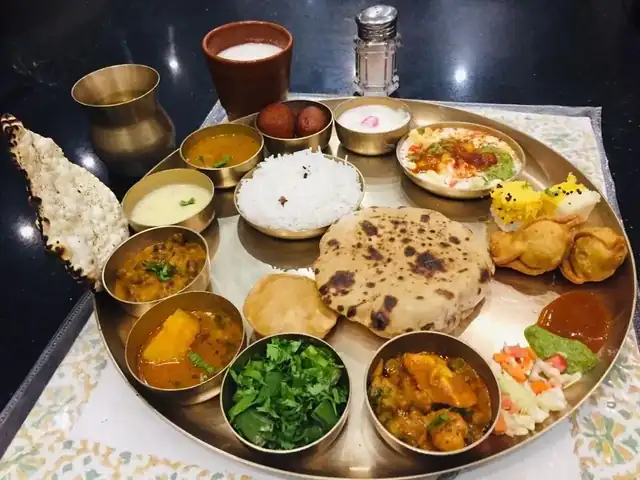
A Taste of India: Many Regions, Many Ways to Eat