This longer reference provides the background behind the topic. Read it alongside the recipe collection when you want to connect an ingredient or food idea with a dish to prepare.
In this story
OverviewFrench experimentsIn the United KingdomIn EuropeIn the United StatesWorld War IMethodsOverview
Canning is a method of food preservation in which food is processed and sealed in an airtight container (jars like Mason jars, and steel and tin cans). Canning provides a shelf life that typically ranges from one to five years, although under specific circumstances, it can be much longer. A freeze-dried canned product, such as canned dried lentils, could last as long as 30 years in an edible state.
In 1974, samples of canned food from the wreck of the Bertrand, a steamboat that sank in the Missouri River in 1865, were tested by the National Food Processors Association. Although appearance, smell, and vitamin content had deteriorated, there was no trace of microbial growth and the 109-year-old food was determined to be still safe to eat.
French experiments
Shortly before the Napoleonic Wars, the French government offered a hefty cash award of 12,000 francs to any inventor who could devise a cheap and effective method of preserving large amounts of food to create well-preserved military rations for the Grande Armée. The larger armies of the period required increased and regular supplies of quality food. Limited food availability was among the factors limiting military campaigns to the summer and autumn months. In 1809, Nicolas Appert, a French confectioner and brewer, observed that food cooked inside a jar did not spoil unless the seals leaked, and developed a method of sealing food in glass jars. Appert was awarded the prize in 1810 by Count Montelivert, a French minister of the interior.
The reason for lack of spoilage was unknown at the time, since it would be another 50 years before Louis Pasteur demonstrated the role of microbes in food spoilage and developed pasteurization.
In the United Kingdom
Based on Appert's methods of food preservation, the tin can process was allegedly developed by Frenchman Philippe de Girard, who came to London and used British merchant Peter Durand as an agent to patent his own idea in 1810. Durand did not pursue food canning himself, selling his patent in 1811 to Bryan Donkin and John Hall, who were in business as Donkin Hall and Gamble, of Bermondsey. Bryan Donkin developed the process of packaging food in sealed airtight cans, made of tinned wrought iron. Initially, the canning process was slow and labour-intensive, as each large can had to be hand-made, and took up to six hours to cook, making canned food too expensive for ordinary people.
The main market for the food at this stage was the British Army and Royal Navy. By 1817, Donkin recorded that he had sold £3000 (equal to £ today) worth of canned meat in six months. In 1824, Sir William Edward Parry took canned beef and pea soup with him on his voyage to the Arctic in HMS Fury, during his search for a northwestern passage to India. In 1829, Admiral Sir James Ross also took canned food to the Arctic, as did Sir John Franklin in 1845. Some of his stores were found by the search expedition led by Captain (later Admiral Sir) Leopold McClintock in 1857.
In Europe
During the mid-19th century, canned food became a status symbol among middle-class households in Europe, being something of a frivolous novelty. Early methods of manufacture employed poisonous lead solder for sealing the cans. Studies in the 1980s attributed the lead from the cans as a factor in the disastrous outcome of the 1845 Franklin expedition to chart and navigate the Northwest Passage. However, studies in 2013 and 2016 suggested that lead poisoning was likely not a factor, and that the crew's ill health may, in fact, have been due to malnutrition—specifically zinc deficiency—possibly due to a lack of meat in their diet.
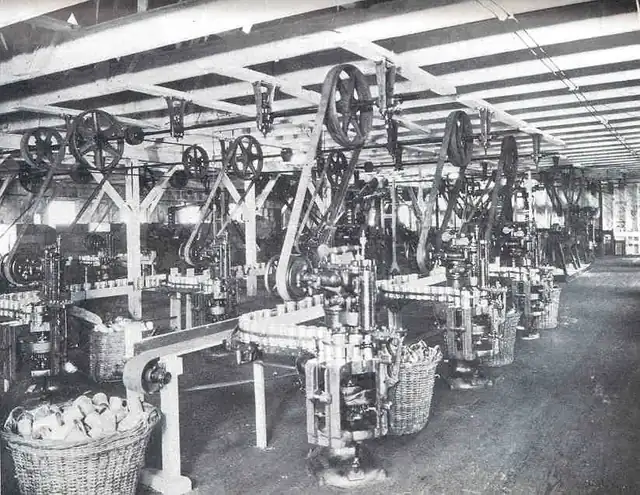
Increasing mechanization of the canning process, coupled with a huge increase in urban populations across Europe, resulted in a rising demand for canned food. A number of inventions and improvements followed, and by the 1860s smaller machine-made steel cans were possible, and the time to cook food in sealed cans had been reduced from around six hours to thirty minutes.
In the United States
Canned food also began to spread beyond Europe. Robert Ayars established the first American canning factory in New York City in 1812, food preserved in jars, later it would begin using improved tin-plated wrought-iron cans for preserving oysters, meats, fruits, and vegetables. Demand for canned food greatly increased during wars. Large-scale wars in the nineteenth century, such as the Crimean War, American Civil War, and Franco-Prussian War, introduced increasing numbers of working-class men to canned food, and allowed canning companies to expand their businesses to meet military demands for non-perishable food, enabling companies to manufacture in bulk and sell to wider civilian markets after wars ended. Urban populations in Victorian Britain demanded ever-increasing quantities of cheap, varied, quality food that they could keep at home without having to go shopping daily.
In response, companies such as Underwood, Nestlé, Heinz, and others provided quality canned food for sale to working class city-dwellers. The late 19th century saw the range of canned food available to urban populations greatly increase, as canners competed with each other using novel foodstuffs, highly decorated printed labels, and lower prices.
World War I
During World War I, Military commanders required vast quantities of cheap, high-calorie food to feed their millions of soldiers. As a result, demand for canned food skyrocketed; canned food would not spoil during long transport and could endure harsh conditions in the trenches. Throughout the war, British soldiers generally subsisted on low-quality canned food, such as pork and beans, British bully beef, canned sausages, and Maconochie's stew. However, by 1916, widespread dissatisfaction and increasing complaints about the poor quality of most canned food distributed to soldiers, resulted in armies seeking better-quality food to improve morale, and soon, complete meals-in-a-can began to appear.
In 1917, the French Army began issuing canned French cuisine such as coq au vin, beef bourguignon, French onion soup, and leek soup, while the Italian Army experimented with canned spaghetti with Bolognese sauce, ravioli, minestrone and pasta e fagioli. Following the war, companies that had supplied canned food to the military, began to improve the quality of their goods for civilian sale.
Methods
The original fragile and heavy glass containers presented challenges for transportation, and glass jars were largely replaced in commercial canneries with cylindrical tin can or wrought-iron canisters (later shortened to "cans") following the work of Peter Durand (1810). Cans are cheaper and quicker to make, and much less fragile than glass jars.
More to savor

Anzac Biscuits I

Salată de Boeuf (Romanian Beef Salad)
Sauce: A Closer Look at Food and How We Eat