This longer reference provides the background behind the topic. Read it alongside the recipe collection when you want to connect an ingredient or food idea with a dish to prepare.
In this story
OverviewBackgroundDiscoveryPropertiesFoods rich in umami componentsTaste receptorsBackground of other taste categoriesOverview
Umami ( from うま味), or savoriness, is one of the five basic tastes. It is characteristic of broths and cooked meats.
People taste umami through taste receptors that typically respond to glutamates and nucleotides, which are widely present in meat broths and fermented products. Glutamates are commonly added to some foods in the form of monosodium glutamate (MSG), and nucleotides are commonly added in the form of disodium guanylate, inosine monophosphate (IMP) or guanosine monophosphate (GMP). Since umami has its own receptors rather than arising out of a combination of the traditionally recognized taste receptors, scientists now consider umami to be a distinct taste.
Food, beverages, or condiments that have a strong umami flavor include meats, shellfish, fish (including fish sauce and preserved fish such as Maldives fish, katsuobushi, sardines, and anchovies), dashi, tomatoes, mushrooms, hydrolyzed vegetable protein, meat extract (Bouillon cubes), yeast extract (beer, Marmite, Vegemite), kimchi, cheeses (Parmesan, Asiago cheese, or blue cheese), as well as sauces such as A1 sauce, Worcestershire sauce, and soy sauce.
Background
Scientists have debated whether umami was a basic taste since Kikunae Ikeda first proposed its existence in 1908. In 1985, the term umami was recognized as the scientific term to describe the taste of glutamates and nucleotides at the first Umami International Symposium in Hawaii. Umami represents the taste of the amino acid L-glutamate and 5'-ribonucleotides such as "inosinate and guanylate". (guanosine monophosphate, GMP, and inosine monophosphate, IMP). It can be described as a pleasant "brothy" or "meaty" taste with a long-lasting, mouthwatering, and coating sensation over the tongue. Umami enhances the palatability of a wide variety of foods.
Studies in genetically engineered mice in which individual TAS1R genes have been deleted indicate that the TAS1R1/TAS1R3 complex is solely responsible for umami taste, whereas TAS1R2/TAS1R3 is solely responsible for sweet taste. As expected, a genetic knockout of TAS1R1 selectively abolishes umami taste, a knockout of TAS1R2 specifically abolishes sweet taste, while a knockout of TAS1R3 eliminates both sweet and umami taste.
Discovery
Glutamate has a long history in cooking. Fermented fish sauces (garum), which are rich in glutamate, were used widely in ancient Rome, fermented barley sauces (murri) rich in glutamate were used in medieval Byzantine and Arab cuisine, and fermented fish sauces and soy sauces have histories going back to the third century in China. Cheese varieties are rich in glutamate and umami flavor. In the late 1800s, chef Auguste Escoffier, who opened restaurants in Paris and London, created meals that combined umami with salty, sour, sweet, and bitter tastes. However, he did not know the chemical source of this unique quality.
Umami was first scientifically identified in 1908 by Kikunae Ikeda, a professor of the Tokyo Imperial University. He found that glutamate was responsible for the palatability of the broth from kombu seaweed. He noticed that the taste of kombu dashi was distinct from sweet, sour, bitter, and salty and named it umami.
Properties
Umami has a mild but lasting aftertaste associated with salivation and a sensation of furriness on the tongue, stimulating the throat, the roof and the back of the mouth. By itself, umami is not palatable, but it makes a great variety of foods pleasant, especially in the presence of a matching aroma. Like other basic tastes, umami is pleasant only within a relatively narrow concentration range.
The optimum umami taste also depends on the amount of salt, and at the same time, low-salt foods can maintain a satisfactory taste with the appropriate amount of umami. One study showed that ratings of pleasantness, taste intensity, and ideal saltiness of low-salt soups were greater when the soup contained umami, whereas low-salt soups without umami were less pleasant. Another study demonstrated that using fish sauce as a source of umami could reduce the need for salt by 10–25% to flavor such foods as chicken broth, tomato sauce, or coconut curry while maintaining overall taste intensity.
Foods rich in umami components
Many foods are rich in the amino acids and nucleotides imparting umami. Naturally occurring glutamate can be found in meats and vegetables. Inosine (IMP) comes primarily from meats and guanosine (GMP) from vegetables. Mushrooms, especially dried shiitake, are rich sources of umami flavor from guanylate. Smoked or fermented fish are high in inosinate, and shellfish in adenylate. Protein in food is tasteless, however processes such as fermentation, curing, or heat treatment release glutamate and other amino acids.
Generally, umami taste is common to foods that contain high levels of L-glutamate, IMP and GMP, most notably in fish, shellfish, cured meats, meat extracts, mushrooms, vegetables (e.g., ripe tomatoes, Chinese cabbage, spinach, celery, etc.), green tea, hydrolyzed vegetable protein, and fermented and aged products involving bacterial or yeast cultures, such as cheeses, shrimp pastes, fish sauce, soy sauce, natto, nutritional yeast, and yeast extracts such as Vegemite and Marmite.
Studies have shown that the amino acids in breast milk are often the first encounter humans have with umami. Glutamic acid makes up half of the free amino acids in breast milk.
Taste receptors
Most taste buds on the tongue and other regions of the mouth can detect umami taste, irrespective of their location. (The tongue map in which different tastes are distributed in different regions of the tongue is a common misconception.) Biochemical studies have identified the taste receptors responsible for the sense of umami as modified forms of mGluR4, mGluR1, and taste receptor type 1 (TAS1R1 + TAS1R3), all of which have been found in all regions of the tongue bearing taste buds. These receptors are also found in some regions of the duodenum.
A 2009 review corroborated the acceptance of these receptors, stating, "Recent molecular biological studies have now identified strong candidates for umami receptors, including the heterodimer TAS1R1/TAS1R3, and truncated type 1 and 4 metabotropic glutamate receptors missing most of the N-terminal extracellular domain (taste-mGluR4 and truncated-mGluR1) and brain-mGluR4." Receptors mGluR1 and mGluR4 are specific to glutamate whereas TAS1R1 and TAS1R3 are responsible for the synergism already described by Akira Kuninaka in 1957. However, as of this date, the specific role of each type of receptor in taste bud cells remained unclear. All three receptors work together to produce the taste sensation.
Background of other taste categories
The five basic tastes (saltiness, sweetness, bitterness, sourness, and savoriness) are detected by specialized taste receptors on the tongue and palate epithelium. The number of taste categories in humans remains under research, with a sixth taste possibly including spicy or pungent.
More to savor
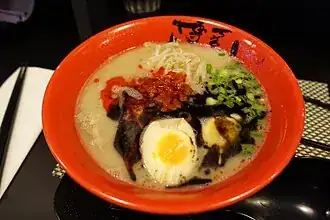
Tonkotsu Ramen

South Indian Millet Swallow (Mudde)

Canning: A Closer Look at Food and How We Eat