This longer reference provides the background behind the topic. Read it alongside the recipe collection when you want to connect an ingredient or food idea with a dish to prepare.
In this story
OverviewDescriptionDomesticationVarietiesColorsHorticultureClimateSeeding and transplantingProductionCulinaryOverview
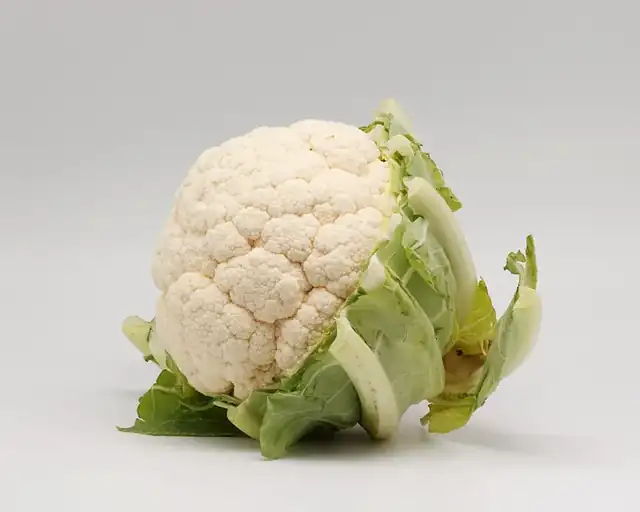
Cauliflower (Brassica oleracea var. botrytis) is a vegetable belonging to the species Brassica oleracea in the family Brassicaceae (the mustard or cabbage family). It is one of several cultivated forms of the species along with cabbage, broccoli, Brussels sprouts, kale, kohlrabi, and others. The edible portion of the plant is its dense head of undeveloped flower buds known as the "curd". The head is usually white but may also be green, orange, or purple. Several cultivars exist, including the Romanesco variety, whose spiral curds grow in fractal patterns.
Cauliflower was domesticated in the Mediterranean region during antiquity, most likely by selective breeding of wild cabbage. It is grown worldwide as a cool-season crop and is widely used in cooking, where it may be eaten raw, steamed, roasted, or incorporated into other dishes. World cauliflower production (combined with broccoli) in 2024 was 27 million tonnes, led by China and India with 73% of the total.
Description
There are four major groups of cauliflower.
Italian: This specimen is diverse in appearance, biennial, and annual in type. This group includes white, Romanesco, and various brown, green, purple, and yellow cultivars. This type is the ancestral form from which the others were derived.
Northern European annuals: These are used in Europe and North America for summer and fall harvests. They were developed in Germany in the 18th century and include the old cultivars Erfurt and Snowball.
Northwest biennial: Used in Europe for winter and early spring harvest, developed in France in the 19th century and includes the old cultivars Angers and Roscoff.
Asian: A tropical cauliflower used in China and India, it was developed in India during the 19th century from the now-abandoned Cornish type and includes old varieties Early Benaras and Early Patna.
Domestication
Cauliflowers are an "arrested inflorescence" subspecies of B. oleracea that arose around 2,500 years ago. Genomic analysis finds initially evolved from broccoli with three MADS-box genes, playing roles in its curd formation. Nine loci and candidate genes are linked with morphological and biological characters.
Varieties
There are hundreds of historic and current commercial varieties used around the world. A comprehensive list of about 80 North American varieties is maintained at North Carolina State University.
Colors
White cauliflower is the most common color of cauliflower, having a contrasting white head (also called "curd", having a similar appearance to cheese curd), surrounded by green leaves.
Orange cauliflower contains beta-carotene as the orange pigment, a provitamin A compound. This orange trait originated from a natural mutant found in a cauliflower field in Canada. Cultivars include 'Cheddar' and 'Orange Bouquet'.
Green cauliflower in the B. oleracea Botrytis Group is sometimes called broccoflower. It is available in the normal curd (head) shape and with a fractal spiral curd called Romanesco broccoli. Both have been commercially available in the U.S. and Europe since the early 1990s. Green-headed varieties include 'Alverda, 'Green Goddess', and 'Vorda'. Romanesco varieties include 'Minaret' and 'Veronica'.
The purple color is caused by the presence of anthocyanins, water-soluble pigments that are found in many other plants and plant-based products, such as red cabbage and red wine. Varieties include 'Graffiti' and 'Purple Cape'.
Horticulture
Cauliflower is relatively difficult to grow compared to cabbage, with common problems such as an underdeveloped head and poor curd quality.
Climate
Because the weather is a limiting factor for producing cauliflower, the plant grows best in moderate daytime temperatures 70–85 °F, with plentiful sun and moist soil conditions high in organic matter and sandy soils. The earliest maturity possible for cauliflower is 7 to 12 weeks from transplanting. In the northern hemisphere, fall season plantings in July may enable harvesting before autumn frost.
Long periods of sun exposure in hot summer weather may cause cauliflower heads to discolor with a red-purple hue.
Seeding and transplanting
Transplantable cauliflowers can be produced in containers such as flats, hotbeds, or fields. In soil that is loose, well-drained, and fertile, field seedlings are shallow-planted 1/2 in and thinned by ample space – about 12 plants per 1 ft. Ideal growing temperatures are about 65 °F when seedlings are 25 to 35 days old. Applications of fertilizer to developing seedlings begin when leaves appear, usually with a starter solution weekly.
Transplanting to the field normally begins in late spring and may continue until mid-summer. Row spacing is about 15-18 in. Rapid vegetative growth after transplanting may benefit from such procedures as avoiding spring frosts, using starter solutions high in phosphorus, irrigating weekly, and applying fertilizer.
Production
In 2024, world production of cauliflower (combined for production reports with broccoli) was 27 million tonnes, led by China and India which together had 73% of the total (table). Secondary producers were the United States, Mexico, and Spain.
Culinary
Cauliflower heads can be roasted, grilled, boiled, fried, steamed, pickled, or eaten raw. When cooking, the outer leaves and thick stalks are typically removed, leaving only the florets (the edible "curd" or "head"). The leaves are also edible but are often discarded.
Cauliflower can be used as a low-calorie, gluten-free alternative to rice and flour. Between 2012 and 2016, cauliflower production in the United States increased by 63%, and cauliflower-based product sales increased by 71% between 2017 and 2018. Cauliflower rice is made by pulsing cauliflower florets and cooking the result in oil. Cauliflower pizza crust is made from cauliflower flour. Mashed cauliflower is a low-carbohydrate alternative to mashed potatoes.
More to savor

Chicken Vindaloo

Koko da Kosai (Fermented Corn Porridge and Bean Fritters)
A Closer Look at Buckwheat: From Ingredient to Meal