This longer reference provides the background behind the topic. Read it alongside the recipe collection when you want to connect an ingredient or food idea with a dish to prepare.
In this story
OverviewDescriptionChemistryHarvesting and storageSulfitesAllergic reactionsCulinaryLeavesSeedsOverview
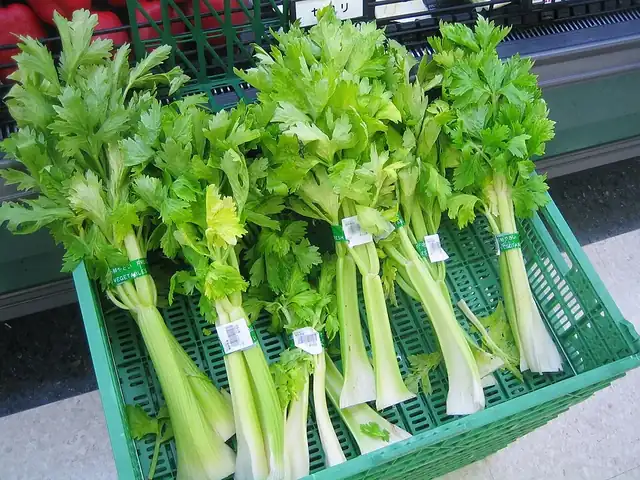
Celery (Apium graveolens Dulce Group or Apium graveolens var. dulce) is a cultivated plant belonging to the species Apium graveolens in the family Apiaceae that has been used as a vegetable since ancient times.
The original wild species has been selectively bred over centuries into three primary cultivar groups: stalk celery (Dulce Group), consumed for its fibrous edible stalks; leaf celery (Secalinum Group), grown for its aromatic leaves; and celeriac (Rapaceum Group), cultivated for its large, edible hypocotyl. Celery is characterized by its long, ribbed stalks, pinnate leaves, and small white flowers arranged in umbels.
Celery is commonly consumed raw in salads, cooked in soups and stews, or juiced. Celery seeds, which have a strong, aromatic flavor, are used as a spice or processed into celery salt. Celery is among a large group of foods that may provoke allergic reactions.
Historically, celery has held culinary and symbolic significance. Literary evidence indicates celery cultivation in Ancient Greece, while ancient Egyptians incorporated it into funeral garlands. Celery remains eaten around the world.
Description
Celery leaves are pinnate to bipinnate with rhombic leaflets 3 – 6 cm long and 2 – 4 cm broad. The flowers are creamy-white, 2 – 3 mm in diameter, and are produced in dense compound umbels. The seeds are broad ovoid to globose, 1.5 – 2 mm long and wide. Modern cultivars have been selected for either solid petioles, leaf stalks, or a large hypocotyl. A celery stalk readily separates into "strings" which are bundles of angular collenchyma cells exterior to the vascular bundles.
Chemistry
The main chemicals responsible for the aroma and taste of celery are butylphthalide and sedanolide.
Harvesting and storage
Harvesting occurs when the average size of celery in a field is marketable; due to extremely uniform crop growth, fields are harvested only once. The petioles and leaves are removed and harvested; celery is packed by size and quality (determined by colour, shape, straightness and thickness of petiole, stalk and midrib length and absence of disease, cracks, splits, insect damage and rot). During commercial harvesting, celery is packaged into cartons which contain between 36 and 48 stalks and weigh up to 27 kg. Under optimal conditions, celery can be stored for up to seven weeks from 0 - 2 C. Inner stalks may continue growing if kept at temperatures above 0 C. Shelf life can be extended by packaging celery in anti-fogging, micro-perforated shrink wrap.
Freshly cut petioles of celery are prone to decay, which can be prevented or reduced through the use of sharp blades during processing, gentle handling, and proper sanitation.
Celery stalk may be preserved through pickling by first removing the leaves, then boiling the stalks in water before finally adding vinegar, salt, and vegetable oil.
Sulfites
In the past, restaurants used to store celery in a container of water with powdered vegetable preservative, but it was found that the sulfites in the preservative caused allergic reactions in some people. In 1986, the U.S. Food and Drug Administration banned the use of sulfites on fruits and vegetables intended to be eaten raw.
Allergic reactions
Celery is among a large group of foods that may provoke allergic reactions; for people with celery allergy, exposure can cause potentially fatal anaphylactic shock. Cases of allergic reaction to ingestion of celery root have also been reported in pollen-sensitive individuals resulting in gastrointestinal disorders and other symptoms, although in most cases, celery sensitivity is not considered clinically significant. In the European Union and the United Kingdom, foods that contain or may contain celery, even in trace amounts, must be clearly marked.
The Apium graveolens plant has an OPALS allergy scale rating of 4 out of 10, indicating moderate potential to cause allergic reactions, exacerbated by over-use of the same plant throughout a garden. Celery has caused skin rashes and cross-reactions with carrots and ragweed.
Culinary
Celery is eaten around the world as a vegetable. In North America and Europe the crisp petiole (leaf stalk) is used. The leaves are strongly flavoured and are used less often, either as a flavouring in soups and stews or as a dried herb. Celery, onions, and bell peppers are the "holy trinity" of Louisiana Creole and Cajun cuisine. Celery, onions, and carrots make up the French mirepoix, often used as a base for sauces and soups. In Italian cuisine, chopped onions, carrots, and celery are slowly cooked in olive oil to make soffritto, which is used as a base for many dishes. Celery is also commonly used in many soups. It is used in the Iranian stew khoresh karafs.
Leaves
Celery leaves are frequently used in cooking to add a mild spicy flavour to foods, similar to, but milder than black pepper. Celery leaves are suitable dried and sprinkled on baked, fried or roasted fish or meats, or as part of a blend of fresh seasonings suitable for use in soups and stews. They may also be eaten raw, mixed into a salad or as a garnish.
Seeds
In temperate countries, celery is also grown for its seeds. Actually very small fruit, these "seeds" yield a valuable essential oil that is used in the perfume industry. The oil contains the chemical compound apiole. Celery seeds can be used as flavouring or spice, either as whole seeds or ground.
Celery seeds are used to flavor Dr. Browns Cel-ray soda, which was first produced in 1868 in New York and frequently appears in pop culture.
More to savor

Chicken Vindaloo
Spaghetti alla Carbonara
A Closer Look at Worcestershire sauce: From Ingredient to Meal