This longer reference provides the background behind the topic. Read it alongside the recipe collection when you want to connect an ingredient or food idea with a dish to prepare.
In this story
OverviewIngredientsLea & PerrinsBrazil and PortugalCosta RicaEl SalvadorGermanyMexicoUnited Kingdom, AustraliaUnited StatesVenezuelaOverview
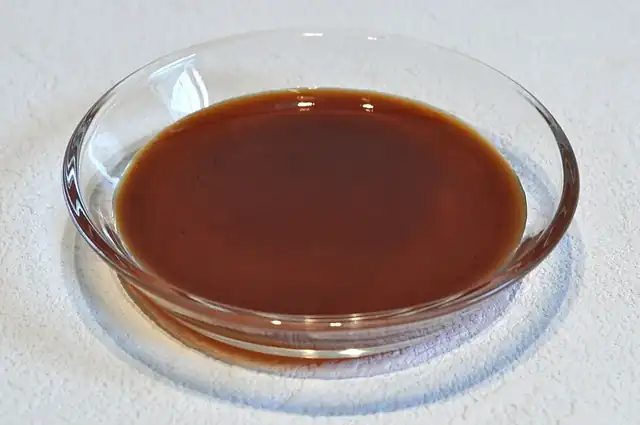
Worcestershire sauce or Worcester sauce is a fermented condiment invented by the pharmacists John Wheeley Lea and William Henry Perrins in Worcester, Worcestershire, England, during the first half of the 19th century. They later formed the company Lea & Perrins. Worcestershire sauce has been a generic term since 1876, when the High Court of Justice ruled that Lea & Perrins did not own a trademark for the name "Worcestershire".
Worcestershire sauce is used on steaks, hamburgers, and other finished dishes, and to flavour cocktails such as the Bloody Mary and Caesar. It is also used to augment recipes such as Welsh rarebit, Caesar salad, Oysters Kirkpatrick, and devilled eggs. As a background flavour and a source of savouriness, it is added to dishes such as beef stew and baked beans.
Ingredients
The ingredients vary by manufacturer but often include vinegar; salt; a sweetener such as sugar or molasses; aromatics such as garlic, shallots, or onions; soy sauce; and fish or fish sauce. Some formulations may include tamarind, umeboshi or other pickles, chili peppers, citrus, or spices, such as cloves.
Several anchovy-free vegetarian and vegan varieties are available for those who avoid, or are allergic to, fish. The Codex Alimentarius recommends that prepared food containing Worcestershire sauce with anchovies include a label warning of fish content, although this is not required in most jurisdictions. The U.S. Department of Agriculture has required the recall of some products with undeclared Worcestershire sauce. Generally, Orthodox Jews refrain from eating fish and meat in the same dish, so they do not use traditional Worcestershire sauce to season meat. However, certain brands are certified to contain less than 1/60 of the fish product and can be used with meat.
Although soy sauce is used in many variations of Worcestershire sauce since the 1880s, it is debated whether Lea & Perrins has ever used any in their preparation. According to William Shurtleff's SoyInfo Center, a 1991 letter from factory general manager J. W. Garnett describes the brand switching to hydrolyzed vegetable protein during World War II due to shortages. As of 2021, soy is not declared as an ingredient in the Lea & Perrins sauce.
Lea & Perrins
The Lea & Perrins brand was commercialised in 1837 and continues to be the leading global brand of Worcestershire sauce.
On 16 October 1897, Lea & Perrins relocated manufacturing of the sauce from their Broad Street pharmacy in Worcester to a factory on Midland Road, where it is still made. The factory produces ready-mixed bottles for domestic distribution and a concentrate for bottling abroad.
In 1930, the Lea & Perrins operation was purchased by HP Foods, which was in turn acquired by the Imperial Tobacco Company in 1967. HP was sold to Danone in 1988 and then to Heinz in 2005.
Some sizes of bottles sold by Lea & Perrins in the United States come packaged in dark glass with a beige label and wrapped in paper. Lea & Perrins USA explains this practice as a vestige of shipping practices from the 19th century, when the product was imported from England, as a measure of protection for the bottles. The producer also claims that its Worcestershire sauce is the oldest commercially bottled condiment in the U.S. The ingredients in the US version of Lea & Perrins also differ somewhat, in that the US version (which include distilled white vinegar, molasses, sugar, water, salt, onions, anchovies, garlic, cloves, tamarind extract, natural flavourings, and chili pepper extract) replaces the malt vinegar used by the UK and Canadian versions with spirit vinegar.
Brazil and Portugal
In Brazil and Portugal, it is known as molho inglês ('English sauce').
Costa Rica
In Costa Rica, a local derivative of the sauce is Salsa Lizano, created in 1920 and a staple condiment in homes and restaurants. Unlike traditional preparations, the Costa Rican version has a sweeter flavor and is made from a vegetable base.
El Salvador
Worcestershire sauce, known as salsa inglesa ('English sauce') or salsa Perrins ('Perrins sauce'), is very popular in El Salvador. Many restaurants provide a bottle on each table, and the per capita annual consumption is 2.5 oz, the highest in the world as of 1996.
Germany
A sweeter, less salty version of the sauce called Worcestersauce Dresdner Art was developed in the beginning of the 20th century in Dresden, where it is still being produced. It contains smaller amounts of anchovies. It is mostly consumed in the eastern part of the country.
Mexico
In Mexico, it is known as salsa inglesa (English sauce). It is a common ingredient in micheladas, a popular beer cocktail.
United Kingdom, Australia
Holbrook's Worcestershire sauce was produced in Birmingham, England from 1875: today only the Australian subsidiary survives. Holbrook's Worcestershire sauce remains very popular in Australia where it is a staple in many households.
United States
Lea & Perrins Worcestershire Sauce is sold in the United States by Kraft Heinz following the Kraft & Heinz merger in 2015.
Other Worcestershire sauce brands in the United States include French's, which was introduced in 1941.
Venezuela
It is commonly named salsa inglesa ('English sauce') and is part of many traditional dishes such as Hallacas (a traditional Christmas dish) and some versions of Asado Negro.
More to savor

Chicken Vindaloo
Spaghetti alla Puttanesca
A Closer Look at Tabasco sauce: From Ingredient to Meal