This longer reference provides the background behind the topic. Read it alongside the recipe collection when you want to connect an ingredient or food idea with a dish to prepare.
In this story
OverviewDescriptionArab Agricultural RevolutionSpread across EuropeTasteProductionDessert fruit and juiceOverview
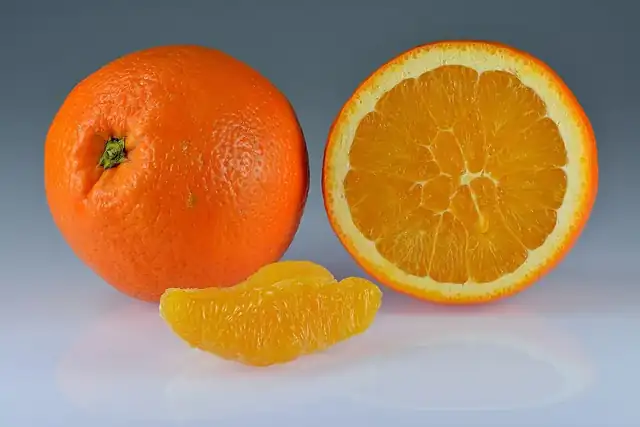
The orange, also called sweet orange to distinguish it from the bitter orange (Citrus × aurantium), is the fruit of a tree in the family Rutaceae. Botanically, this is the hybrid Citrus × sinensis, between the pomelo (Citrus maxima) and the mandarin orange (Citrus reticulata). The chloroplast genome, and therefore the maternal line, is that of pomelo. Hybrids of the sweet orange form later types of mandarin and the grapefruit. The sweet orange has had its full genome sequenced.
The orange originated in a region encompassing Southern China, Northeast India, and Myanmar; the earliest mention of the sweet orange was in Chinese literature in 314 BC. Orange trees are widely grown in tropical and subtropical areas for their sweet fruit. The fruit of the orange tree can be eaten fresh or processed for its juice or fragrant peel. In 2024, 67 million tonnes of oranges were grown worldwide, with Brazil producing 23% of the total, followed by China and Mexico.
Oranges, variously understood, have featured in human culture since ancient times. They first appear in Western art in the Arnolfini Portrait by Jan van Eyck, but they had been depicted in Chinese art centuries earlier, as in Zhao Lingrang's Song dynasty fan painting Yellow Oranges and Green Tangerines. By the 17th century, an orangery had become an item of prestige in Europe, as seen at the Versailles Orangerie. More recently, artists such as Vincent van Gogh, John Sloan, and Henri Matisse included oranges in their paintings.
Description
The orange tree is a relatively small evergreen, flowering tree, with an average height of 9 to 10 m, although some very old specimens can reach 15 m. Its oval leaves, which are alternately arranged, are 4 to 10 cm long and have crenulate margins. Sweet oranges grow in a range of different sizes, and shapes varying from spherical to oblong. Inside and attached to the rind is a porous white tissue, the white, bitter mesocarp or albedo (pith). The orange contains a number of distinct carpels (segments or pigs, botanically the fruits) inside, typically about ten, each delimited by a membrane and containing many juice-filled vesicles and usually a few pips. When unripe, the fruit is green.
The grainy irregular rind of the ripe fruit can range from bright orange to yellow-orange, but frequently retains green patches or, under warm climate conditions, remains entirely green. Like all other citrus fruits, the sweet orange is non-climacteric, not ripening off the tree. The Citrus sinensis group is subdivided into four classes with distinct characteristics: common oranges, blood or pigmented oranges, navel oranges, and acidless oranges. The fruit is a hesperidium, a modified berry; it is covered by a rind formed by a rugged thickening of the ovary wall.
Arab Agricultural Revolution
In Europe, the Moors introduced citrus fruits including the bitter orange, lemon, and lime to al-Andalus in the Iberian Peninsula during the Arab Agricultural Revolution. Large-scale cultivation started in the 10th century, as evidenced by complex irrigation techniques specifically adapted to support orange orchards. Citrus fruits—among them the bitter orange—were introduced to Sicily in the 9th century during the period of the Emirate of Sicily, but the sweet orange was unknown there until the late 15th century or the beginnings of the 16th century, when Italian and Portuguese merchants brought orange trees into the Mediterranean area.
Spread across Europe
Shortly afterward, the sweet orange quickly was adopted as an edible fruit. It was considered a luxury food grown by wealthy people in private conservatories, called orangeries. By 1646, the sweet orange was well known throughout Europe; it went on to become the most often cultivated of all fruit trees. Louis XIV of France had a great love of orange trees and built the grandest of all royal Orangeries at the Palace of Versailles. At Versailles, potted orange trees in solid silver tubs were placed throughout the rooms of the palace, while the Orangerie allowed year-round cultivation of the fruit to supply the court. When Louis condemned his finance minister, Nicolas Fouquet, in 1664, part of the treasures that he confiscated were over 1,000 orange trees from Fouquet's estate at Vaux-le-Vicomte.
Taste
The taste of oranges is determined mainly by the ratio of sugars to acids, whereas orange aroma derives from volatile organic compounds, including alcohols, aldehydes, ketones, terpenes, and esters. Bitter limonoid compounds, such as limonin, decrease gradually during development, whereas volatile aroma compounds tend to peak in mid- to late-season development. Taste quality tends to improve later in harvests when there is a higher sugar/acid ratio with less bitterness. As a citrus fruit, the orange is acidic, with pH levels ranging from 2.9 to 4.0. Taste and aroma vary according to genetic background, environmental conditions during development, ripeness at harvest, postharvest conditions, and storage duration.
Production
In 2024, world production of oranges was 67 million tonnes, led by Brazil with 23% of the total, followed by China, Mexico, and Egypt (table).
Dessert fruit and juice
Oranges, whose flavour may vary from sweet to sour, are commonly peeled and eaten fresh raw as a dessert. Orange juice is obtained by squeezing the fruit on a special tool (a juicer or squeezer) and collecting the juice in a tray or tank underneath. This can be made at home or, on a much larger scale, industrially. Orange juice is a traded commodity on the Intercontinental Exchange. Frozen orange juice concentrate is made from freshly squeezed and filtered juice.
More to savor

Chicken Vindaloo

Malpua (South Asian Sweet Pancake)
Mulberries in the Kitchen: Exploring an Everyday Ingredient