This longer reference provides the background behind the topic. Read it alongside the recipe collection when you want to connect an ingredient or food idea with a dish to prepare.
In this story
OverviewUnited StatesCanadaCultured methodDirect acid-set methodAdditives and flavoringConsumptionOverview
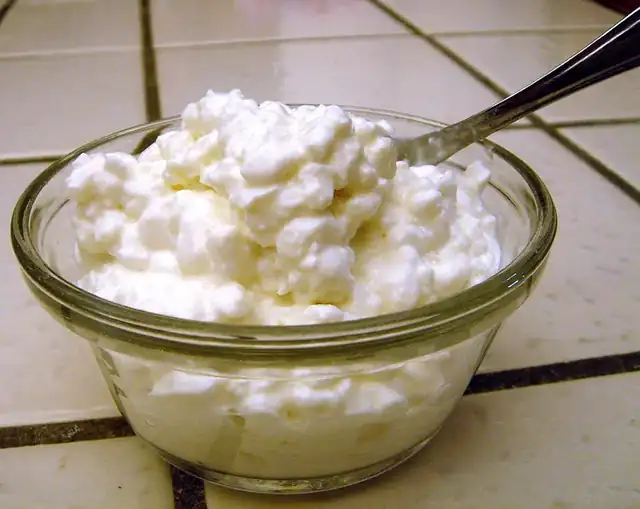
Cottage cheese is a type of fresh cheese with a mild flavor and a creamy, heterogeneous texture made from skimmed milk – hence the low milkfat content. It is made by adding an acid – like vinegar or lemon juice – to the milk which causes the milk proteins (curds) to separate from the liquid (whey). The curds are then drained and mixed with cream and salt, giving cottage cheese its slightly tangy taste and creamy texture. The addition of a "dressing" to the curd grains is primarily responsible for the taste of the finished food. Cottage cheese is not aged.
It was first called 'cottage cheese' in 1831, likely originating from Pennsylvania Dutch immigrants making cheese curds to spread on snacks in their homesteads (cottages).
Cottage cheese can be relatively low in milkfat and calories for the high amount of protein it provides, and is a rich source of vitamin B. Cottage cheese comes in different fat levels, including low–fat and fat–free – but even an original 'full fat' version has fewer calories than a chunk of hard cheese or wedge of soft cheese. Cottage cheese is a versatile nutritious food readily added to fruit, vegetables, bread and breakfast items, pastas, sauces, and desserts.
United States
Cottage cheese was widely promoted in America during the First World War, along with other dairy products, to save meat for infantry rations. This promotion was shown in many war posters, including one which claimed that one pound of cottage cheese contains more protein than a pound of lamb, pork, beef, or chicken.
After the war, cottage cheese quickly became more commonly consumed. 30,000,000 lb of cottage cheese were produced in 1919 (out of 418,000,000 lb of cheese in general in 1920), and by 1928, 87,000,000 lb were manufactured. Consumption peaked in the United States in the 1970s when dieting became common, and some $1.3 billion of cottage cheese was sold per year.
Market reviews for the cottage cheese indicate it may have a resurgence in consumer interest during the 21st century by comparison to Greek yogurt, as both foods provide a high protein and low-sugar dietary choice. In 2026, increased consumption of cottage cheese in the United States as a high-protein food source induced cheese factories in Wisconsin and other states to modify equipment to meet the elevated demand.
Canada
In 2026, cottage cheese consumption increased by 15-20% over market levels in recent years, causing a supply shortage in some regions. In 2025, 35,459 tonnes (78,174,000 lb) of cottage cheese were produced in Canada. The Canadian Dairy Commission maintains consumer guidelines and standards for quality manufacturing of cottage cheese.
Manufacturing
Industrial production of cottage cheese relies on two primary methodologies: the traditional cultured method and the direct acid-set method. The global adoption of these processes varies by region due to local clean-label food regulations, factory scales, and consumer flavour preferences. Both processes begin with pasteurised skimmed milk, concentrated non-fat milk, or reconstituted non-fat dry milk to control baseline protein ratios.
Cultured method
The cultured method relies on natural bacterial fermentation to coagulate milk proteins and develop flavour. It is the dominant methodology used across the United Kingdom and continental Europe, where commercial dairy producers (such as Arla Foods) align with consumer preferences for clean-label, minimally processed foods that avoid direct chemical additives.
Inoculation and fermentation: Skimmed milk is pumped into enclosed vats and heated to approximately 30–32 °C (86–90 °F). A mesophilic starter culture of lactic acid-producing strains (such as Lactococcus lactis ssp. lactis or L. lactis ssp. cremoris) is introduced. These bacteria ferment the milk's lactose into lactic acid, dropping the pH over 4 to 8 hours.
Direct acid-set method
The direct acid-set method bypasses bacterial fermentation. Instead, food-grade acids (such as vinegar, citric acid, or lactic acid) are added directly to cold skimmed milk to induce instant coagulation.
This method is common in high-volume manufacturing in Canada and the United States. Eliminating the fermentation window reduces overall production timelines by approximately half and prevents "vat failures" caused by bacteriophages (viruses that disrupt starter cultures). Because the process does not produce natural fermentation aromatics, a starter distillate (diacetyl) is often added to impart a buttery flavour profile similar to cultured varieties. Under US regulations, cottage cheese manufactured via this process must be labelled as "direct acid set".
Additives and flavoring
To achieve a buttery profile in cultured lines, manufacturers can add small amounts of citrate-fermenting lactococci or Leuconostoc bacterial strains to the starter mix to produce diacetyl. Producers typically maintain a diacetyl-to-acetaldehyde ratio of 3–5 to 1; deviations from this ratio alter the sensory profile, with lower ratios yielding notes described as grassy and higher ratios yielding a sharper taste.
Titanium dioxide (E171) is added to some commercial brands to act as an opaque whitening agent. While permitted up to 1% of total volume by weight in the United States by the Food and Drug Administration (FDA), its global usage has declined due to shifting regional regulations on nanoparticle technology in food ingredients. Following a 2021 assessment by the European Food Safety Authority (EFSA) highlighting unresolved genotoxicity and nanoparticle accumulation concerns, the European Union implemented a full ban on E171 in food products starting in August 2022.
In contrast, the United Kingdom represents a distinct post-Brexit regulatory divergence. The UK Food Standards Agency (FSA), alongside the Committee on Toxicity (COT) and the Committee on Mutagenicity (COM), reviewed the EFSA evidence and concluded that the dietary risk of genotoxicity from food-grade E171 was low. Consequently, titanium dioxide remains a permitted food additive in Great Britain under retained domestic food law.
Consumption
In the United States and Canada, cottage cheese is used in many culinary dishes. It can be combined with fruit and sugar, salt and pepper, fruit purée, tomatoes, or granola and cinnamon. It can be eaten on toast, in salads, as a chip dip, as a replacement for mayonnaise in tuna salad, and as an ingredient in recipes such as jello salad and various desserts. Cottage cheese is also consumed with fruit, such as pineapple, pears, peaches, or mandarin oranges.
The sour taste of the product is due to lactic acid, which is present at 124–452 mg/kg. Formic, acetic, propionic and butyric acids contribute to the flavor and aroma.
Due to its incorporation of whey, cottage cheese is high in lactose relative to most other cheeses. However, lactose is partially decomposed by lactic acid fermentation, and is mostly removed after washing the curds.
More to savor

Chicken Vindaloo

Grilled Cheese Sandwich II

Cheddar cheese in the Kitchen: Exploring an Everyday Ingredient