This longer reference provides the background behind the topic. Read it alongside the recipe collection when you want to connect an ingredient or food idea with a dish to prepare.
Overview
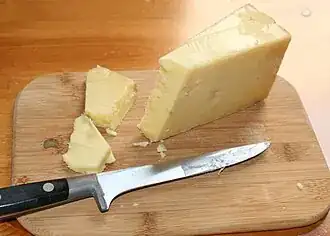
Cheese is a type of dairy product produced in a range of flavors, textures, and forms by curdling of milk, usually from cows, goats or sheep, and sometimes of water buffalo. During production, milk is usually acidified and either the enzymes of rennet or bacterial enzymes with similar activity are added to cause the protein casein to coagulate. The solid curds, consisting of proteins and milkfat, are then separated from the liquid whey and pressed into finished cheese. Some cheeses have aromatic molds on the outer layer or rind, while others have them throughout.
Over a thousand types of cheese exist, produced in various countries. Their styles, textures and flavors depend on the origin of the milk (including the animal's diet), whether they have been pasteurised, the butterfat content, the bacteria and mold, the processing, and how long they have been aged. Herbs, spices, or wood smoke may be used as flavoring agents. Other added ingredients may include black pepper, garlic, chives or cranberries. A cheesemonger, or specialist seller of cheeses, may have expertise with selecting, purchasing, receiving, storing and ripening cheeses.
Most cheeses are acidified by bacteria, which turn milk sugars into lactic acid; the addition of rennet completes the curdling. Vegetarian varieties of rennet are available; most are produced through fermentation by the fungus Mucor miehei, but others have been extracted from Cynara thistles. For a few cheeses, the milk is curdled by adding acids such as vinegar or lemon juice.
Production
In 2022, world production of cheese from whole cow milk was 22.6 million tonnes, with the United States accounting for 28% of the total, followed by Germany, France, Italy and the Netherlands as secondary producers (table).
As of 2021, the carbon footprint of a kilogram of cheese ranged from 6 to 12 kg of CO2eq, depending on the amount of milk used; accordingly, it is generally lower than beef or lamb, but higher than other foods.
Consumption
France, Iceland, Finland, Denmark and Germany were the highest consumers of cheese in 2014, averaging 25 kg per person per annum.
Types
There are many types of cheese, with around 500 different varieties recognized by the International Dairy Federation, more than 400 identified by Walter and Hargrove, more than 500 by Burkhalter, and more than 1,000 by Sandine and Elliker. The varieties may be grouped or classified into types according to criteria such as length of ageing, texture, methods of making, fat content, animal milk, country or region of origin, etc.—with these criteria either being used singly or in combination, but with no single method being universally used.
The method most commonly and traditionally used is based on moisture content, which is then further discriminated by fat content and curing or ripening methods. Some attempts have been made to rationalise the classification of cheese—a scheme was proposed by Pieter Walstra which uses the primary and secondary starter combined with moisture content, and Walter and Hargrove suggested classifying by production methods which produces 18 types, which are then further grouped by moisture content.
Cooking and eating
At refrigerator temperatures, the fat in a piece of cheese is as hard as unsoftened butter, and its protein structure is stiff as well. Flavor and odor compounds are less easily liberated when cold. For improvements in flavor and texture, it is widely advised that cheeses warm up to room temperature before eating. If the cheese is further warmed, to 26 – 32 C, the fats begin to "sweat out" as they go beyond soft to fully liquid.
Above room temperatures, most hard cheeses melt. Rennet-curdled cheeses have a gel-like protein matrix that is broken down by heat. When enough protein bonds are broken, the cheese itself turns from a solid to a viscous liquid. Soft, high-moisture cheeses melt at around 55 C, while hard, low-moisture cheeses such as Parmesan remain solid until they reach about 82 C. Acid-set cheeses, including halloumi, paneer, some whey cheeses and many varieties of fresh goat cheese, have a protein structure that remains intact at high temperatures. When cooked, these cheeses just get firmer as water evaporates.
Some cheeses, like raclette, melt smoothly; many tend to become stringy or suffer from a separation of their fats. Many of these can be coaxed into melting smoothly in the presence of acids or starch. Fondue, with wine providing the acidity, is a good example of a smoothly melted cheese dish. Elastic stringiness is a quality that is sometimes enjoyed, in dishes including pizza and Welsh rarebit. Even a melted cheese eventually turns solid again, after enough moisture is cooked off. The saying "you can't melt cheese twice" (meaning "some things can only be done once") refers to the fact that oils leach out during the first melting and are gone, leaving the non-meltable solids behind.
Cheeseboard
A cheeseboard (or cheese course) may be served at the end of a meal before or following dessert, or replacing the last course. The British tradition is to have cheese after dessert, accompanied by sweet wines like port. In France, cheese is consumed before dessert, with robust red wine. A cheeseboard typically has contrasting cheeses with accompaniments, such as crackers, biscuits, grapes, nuts, celery or chutney.
A cheeseboard typically contains four to six cheeses, for example: mature Cheddar or Comté (hard: cow's milk cheeses); Brie or Camembert (soft: cow's milk); a blue cheese such as Stilton (hard: cow's milk), Roquefort (medium: ewe's milk) or Bleu d'Auvergne (medium-soft cow's milk); and a soft/medium-soft goat's cheese (e.g. Sainte-Maure de Touraine, Pantysgawn, Crottin de Chavignol).
Odorous cheeses
Even in cultures with long cheese traditions, consumers may perceive some cheeses that are especially pungent-smelling, or mold-bearing varieties such as Limburger, Stilton or Roquefort, as unpalatable. Such cheeses are an acquired taste because they are processed using molds or microbiological cultures, allowing odor and flavor molecules to resemble those in rotten foods. McGee writes, "An aversion to the odor of decay has the obvious biological value of steering us away from possible food poisoning, so it is no wonder that an animal food that gives off whiffs of shoes and soil and the stable takes some getting used to." He notes that "the 17th century saw the publication of at least two learned treatises (by Martin Shook, a Dutchman, and Thomas Sagittarius, a German), 'de aversatione casei,' or 'on the aversion to cheese."
More to savor

Chicken Vindaloo

Spaghetti alla Carbonara

Beyond the Shopping List: The Story of Blue cheese