The dish is a starting point for exploring a wider food story. The guide below looks more closely at its background and different forms. When you want to cook, visit the recipe collection for ingredient quantities and step-by-step methods.
Overview
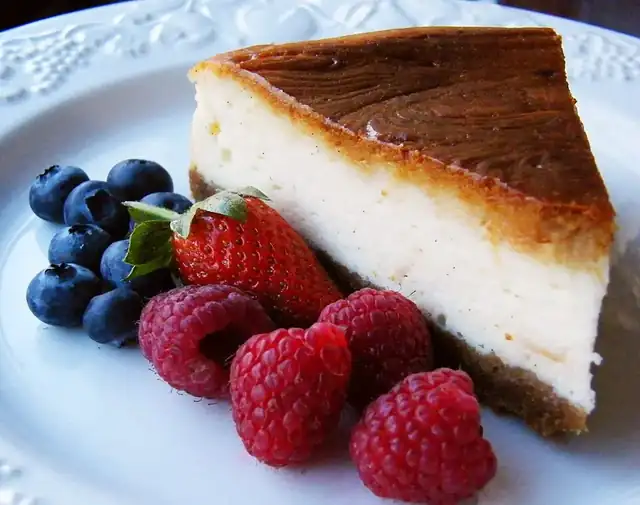
Cheesecake is a dessert made with a soft fresh cheese (typically cottage cheese, cream cheese, mascarpone, quark, or ricotta), and sugar, with either eggs or cream depending if it is to be baked or not. It may have a crust or base made from crushed cookies, digestive biscuits, graham crackers, pastry, or sometimes sponge cake. Cheesecake is known for its rich, creamy flavor and smooth texture. It may be baked or unbaked and is usually served chilled.
Cheesecake dates back to ancient Greece, and evolved into the modern form around the 18th century. There are many regional variations of cheesecake.
Vanilla, spices, lemon, chocolate, pumpkin, or other flavors may be added to the main cheese layer. Additional flavors and visual appeal may be added by topping the finished dessert with fruit, whipped cream, nuts, cookies, fruit sauce, chocolate syrup, or other ingredients.
England
Cheesecakes made with soft cheese were recorded in England as early as 1265, when the account books of the Countess of Leicester listed "cheese for tarts". However, the earliest recipe that has been found didn't appear until 1390, in the first English cookbook Forme of Cury, featuring a baked pastry shell called Tart de Bry filled with cheese, egg yolks, sugar, salt, ginger, and saffron. Another similar recipe included nessh (a soft, fresh curd cheese), whole eggs and butter, but no saffron or ginger. A more modern recipe from the cookbook is Sambocade, which involves lining a baking dish with pastry crust, mixing strained and dried cheese curds with breadcrumbs, sugar, eggs, and elderflower, then drizzling rosewater over the cheesecake after being completely baked.
On this basis, the English chef Heston Blumenthal argues that cheesecake is an English invention. Because the recipe does not specify an amount of sugar and due to the ingredient's rarity in 14th century England, the food historian Janet Clarkson gives a different perspective, writing "it seems reasonable to assume" that sambocade would be closer to the modern quiche than cheesecake.
Hannah Wolley gives a more modern cheesecake recipe in her Queenlike Closet in 1664, which includes currants and rose water:
Take four gallons of new milk, set it with a little runnet, and when it is come, break it gently, and whey it very well, then take some manchet, first scalded well in new milk, let the milk be thick with it, and while it is hot, put in a quarter of a pound of fresh butter, and stir it in, when it is cold, mix that and your curd together very well, then put in one pound and half of plumped currans, some beaten spice, a very little salt, rosewater, and the yolks of eight eggs, half a pint of cream, and a little sugar, mix them well together, then make some paste, with flower, butter, the yolk of an egg and fair water, and roul it out thin, and so bake them in bake-pans, and do not let them stand too long in the oven.
Cheese tarts were regarded as luxury foods and were popular at medieval summers feasts and fairs.
The English name cheesecake emerged in the 15th century, and the cheesecake did not evolve into its modern form until somewhere around the 18th century. In the early 17th century, foods known as cheesecakes typically had cheese curds, eggs and spices as their base. The food historian C. Anne Wilson describes these as "spiced cheese tarts". By the middle of the century, some recipes for these had lost their cheese altogether, including a mixture of eggs, clotted cream, flour and butter as a filling. Around the late 17th century the lemon cheesecake was created, and then the orange cheesecake. These were filled with fruit curd, and lacked cheese altogether. Dishes made under the name cheesecake without cheese continued into the 18th century.
Modern cheesecakes
Modern commercial American cream cheese was developed in 1872, when William Lawrence, from Chester, New York, was searching for a way to recreate the soft, French cheese Neufchâtel. He discovered a way of making an "unripened cheese" that is heavier and creamier; other dairymen came up with similar creations independently.
Modern cheesecake comes in two different types. Along with the baked cheesecake, some cheesecakes are made with uncooked cream cheese on a crumbled-cookie or graham cracker base. This type of cheesecake was invented in the United States.
Culinary classification
Modern cheesecake is not usually classified as an actual "cake", despite the name (much like Boston cream "pie"). Some people classify baked cheesecake as a torte due to the usage of many eggs, which are the sole source of leavening, as a key factor. Others find compelling evidence that it is a custard pie, based on the overall structure, with the separate crust, the soft filling, and the absence of flour. Other sources identify it as a flan, or tart.
Smoked salmon cheesecake is a savoury form, containing smoked salmon. It is most frequently served as an appetizer or a buffet item. A smoked salmon cheesecake was a prize-winning recipe in 1996 in Better Homes and Gardens' Prize Tested Recipe Contest. The recipe called for the use of Swiss cheese along with the more usual (for cheesecakes) ricotta.
National varieties
Cheesecakes can be broadly categorized into two basic types: baked and unbaked. Some do not have a crust or base. Cheesecake comes in a variety of styles based on region:
Africa
One popular variant of cheesecake in South Africa is made with whipped cream, cream cheese, gelatin for the filling, and a buttered digestive biscuit crust. It is not baked, and is sometimes made with Amarula liqueur. This variant is very similar to British cheesecake. This cheesecake is more common in British South African communities.
Asia
Japanese cheesecake (also known as soufflé-style or cotton cheesecake), is made with cream cheese, butter, sugar, and eggs, and has a characteristic wobbly and airy texture, similar to chiffon cake. No-bake cheesecakes are known as rare cheesecake (レアチーズケーキ).
The most prominent version of cheesecake in the Philippines is ube cheesecake. It is made with a base of crushed graham crackers and an upper layer of cream cheese and ube halaya (mashed purple yam with milk, sugar, and butter). It can be prepared, baked, or simply refrigerated. Like other ube desserts in the Philippines, it is characteristically purple in color.
More to savor
Lefse (Norwegian Potato Flatbread)
Crêpes I
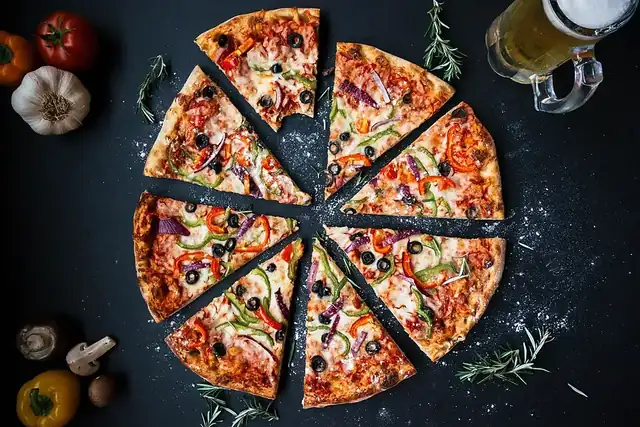
Pizza: How a Simple Base Became So Many Different Meals