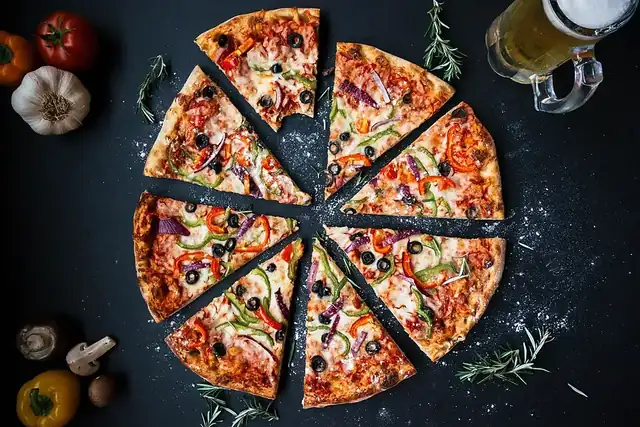
The dish is a starting point for exploring a wider food story. The guide below looks more closely at its background and different forms. When you want to cook, visit the recipe collection for ingredient quantities and step-by-step methods.
Overview
Pizza is an Italian dish typically consisting of a flat base of leavened wheat-based dough topped with tomato, cheese, and other ingredients, baked at a high temperature, traditionally in a wood-fired oven.
The term pizza was first recorded in AD 997, in a Latin manuscript from the southern Italian town of Gaeta, in Lazio, on the border with Campania. Raffaele Esposito is often credited with creating the modern version of pizza in Naples at the end of the 19th century. In 2009, Neapolitan pizza was registered with the European Union as a traditional speciality guaranteed (TSG) dish. In 2017, the art of making Neapolitan pizza was included on UNESCO's list of intangible cultural heritage.
Pizza and its variants are among the most popular foods in the world. Pizza is sold at a variety of restaurants, including pizzerias, Mediterranean restaurants, via delivery, and as street food. In Italy, pizza served in a restaurant is presented unsliced, and is eaten with the use of a knife and fork. In casual settings, however, it is typically cut into slices to be eaten while held in the hand. Pizza is also sold in grocery stores in a variety of forms, including frozen or as kits for self-assembly. Store-bought pizzas are then cooked using a home oven.
In 2017, the world pizza market was US$128 billion; in the US, it was $44 billion spread over 76,000 pizzerias. Overall, 13% of the US population aged two years and over consumed pizza on any given day.
Preparation
Pizza is sold fresh or frozen, whole or in portion-size slices. Methods have been developed to overcome challenges such as preventing the sauce from combining with the dough, and producing a crust that can be frozen and reheated without becoming rigid. There are frozen pizzas with raw ingredients and self-rising crusts.
In the US, another form of pizza is available from take and bake pizzerias. This pizza is assembled in the store, then sold unbaked to customers to bake in their own ovens. Some grocery stores sell fresh dough along with sauce and basic ingredients, to assemble at home before baking in an oven.
Baking
In restaurants, pizza can be baked in an oven with fire bricks above the heat source, an electric deck oven, a conveyor belt oven, or in traditional style in a wood or coal-fired brick oven. The pizza is slid into the oven on a long paddle, called "peel", and baked directly on hot bricks, a screen (a round metal grate, typically aluminum), or whatever the oven surface is. Before use, a peel is typically sprinkled with cornmeal to allow the pizza to easily slide on and off it. When made at home, a pizza can be baked on a pizza stone in a regular oven to reproduce some of the heating effect of a brick oven. Cooking directly on a metal surface results in too rapid heat transfer to the crust, burning it.
Some home chefs use a wood-fired pizza oven, usually installed outdoors. As in restaurants, these are often dome-shaped, as pizza ovens have been for centuries, in order to achieve even heat distribution. Another variation is grilled pizza, in which the pizza is baked directly on a barbecue grill. Some types, such as Sicilian pizza, are baked in a pan rather than directly on the bricks of the pizza oven.
Most restaurants use standard and purpose-built pizza preparation tables to assemble their pizzas. Mass production of pizza by chains can be completely automated.
Cheese
Mozzarella is commonly used on pizza, with the buffalo mozzarella produced in the surroundings of Naples. Other cheeses are also used, particularly burrata, Gorgonzola, provolone, pecorino romano, ricotta, and scamorza. Less expensive processed cheeses or cheese analogues have been developed for mass-market pizzas to produce desirable qualities such as browning, melting, stretchiness, consistent fat and moisture content, and stable shelf life. This quest to create the ideal and economical pizza cheese has involved many studies and experiments analyzing the impact of vegetable oil, manufacturing and culture processes, denatured whey proteins, and other changes in manufacture. In 1997, it was estimated that annual production of pizza cheese was 1 e6MT in the US and 100000 MT in Europe.
Varieties and styles
A great number of pizza varieties exist. These include pizzas defined by their toppings, their crust, their method of preparation, or all three. Pizza variations are often named after the region in which they first became prevalent, particularly in North America (such as New York–style pizza). Local varieties of pizza are often a staple of regional cuisines.
The following lists show some notable pizza varieties:
Dessert pizza
The terms dessert pizza and sweet pizza are used for a variety of dishes resembling a pizza, including chocolate pizza and fruit pizza. Some are based on a traditional yeast dough pizza base, while others have a cookie-like base and resemble a traditional pizza solely in having a flat round shape with a distinct base and topping. Some pizza restaurants offer dessert pizzas.
Similar dishes
Calzone and stromboli are similar dishes that are often made of pizza dough folded (calzone) or rolled (stromboli) around a filling.
Coca is a similar dish consumed mainly in Catalonia and neighboring regions, but that has extended to other areas in Spain, and to Algeria. There are sweet and savory versions.
Farinata or cecina is a Ligurian (farinata) and Tuscan (cecina) regional dish. It is often baked in a brick oven, and typically weighed and sold by the slice.
Flammekueche is a food speciality of the Alsace region.
Focaccia is a flat leavened oven-baked Italian bread, similar in style and texture to pizza; in some places, it is called pizza bianca .
Garlic fingers is an Atlantic Canadian dish, similar to a pizza in shape and size, and made with similar dough. It is garnished with melted butter, garlic, cheese, and sometimes bacon.
Semsek is an Armenian dish made with dough thats shaped into a circle with braided edges. It is topped with a mixture of seasoned mixture of minced meat and puréed roasted vegetables such as tomatoes and peppers.
Khachapuri is a Georgian dish that may resemble a cheese-filled bread, or a boat-shaped dough topped with cheese, butter and an egg.
More to savor

Fried Bananas
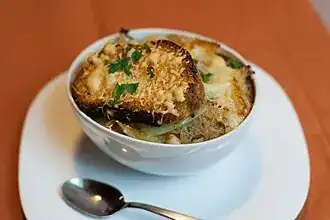
French Onion Soup
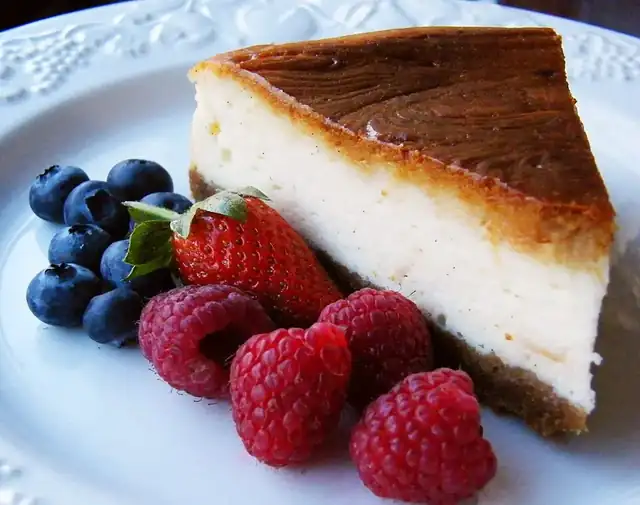
Cheesecake: The Sweet Story Behind a Creamy Slice