This longer reference provides the background behind the topic. Read it alongside the recipe collection when you want to connect an ingredient or food idea with a dish to prepare.
In this story
OverviewTrue cherriesBush cherriesBird cherries, cherry laurels, and other racemose cherriesAntiquityGrowing seasonCultivarsProductionMiddle EastEuropeNorth AmericaOverview
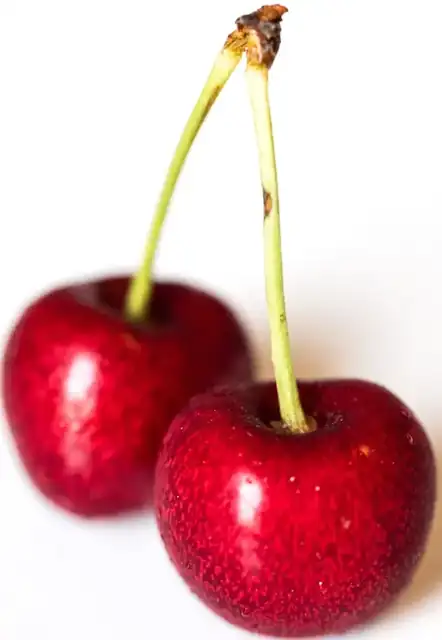
A cherry is the fruit of many plants of the genus Prunus, and is a fleshy drupe (stone fruit).
Commercial cherries are obtained from cultivars of several species, such as the sweet Prunus avium and the sour Prunus cerasus. The tree, its flowers, and its wood are all called by the same name, as in "ornamental cherry" or "cherry blossom". Wild cherry can be any of the cherry species growing outside cultivation, although Prunus avium is often specifically called "wild cherry" in the British Isles.
True cherries
Prunus subg. Cerasus contains species that are typically called cherries. They are known as true cherries and distinguished by having a single winter bud per axil, by having the flowers in small corymbs or umbels of several together (occasionally solitary, e.g. P. serrula; some species with short racemes, e.g. P. maacki), and by having smooth fruit with no obvious groove.
Bush cherries
Bush cherries are characterized by having three winter buds per axil. They used to be included in Prunus subg. Cerasus, but phylogenetic research indicates they should be a section of Prunus subg. Prunus.
Bird cherries, cherry laurels, and other racemose cherries
Prunus subg. Padus contains most racemose species that are called cherries which used to be included in the genera Padus (bird cherries), Laurocerasus (cherry laurels), Pygeum (tropical species such as African cherry) and Maddenia.
Antiquity
The indigenous range of the sweet cherry extends through most of Europe, western Asia, and parts of northern Africa, and the fruit has been consumed throughout its range since prehistoric times. A cultivated cherry is recorded as having been brought to Rome by Lucius Licinius Lucullus from northeastern Anatolia, also known as the Pontus region, in 72 BCE.
Cherries were introduced into England at Teynham, near Sittingbourne in Kent, by order of Henry VIII, who had tasted them in Flanders.
Cherries, along with many other fruiting trees and plants, probably first arrived in North America around 1606 in the New France colony of Port Royal, which is modern-day Annapolis Royal, Nova Scotia. Richard Guthrie described in 1629, the "fruitful valley adorned with...great variety of fruit trees, chestnuts, pears, apples, cherries, plums and all other fruits."
Growing season
Like most temperate-latitude trees, cherry trees require a certain number of chilling hours each year to break dormancy and bloom and produce fruit. The number of chilling hours required depends on the variety. Because of this cold-weather requirement, no members of the genus Prunus can grow in tropical climates. (See "production" section for more information on chilling requirements)
Cherries have a short growing season and can grow in most temperate latitudes. Cherries blossom in April (in the Northern Hemisphere) and the peak season for the cherry harvest is in the summer. In southern Europe in June, in North America in June, in England in mid-July, and in southern British Columbia (Canada) in June to mid-August. In many parts of North America, they are among the first tree fruits to flower and ripen in mid-Spring.
In the Southern Hemisphere, cherries are usually at their peak in late December and are widely associated with Christmas. 'Burlat' is an early variety which ripens during the beginning of December, 'Lapins' ripens near the end of December, and 'Sweetheart' finish slightly later.
Cultivars
The following cultivars have gained the Royal Horticultural Society's Award of Garden Merit:
See cherry blossom and Prunus for ornamental trees.
Production
In 2020, world production of sweet cherries was 2.61 million tonnes, with Turkey producing 28% of this total. Other major producers of sweet cherries were the United States and Chile. World production of sour cherries in 2020 was 1.48 million tonnes, led by Russia, Turkey, Ukraine and Serbia.
Middle East
Major commercial cherry orchards in West Asia are in Turkey, Iran, Syria, Lebanon, and Azerbaijan.
Europe
Major commercial cherry orchards in Europe are in Turkey, Italy, Spain and other Mediterranean regions, and to a smaller extent in the Baltic States and southern Scandinavia.
In France since the 1920s, the first cherries of the season come in April/May from the region of Céret (Pyrénées-Orientales), where the local producers send, as a tradition since 1932, the first crate of cherries to the president of the Republic.
North America
In the United States, most sweet cherries are grown in Washington, California, Oregon, Wisconsin, and Michigan. Important sweet cherry cultivars include Bing, Ulster, Rainier, Brooks, Tulare, King, and Sweetheart. Both Oregon and Michigan provide light-colored 'Royal Ann' ('Napoleon'; alternately 'Queen Anne') cherries for the maraschino cherry process. Most sour (also called tart) cherries are grown in Michigan, followed by Utah, New York, and Washington. Sour cherries include 'Nanking' and 'Evans.' Traverse City, Michigan is called the "Cherry Capital of the World", hosting a National Cherry Festival.
Most cherry varieties have a chilling requirement of 800 or more hours, meaning that in order to break dormancy, blossom, and set fruit, the winter season needs to have at least 800 hours where the temperature is below 7 C. "Low chill" varieties requiring 300 hours or less are Minnie Royal and Royal Lee, requiring cross-pollinization, whereas the cultivar, Royal Crimson, is self-fertile. These varieties extend the range of cultivation of cherries to the mild winter areas of southern US. This is a boon to California producers of sweet cherries, as California is the second largest producer of sweet cherries in the US.
Native and non-native sweet cherries grow well in Canada's provinces of Ontario and British Columbia where an annual cherry festival has been celebrated for seven consecutive decades in the Okanagan Valley town of Osoyoos. In addition to the Okanagan, other British Columbia cherry growing regions are the Similkameen Valley and Kootenay Valley, all three regions together producing 5.5 million kg annually or 60% of total Canadian output.
More to savor

Chicken Vindaloo

Chicken Tikka Masala

Cheddar cheese in the Kitchen: Exploring an Everyday Ingredient