This longer reference provides the background behind the topic. Read it alongside the recipe collection when you want to connect an ingredient or food idea with a dish to prepare.
Overview
The fig is the edible fruit of Ficus carica (the common fig), a species of tree or shrub in the flowering plant family Moraceae, native to the Mediterranean region, and to western and southern Asia. It has been cultivated since ancient times and is now widely grown throughout the world. Ficus carica is the type species of the genus Ficus, which comprises over 800 tropical and subtropical plant species.
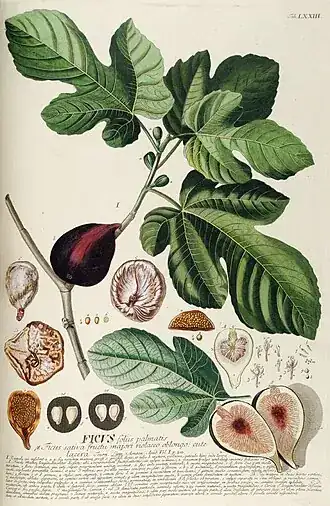
The fig plant is a deciduous tree or large shrub, growing up to 7-10 m tall, with smooth white bark. Its large leaves have three to five deep lobes. Its fruit (a syconium) is teardrop-shaped, 3-5 cm long, initially green but may ripen toward purple or brown, and has sweet soft reddish flesh containing numerous small seeds. In the Northern Hemisphere, fresh figs are in season from early August to early October. They tolerate moderate seasonal drought and can be grown even in hot-summer continental climates.
In 2020, world production of raw figs was 1.26 million tonnes, led by Turkey (with 25% of the world total), Egypt, Morocco, and Algeria, collectively accounting for 62% of the total. Although the milky sap of the green parts of the plant is an irritant to human skin, figs can be eaten fresh or dried. They are also processed into jam, rolls, biscuits, and other types of desserts. Since ripe fresh figs are easily damaged in transport and do not keep well, most commercial production is in dried and processed forms. Raw figs contain roughly 80% water and 20% carbohydrates, with negligible protein, fat, and micronutrient content. They are a moderate source of dietary fiber.
Description
Ficus carica is a gynodioecious, deciduous tree or large shrub that grows up to 7–10 m tall, with smooth white bark. Its fragrant leaves are some 20 cm long and 14 cm wide, rough, and deeply lobed (three or five lobes).
The fig fruit develops as a hollow, fleshy structure called the syconium that is lined with numerous unisexual flowers. The tiny flowers bloom out of sight inside this structure. Although commonly called a fruit, the syconium is botanically an infructescence, containing multiple fruits. The small fig flowers and later small single-seeded (true) fruits line its interior surface. A small opening or ostiole, at the apex of the fruit, is a narrow passage that allows the specialized fig wasp, Blastophaga psenes, to enter and pollinate the flowers. Each fertilized ovule (one per flower, in its ovary) develops into a small, single-seeded fruit, (a drupelet). At maturity, these 'seeds' (single-seeded fruits) line the inside of the fig, a false fruit. The mature fig is 3–5 cm long, with a green skin that sometimes ripens toward purple or brown.
The tree has milky sap, produced by laticifer cells.
Chemistry
Figs contain diverse phytochemicals under basic research for their potential biological properties, including polyphenols, such as gallic acid, chlorogenic acid, syringic acid, (+)-catechin, (−)-epicatechin and rutin. Fig color may vary between cultivars due to various concentrations of anthocyanins, with cyanidin-3-O-rutinoside having particularly high content.
Distribution and habitat
The fig has been cultivated since ancient times and grows wild in dry and sunny locations with deep and fresh soil, and in rocky locations that are at sea level to 1,700 m in elevation. It prefers relatively porous and freely draining soil, and can grow in nutritionally poor soil. Unlike other fig species, F. carica does not always require pollination by a wasp or from another tree, but can be pollinated by the fig wasp, Blastophaga psenes, to produce seeds. Fig wasps are not present to pollinate in colder regions such as the British Isles.
The species is naturalized in scattered locations in Asia and North America. The mountain or rock fig (انجیر کوهی) is a wild variety, tolerant of cold dry climates, of the semi-arid rocky montane regions of Iran, especially in the Kūhestān mountains of Khorasan.
Overwintering
People of the Italian diaspora who live in cold-winter climates have the practice of burying imported fig trees to overwinter them and protect the fruiting hard wood from cold. Italian immigrants to America in the 19th century introduced this common practice in cities such as New York, Philadelphia, Boston, and Toronto, where winters are normally too cold to leave the tree exposed. This practice consists in digging a trench that is appropriate to the size of the specimen, some of which are more than 3 m tall, severing part of the root system, and bending the specimen into the trench. Specimens are often wrapped in waterproof material to discourage the development of mold and fungus, then covered with a heavy layer of soil and leaves.
Sometimes plywood or corrugated metal is placed on top to secure the tree. In borderline climates like New York City, burying trees is no longer needed because low winter temperatures have increased. Often, specimens are simply wrapped in plastic and other insulating material, or not protected if planted in a sheltered site against a wall that absorbs sunlight.
Production
In 2024, world production of raw figs was 1.34 million tonnes, led by Turkey (with 28% of the world total), Egypt, Algeria and Morocco as the largest producers, collectively accounting for 61% of the total.
Culinary
Figs can be eaten fresh or dried, and used in jam-making. Most commercial production is in dried or otherwise processed forms, since the ripe fruit does not transport or keep well. In the Northern Hemisphere, fresh figs are in season from August through to early October. Fresh figs used in cooking should be plump and soft, and without bruising or splits. If they smell sour, the figs have become over-ripe. Slightly under-ripe figs can be kept at room temperature for 1–2 days to ripen before serving. Figs are most flavorful at room temperature.
Freshly harvested figs can undergo two distinct drying methods for preservation. The first method is natural sun-drying, where figs are exposed to the warmth and light of the sun. The second method involves oven-drying, where figs are placed in a controlled temperature environment within an oven. Each process has its unique impact on the texture and flavor profile of the dried figs.
More to savor

Chicken Vindaloo
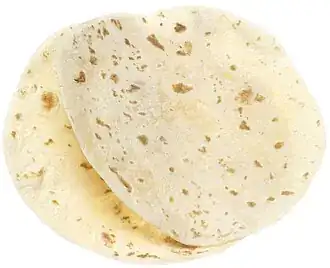
Homemade Wheat Tortillas
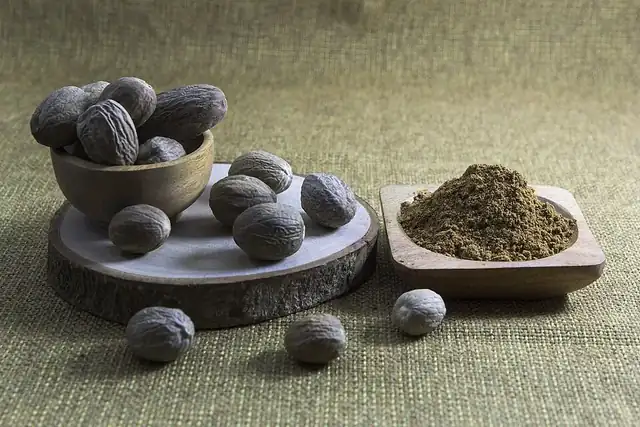
Nutmeg at the Table: The Food Behind the Name