Use the regional background below as a starting point for exploring the food, rather than expecting one dish to represent every household. Food traditions differ within a country and continue to change through travel, migration, and everyday cooking.
Overview
Chinese cuisine comprises cuisines originating from China, that varies with the country's large population and geographic diversity, as well as from Chinese people from other parts of the world. Due to the Chinese diaspora and the historical power of the country, Chinese cuisine has profoundly influenced other cuisines in Asia and beyond, with modifications made to cater to local palates. Chinese food staples like rice, soy sauce, noodles, tea, chili oil, and tofu, and utensils such as chopsticks and the wok, can now be found worldwide.
The world's earliest eating establishments recognizable as restaurants in the modern sense first emerged in the Song dynasty China during the 11th and 12th centuries. Street food became an integral aspect of Chinese food culture in the 7th century during the Tang dynasty, and the street food culture of much of Southeast Asia was established by workers imported from China during the late 19th century.
The preferences for seasoning and cooking techniques in Chinese provinces depend on differences in social class, religion, historical background, and ethnic groups. Geographic features including mountains, rivers, forests, and deserts also have a strong effect on the locally available ingredients, considering that the climate of China varies from tropical in the south to subarctic in the northeast. Imperial royal and noble preferences also play a role in the change of Chinese cuisine. Because of imperial expansion, immigration, and trading, ingredients and cooking techniques from other cultures have been integrated into Chinese cuisines over time and Chinese culinary influences have spread worldwide.
There are numerous regional, religious, and ethnic styles of Chinese cuisine found within China and abroad. Chinese cuisine is highly diverse and most frequently categorised into provincial divisions, although these province-level classifications consist of many more styles within themselves. During the Qing dynasty, the most praised Four Great Traditions in Chinese cuisine were Chuan, Lu, Yue, and Huaiyang, representing cuisines of West, North, South, and East China, respectively.
For example, in Northern China, the dry, temperate climate makes it suitable for the cultivation of wheat, millet and other grains. As such, noodles, porridge and bread are dietary staples.
Regional cuisines
Chinese cuisine exhibits an immense amount of regional diversity. A number of different styles contribute to Chinese cuisine but perhaps the best known and most influential are Cantonese cuisine, Shandong cuisine, Jiangsu cuisine (specifically Huaiyang cuisine) and Sichuan cuisine. These styles are distinctive from one another due to factors such as availability of resources, climate, geography, history, cooking techniques and lifestyle.
One style may favour the use of garlic and shallots over chili and spices, while another may favour preparing seafood over other meats and fowl. Jiangsu cuisine favours cooking techniques such as braising and stewing, while Sichuan cuisine employs baking. Zhejiang cuisine focuses more on serving fresh food, Fujian cuisine is famous for its seafood and soups and the use of spices, Hunan cuisine is famous for its hot and salty taste, Anhui cuisine incorporates wild ingredients for an unusual taste.
Based on the raw materials and ingredients used, the method of preparation and cultural differences, a variety of foods with different flavors and textures are prepared in different regions of the country. Many traditional regional cuisines rely on basic methods of preservation such as drying, salting, pickling and fermentation.
In addition, the "rice theory" attempts to describe cultural differences between north and south China; in the north, noodles are more consumed due to wheat being widely grown whereas in the south, rice is more preferred as it has historically been more cultivated there.
Staple foods
Chinese ancestors successfully planted millet, rice, and other grains about 8,000 to 9,000 years ago. Wheat, another staple, took another three or four thousand years. For the first time, grains provided people with a steady supply of food. Because of the lack of various foods, Chinese people had to adapt to new eating habits. Meat was scarce, and so people cooked with small amounts of meat and rice or noodles.
Rice
Rice was domesticated in the Yangtze River basin in southern China approximately 9,000 years ago and is a primary staple food for people from rice farming areas in southern China. Steamed rice (米饭 mǐfàn), usually white rice, is the most commonly eaten form. People in South China also like to use rice to make congee as breakfast. Rice is also used to produce beer and vinegar. Glutinous rice ("sticky rice") is a variety of rice used in special dishes such as lotus leaf rice and glutinous rice balls.
Noodles
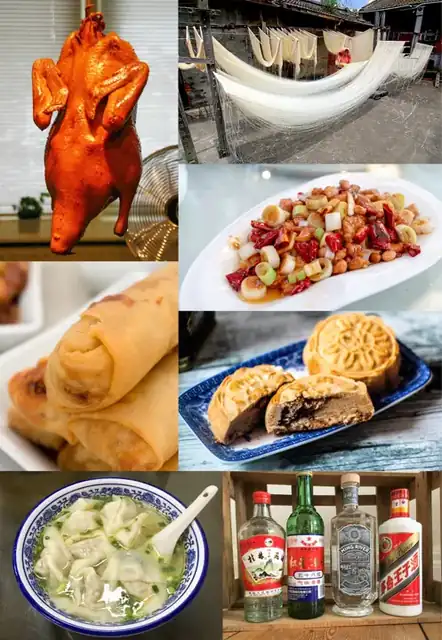
Noodles (面/麵 miàn) were invented in China over 4,000 years ago and have since spread across the world. Chinese noodles come dry or fresh in a variety of sizes, shapes and textures and are often served in soups or fried as toppings. Some varieties, such as Shou Mian (寿面, literally noodles of longevity), is an avatar of long life and good health according to Chinese traditions. Noodles can be served hot or cold with different toppings, with broth, and occasionally dry (as is the case with mi-fen). Noodles are commonly made with rice flour or wheat flour, but other flours such as soybean are also used in minor groups. Some noodles names describe their methods of creation, such as the hand-pulled noodle.
Vegetables
Apart from vegetables that can be commonly seen, some unique vegetables used in Chinese cuisine include baby corn, bok choy, snow peas, Chinese eggplant, Chinese broccoli, and straw mushrooms. Other vegetables, including bean sprouts, pea vine tips, watercress, lotus roots, chestnuts, water chestnuts, and bamboo shoots, are also used in different cuisines of China.
Because of different climate and soil conditions, cultivars of green beans, peas, and mushrooms can be found in rich variety.
A variety of dried or pickled vegetables are also processed, especially in drier or colder regions where fresh vegetables were hard to get out of season.
Cold dishes
Cold dishes are usually served before the main meal. Besides salad and pickles as appetizers, they can range from jelly, beancurd, noodle salad, cooked meat, and sausages to jellyfish or cold soups.
Chinese sausages vary from region to region. The most common sausage is made of pork and pork fat. The flavor is generally salty-sweet in Southern China. In other parts of China, sausages are salted to be preserved. Chinese sausage is prepared in many different ways, including oven-roasting, stir-frying, and steaming.
More to savor
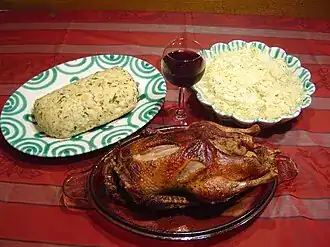
Stuffed Duck Breast with Cabbage and Dumplings
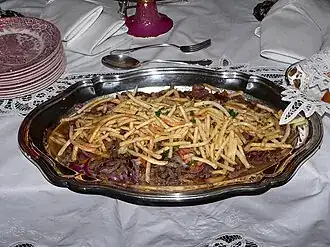
Lomo Saltado (Peruvian Steak Stir-fry)
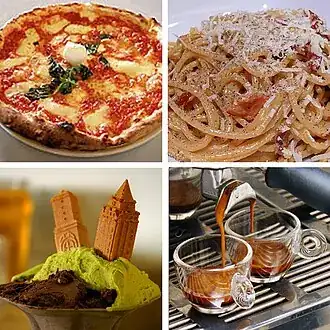
Beyond Pasta: A Taste of Italy's Regional Tables