Use the regional background below as a starting point for exploring the food, rather than expecting one dish to represent every household. Food traditions differ within a country and continue to change through travel, migration, and everyday cooking.
Overview
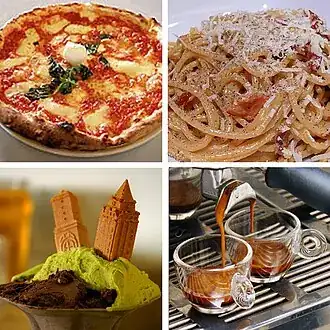
Italian cuisine is a Mediterranean cuisine consisting of the ingredients, recipes, and cooking techniques developed in Italy since Roman times, and later spread around the world together with waves of Italian diaspora. Significant changes occurred with the colonization of the Americas and the consequent introduction of potatoes, tomatoes, capsicums, and maize, as well as sugar beet—the latter introduced in quantity in the 18th century. Italian cuisine is one of the best-known and most widely appreciated worldwide. In 2025, Italian cuisine was listed as intangible cultural heritage by UNESCO.
The cuisine includes deeply rooted countrywide traditions as well as diverse regional dishes. Many dishes that were once regional have proliferated with variations throughout the country. Italian cuisine is one of the most popular and copied around the world. Italian cuisine has left a significant influence on several other cuisines around the world, particularly in East Africa, such as Italian Eritrean cuisine, and in the United States in the form of Italian-American cuisine.
Pasta
Italian cuisine is also well known (and well regarded) for its use of a diverse variety of pasta. Pasta includes noodles in various lengths, widths, and shapes. Most pastas may be distinguished by the shapes for which they are named—penne, maccheroni, spaghetti, linguine, fusilli, lasagna. More varieties are filled with other ingredients, such as ravioli and tortellini.
The word pasta is also used to refer to dishes in which pasta products are a primary ingredient. It is usually served with sauce. There are hundreds of different shapes of pasta with at least locally recognised names. Examples include spaghetti ('thin rods'), rigatoni ('tubes' or 'cylinders'), fusilli ('swirls'), and lasagna. Dumplings, such as gnocchi (made with potatoes or pumpkin) and noodles such as spätzle, are sometimes considered pasta.
Pasta is divided into two broad categories: dry pasta (100% durum wheat flour mixed with water) and fresh pasta (also with soft wheat flour and almost always mixed with eggs). Pasta is generally cooked by boiling. Under Italian law, dry pasta (pasta secca) can only be made from durum wheat flour or durum wheat semolina, and is more commonly used in southern Italy compared to their northern counterparts, who traditionally prefer the fresh egg variety.
Regional cuisines
Each area has its own specialties, primarily at a regional level, but also at the provincial level. The differences can come from a bordering country, whether a region is close to the sea or the mountains, and economics. Italian cuisine is also seasonal with priority placed on the use of fresh produce.
Emilia-Romagna
Emilia-Romagna is especially known for its egg and filled pasta made with soft wheat flour. The Romagna subregion is renowned for pasta dishes such as cappelletti, garganelli, strozzapreti, sfoglia lorda, and tortelli alla lastra as well as cheeses such as squacquerone. piadina is also a specialty of the subregion.
Bologna and Modena are notable for pasta dishes such as tortellini, tortelloni, lasagna, gramigna, and tagliatelle, which are found also in many other parts of the region in different declinations, while Ferrara is known for cappellacci di zucca, pumpkin-filled dumplings, and Piacenza for pisarei e faśö, wheat gnocchi with beans and lard. The celebrated balsamic vinegar is made only in the Emilian cities of Modena and Reggio Emilia, following legally binding traditional procedures.
Meal structure
Italian meal structure is typical of the European Mediterranean region and differs from North, Central, and Eastern European meal structure, although it still often consists of breakfast (Italian: colazione), lunch (Italian: pranzo), and supper (Italian: cena). However, much less emphasis is placed on breakfast, and breakfast itself is often skipped or involves lighter meal portions than are seen in non-Mediterranean Western countries. Late-morning and mid-afternoon snacks, called merenda, are also often included in this meal structure.
Traditional meals in Italy typically contained four or five courses. Especially on weekends, meals are often seen as a time to spend with family and friends rather than simply for sustenance; thus, meals tend to be longer than in other cultures. According to a dataset of OECD countries, Italians ranked third highest among countries surveyed on time spent eating and drinking, averaging 114 minutes per day. During holidays such as Christmas and New Year's Eve, feasts can last for hours.
Coffee
Italian style coffee (Italian: caffè), also known as espresso, is made from a blend of coffee beans. Espresso beans are roasted medium to medium dark in the north, and darker as one moves south.
A common misconception is that espresso has more caffeine than other coffee; in fact, the opposite is true. The longer roasting period extracts more caffeine. The modern espresso machine, invented in 1937 by Achille Gaggia, uses a pump and pressure system with water heated to 90 to 95 C and forced at high pressure through a few grams of finely ground coffee in 25–30 seconds, resulting in about 25 millilitres (0.85 fl oz, two tablespoons) of liquid.
Desserts
From the Italian perspective, biscuits and candy belong to the same category of sweets. Traditional candies include candied fruits, torrone, and nut brittles, all of which are still popular in the modern era. In medieval times, northern Italy became so famous for the quality of its stiff fruit pastes (similar to marmalade or conserves, except stiff enough to mold into shapes) that "Paste of Genoa" became a generic name for high-quality fruit conserves. Italy is famous for artisanal gelato (the Italian ice cream) and has become widespread with the ice cream cone, covering 55% of the Italian market.
Silver-coated almond dragées, which are called confetti in Italian, are thrown at weddings (white coating) and baptisms (blue or pink coating, according to the sex of the newborn baby), or graduations (red coating), often wrapped in a small tulle bag as a gift to the guests. The idea of including a romantic note with candy may have begun with Italian dragées, no later than the early 19th century, and is carried on with the multilingual love notes included in boxes of Italy's most famous chocolate, Baci by Perugina in Milan. The most significant chocolate style is a combination of hazelnuts and milk chocolate, which is featured in gianduja pastes such as Nutella, which is made by Ferrero SpA in Alba, Piedmont, as well as Perugnia's Baci and many other chocolate confections.
More to savor
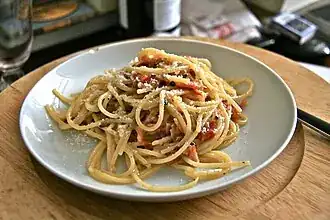
Spaghetti alla Carbonara
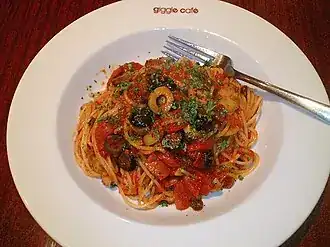
Spaghetti alla Puttanesca
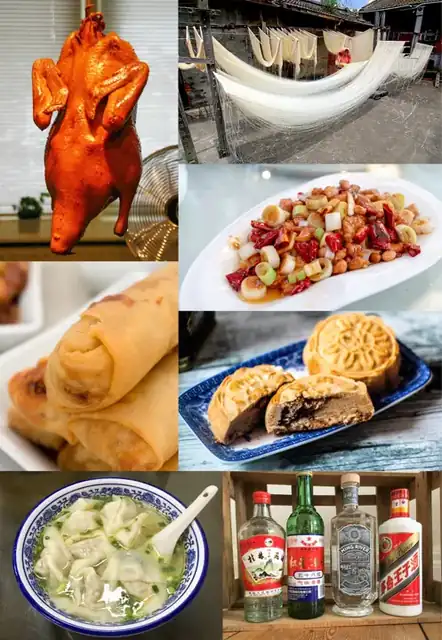
Beyond One Menu: Exploring China's Many Food Traditions