This longer reference provides the background behind the topic. Read it alongside the recipe collection when you want to connect an ingredient or food idea with a dish to prepare.
In this story
OverviewEtymologyDescriptionUsesNon-culinary usesAdverse effects and potential usesHistoryOverview
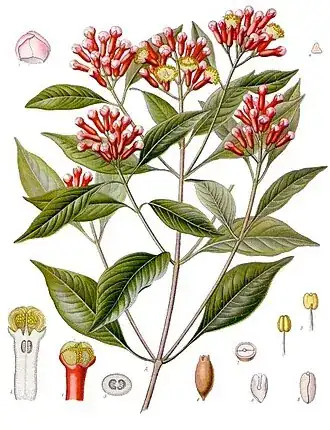
Cloves are the aromatic flower buds of a tree in the family Myrtaceae, Syzygium aromaticum . They are native to the Maluku Islands, or Moluccas, in Indonesia, and are commonly used as a spice, flavoring, or fragrance in consumer products, such as toothpaste, soaps, or cosmetics. Freshly harvested cloves are available throughout the year owing to different harvest seasons across various countries.
Etymology
The word clove, first used in English in the 15th century, derives via Middle English clow of gilofer, Anglo-French clowes de gilofre and Old French clou de girofle, from the Latin word clavus "nail". The related English word gillyflower, originally meaning "clove", derives via said Old French girofle and Latin caryophyllon, from the Greek karyophyllon "clove", literally "nut leaf".
Description
The clove tree is an evergreen that grows up to 8 – 12 m tall, with large leaves and crimson flowers grouped in terminal clusters. The flower buds initially have a pale hue, gradually turn green, then transition to a bright red when ready for harvest. Cloves are harvested at 1.5 – 2 cm long, and consist of a long calyx that terminates in four spreading sepals, and four unopened petals that form a small central ball.
Clove stalks are slender stems of the inflorescence axis that show opposite decussate branching. Externally, they are brownish, rough, and irregularly wrinkled longitudinally with short fracture and dry, woody texture. Mother cloves (anthophylli) are the ripe fruits of cloves that are ovoid, brown berries, unilocular and one-seeded.
Blown cloves are expanded flowers from which both corollae and stamens have been detached. Exhausted cloves, also known as used cloves, have most or all the oil removed by distillation.
Uses
Cloves are used in the cuisine of Asian, African, Mediterranean, and the Near and Middle East countries, lending flavor to meats (such as baked ham), curries, and marinades, as well as fruit (such as apples, pears, and rhubarb). Cloves may be used to give aromatic and flavor qualities to hot beverages, often combined with other ingredients such as lemon and sugar. They are a common element in spice blends (as part of the Malay rempah empat beradik –"four sibling spices"– besides cinnamon, cardamom and star anise for example), including pumpkin pie spice and speculaas spices.
In Mexican cuisine, cloves are best known as clavos de olor, and often accompany cumin and cinnamon. They are also used in Peruvian cuisine, in a wide variety of dishes such as carapulcra and arroz con leche.
A major component of clove's taste is imparted by the chemical eugenol, and the quantity of the spice required is typically small. It pairs well with cinnamon, allspice, vanilla, red wine, basil, onion, citrus peel, star anise, and peppercorns.
Non-culinary uses
It is often added to betel quids to enhance aroma while chewing. The spice is used in a type of cigarette called kretek in Indonesia. Clove cigarettes were smoked throughout Europe, Asia, and the United States. Clove cigarettes are currently classified in the United States as cigars, the result of a ban on flavored cigarettes in September 2009.
Clove essential oil may be used to inhibit mold growth on various types of foods. In addition to these non-culinary uses of clove, it can be used to protect wood in a system for cultural heritage conservation, and showed the efficacy of clove essential oil to be higher than a boron-based wood preservative. Cloves can be used to make a fragrant pomander when combined with an orange. When given as a gift in Victorian England, such a pomander indicated warmth of feeling.
Adverse effects and potential uses
The use of clove for any medicinal purpose has not been approved by the US Food and Drug Administration, and its use may cause adverse effects if taken orally by people with liver disease, blood clotting and immune system disorders, or food allergies.
Cloves are used in traditional medicine as an essential oil, which is intended to be an anodyne (analgesic) mainly for dental emergencies. There is evidence that clove oil containing eugenol is effective for toothache pain and other types of pain. Clove essential oil may prevent the growth of Enterococcus faecalis bacteria which may be present in an unsuccessful root canal treatment.
One review reported the efficacy of eugenol combined with zinc oxide as an analgesic for alveolar osteitis. Studies to determine its effectiveness for fever reduction, as a mosquito repellent, and to prevent premature ejaculation have been inconclusive. It remains unproven whether blood sugar levels are reduced by cloves or clove oil. The essential oil may be used in aromatherapy.
History
Until the colonial era, cloves only grew on a few islands in the Moluccas (historically called the Spice Islands), including Bacan, Makian, Moti, Ternate, and Tidore.
Cloves were first traded by the Austronesian peoples in the Austronesian maritime trade network (which began around 1500 BC, later becoming the Maritime Silk Road and part of the Spice Trade). The first notable example of modern clove farming developed on the east coast of Madagascar, and is cultivated in three separate ways, a monoculture, agricultural parklands, and agroforestry systems.
Archaeologist Giorgio Buccellati found cloves in Terqa, Syria, in a burned-down house which was dated to 1720 BC during the kingdom of Ḫana. This was the first evidence of cloves being used in the west before Roman times. The discovery was first reported in 1978. They reached Rome by the first century AD.
Other archeological finds of cloves include: At the Batujaya site a single clove was found in a waterlogged layer dating to between the 100s BC to 200s BC corresponding to the Buni culture phase of this site. A study at the site of Óc Eo in the Mekong Delta of Vietnam found starch grains of cloves on stone implements used in food processing. This site was occupied from the first to eighth century BC, and was a trading center for the kingdom of Funnan. Two cloves were found during archaeological excavations at the Sri Lankan city of Mantai dated to around 900–1100 AD.
More to savor

Chicken Vindaloo

Penne with Hearty Meat Sauce
Nutmeg at the Table: The Food Behind the Name