This longer reference provides the background behind the topic. Read it alongside the recipe collection when you want to connect an ingredient or food idea with a dish to prepare.
Overview
Nutmeg is the seed, or the ground spice derived from the seed, of several tree species of the genus Myristica; fragrant nutmeg or true nutmeg (M. fragrans) is a dark-leaved evergreen tree cultivated for two spices derived from its fruit: nutmeg, from its seed, and mace, from the seed covering. It is also a commercial source of nutmeg essential oil and nutmeg butter. The Banda Islands, in Maluku, Indonesia, are the main producer of nutmeg and mace, and the true nutmeg tree is native to the islands.
Nutmeg and mace, commonly used as food spices, have been used in folk medicine for their psychoactive properties, while their supposed aphrodisiac effects are not supported by clinical evidence. High doses can cause serious toxic effects including acute psychosis, with risks heightened during pregnancy and with psychiatric conditions.
Conifers of the genus Torreya, commonly known as the nutmeg yews, have edible seeds of similar appearance, but are not closely related to M. fragrans, and are not used as a spice.
Common nutmeg
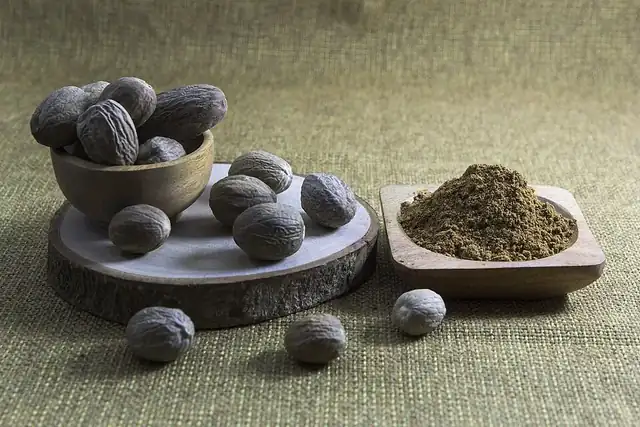
Nutmeg is the spice made by grinding the seed of the fragrant nutmeg tree (Myristica fragrans) into powder. The spice has a distinctive pungent fragrance and a warm, slightly sweet taste; it is used to flavor many kinds of baked goods, confections, puddings, potatoes, meats, sausages, sauces, and vegetables, and beverages, such as eggnog.
The seeds are dried gradually in the sun over a period of 15 to 30 weeks. During this time, the nutmeg shrinks away from its hard seed coat until the kernels rattle in their shells when shaken. The shell is then broken with a wooden club and the nutmegs are picked out. Dried nutmegs are greenish brown ovoids with furrowed surfaces. The nutmegs are roughly egg-shaped, about 20.5-30 mm long and 15-18 mm wide, weighing 5-10 g dried.
Two other species of genus Myristica with different flavors, M. malabarica and M. argentea, are sometimes used to adulterate nutmeg as a spice.
Mace
Mace is the spice made from the reddish seed covering (aril) of the nutmeg seed. Its flavor is similar to that of nutmeg but more delicate; it is used to flavor baked goods, meat, fish, and vegetables, and in preserving and pickling.
In the processing of mace, the crimson-colored aril is removed from the nutmeg seed that it envelops and is flattened out and dried for 10 to 14 days. Its color changes to pale yellow, orange, or tan. Whole dry mace consists of flat pieces—smooth, horn-like, and brittle—about 40 mm long.
Spice
Nutmeg and mace have similar sensory qualities, with nutmeg having a slightly sweeter and mace a more delicate flavor. Mace is often preferred in light dishes for the bright orange, saffron-like hue it imparts. Nutmeg is used for flavoring many dishes. Whole nutmeg can also be ground at home using a grater specifically designed for nutmeg or a multi-purpose grating tool.
In Indonesian cuisine, nutmeg is used in dishes such as spicy soups including variants of soto, konro, oxtail soup, sup iga (ribs soup), bakso, and sup kambing. It is also used in gravy for meat dishes, such as semur, beef stew, ribs with tomato, and European derived dishes such as bistik (beef steak), rolade (minced meat roll), and bistik lidah (beef tongue steak).
In Indian cuisine, nutmeg is used in many sweet, as well as savory, dishes. In Kerala's Malabar region, grated nutmeg is used in meat preparations and also sparingly added to desserts for the flavor. It may also be used in small quantities in garam masala.
In traditional European cuisine, nutmeg and mace are used especially in potato and spinach dishes and in processed meat products; they are also used in soups, sauces, and baked goods. It is also commonly used in rice pudding. In Dutch cuisine, nutmeg is added to vegetables such as Brussels sprouts, cauliflower, and string beans. Nutmeg is a traditional ingredient in mulled cider, mulled wine, junket and eggnog. In Scotland, mace and nutmeg are usually both ingredients in haggis. In Italian cuisine, nutmeg is used as part of the stuffing for many regional meat-filled dumplings like tortellini, as well as for the traditional meatloaf.
Nutmeg is a common spice for pumpkin pie and in recipes for other winter squashes, such as baked acorn squash. In the Caribbean, nutmeg is often used in drinks, such as the Bushwacker, Painkiller, and Barbados rum punch. Typically, it is a sprinkle on top of the drink.
Fruit
The pericarp (fruit covering) is used to make jam, or is finely sliced, cooked with sugar, and crystallised to make a fragrant candy. Sliced nutmeg fruit flesh is made as manisan (sweets), either wet, which is seasoned in sugary syrup liquid, or dry coated with sugar, a dessert called manisan pala in Indonesia. In Penang cuisine, dried, shredded nutmeg rind with sugar coating is used as toppings on the uniquely Penang ais kacang. The flesh of the nutmeg fruit is also blended, in the fresh state, into a type of smoothie (white in color and having a fresh, ‘green’, tangy taste); or boiled, resulting in a brown liquid, much sweeter in taste, which is used in the preparation of iced drinks. In Kerala Malabar region of India, it is used for juice, pickles and chutney.
Essential oil
The essential oil obtained by steam distillation of ground nutmeg is used in the perfumery and pharmaceutical industries. The volatile fraction contains dozens of terpenes and phenylpropanoids, including D-pinene, limonene, D-borneol, L-terpineol, geraniol, safrole, and myristicin. In its pure form, myristicin is a toxin, and consumption of excessive amounts of nutmeg can result in myristicin poisoning.
The oil is colorless or light yellow, and smells and tastes of nutmeg. It is used as a natural food flavoring in baked goods, syrups, beverages, and sweets. It is used to replace ground nutmeg, as it leaves no particles in the food. The essential oil is also used in the manufacturing of toothpaste and cough syrups.
Production
In 2024, world production of nutmeg (combined with cardamom) was 197,199 tonnes, led by Guatemala with 76,339 tonnes and India and Indonesia as secondary producers (94,477 tonnes combined); the three countries accounted for 87% of the world total.
More to savor

Chicken Vindaloo
Pan-Fried White Brined Cheese (Saganaki)
Dill at the Table: The Food Behind the Name