This longer reference provides the background behind the topic. Read it alongside the recipe collection when you want to connect an ingredient or food idea with a dish to prepare.
Overview
Coriander , or Coriandrum sativum, is an annual herb in the family Apiaceae. The leaves are known as cilantro in the US. Most people perceive the leaves as having a fresh, slightly citrus taste. Due to variations in the gene OR6A2, some people perceive its flavor to be more soaplike or rotten.
The species is native to the Mediterranean Basin. All parts of the plant are edible, with the fresh leaves and dried seeds most traditionally used in cooking. It is included in Peruvian, Mexican, Indian and Southeast Asian cuisines.
Description
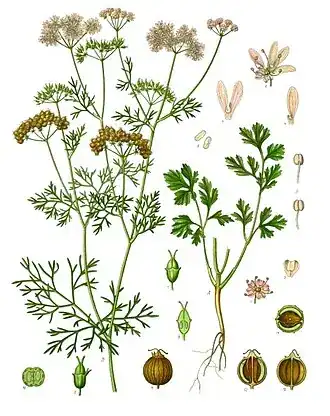
It is a soft plant growing to 50 cm tall. The leaves are variable in shape, broadly lobed at the base of the plant, and slender and feathery higher on the flowering stems.
The flowers are borne in small umbels, white or very pale pink, asymmetrical, with the petals pointing away from the centre of the umbel longer (5–6 mm) than those pointing toward it (only 1–3 mm long). The fruit is a globular, dry schizocarp 3–5 mm in diameter. The pollen size is approximately 30 μm.
Taste and smell
The essential oil from coriander leaves and seeds contains mixed polyphenols and terpenes, including linalool as the major constituent accounting for the aroma and flavour of coriander.
Different people may perceive the taste of coriander leaves differently. Those who enjoy it say it has a refreshing, lemony or lime-like flavour, while those who dislike it have a strong aversion to its pungent taste and smell, characterizing it as soapy or rotten. Studies also show variations in preference among different ethnic groups: 21% of East Asians, 17% of Europeans, and 14% of people of African descent expressed a dislike for coriander, but among the groups where coriander is popular in their cuisine, only 7% of South Asians, 4% of Hispanics, and 3% of Middle Eastern subjects expressed a dislike.
About 80% of identical twins shared the same preference for the herb, but fraternal twins agreed only about half the time, strongly suggesting a genetic component to the preference. In a genetic survey of nearly 30,000 people, two genetic variants linked to the perception of coriander have been found, the more common of which is a gene involved in sensing smells. The gene OR6A2 lies within a cluster of olfactory-receptor genes, and encodes a receptor that is highly sensitive to aldehyde chemicals. Flavour chemists have found that the coriander aroma is created by a half-dozen substances, most of which are aldehydes. Those who dislike the taste are sensitive to the offending unsaturated aldehydes and, at the same time, may be unable to detect the aromatic chemicals that others find pleasant.
Association between its taste and several other genes, including a bitter-taste receptor, have also been found.
Similar plants
Eryngium foetidum, also a member of the Apiaceae, has a similar but more intense taste. Known as culantro and ngò gai, it is found in Mexico, the Caribbean, Central and South America, and South East Asia cuisine.
Persicaria odorata is commonly called Vietnamese coriander, or rau răm. The leaves have a similar odour and flavour to coriander. It is a member of the Polygonaceae, or buckwheat family.
"Summer cilantro" is one common name for Porophyllum ruderale subsp. macrocephalum, a member of the Asteraceae, the sunflower family. This species is found growing wild from Texas to Argentina.
Allergies
Some people are allergic to coriander leaves or seeds, having symptoms similar to those of other food allergies. A cross-sectional study of 589 cases where food allergies to spices were suspected found 32% of pin-prick tests in children and 23% in adults were positive for coriander and other members of the family Apiaceae, including caraway, fennel, and celery. The allergic symptoms may be minor or life-threatening.
Culinary
All parts of the plant are edible. The fresh leaves and dried seeds are the most commonly used in cooking. Coriander is used in cuisines throughout the world.
Leaves
The leaves are variously referred to as coriander leaves, fresh coriander, Chinese parsley, or cilantro (US, commercially in Canada, and Spanish-speaking countries). The fresh leaves are an ingredient in many foods, such as chutneys and salads, salsa, guacamole, and as a widely used garnish for soup, fish, and meat. As heat diminishes their flavour, coriander leaves are often used raw or added to the dish immediately before serving. In Indian and Central Asian recipes, coriander or dhania leaves are used in large amounts and cooked until the flavour diminishes. The leaves spoil quickly when removed from the plant and lose their aroma when dried or frozen.
The taste of the leaves differs from that of the seeds. The seeds exhibit citrus overtones. The dominant flavorants in the leaves are the aldehydes 2-decenal and 2-dodecenal. The main flavorant in the seeds is (+)-linalool.
Seeds
The dry fruits are coriander seeds. The word "coriander" in food preparation may refer solely to these seeds (as a spice), rather than the plant. The seeds have a lemony citrus flavor when crushed due to the terpenes linalool (which comprises about two thirds of its volatile components) and pinene. It is described as warm, nutty, spicy, and orange-flavoured.
The variety C. sativum var. sativum has a fruit diameter of 3–5 mm, while var. microcarpum fruits have a diameter of 1.5 – 3 mm, and var. indicum has elongated fruits. Large-fruited types are grown mainly by tropical and subtropical countries, such as Morocco, India, and Australia, and contain a low volatile oil content (0.1–0.4%). They are used for grinding and blending purposes in the spice trade. Types with smaller fruit are produced in temperate regions and usually have a volatile oil content of around 0.4–1.8%, so they are highly valued as a raw material for the preparation of essential oil.
Coriander is commonly found both as whole dried seeds and in ground form. Roasting or heating the seeds in a dry pan heightens the flavor, aroma, and pungency. Ground coriander seed loses flavor quickly in storage and is best ground fresh. Coriander seed is a spice in garam masala, and Indian curries, which often employ the ground fruits in generous amounts together with cumin, acting as a thickener in a mixture called dhania jeera. Roasted coriander seeds, called dhania dal, are eaten as a snack.
More to savor

Chicken Vindaloo
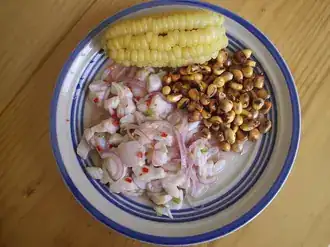
White Fish Ceviche (Cebiche de Pescado)
Oranges in the Kitchen: Exploring an Everyday Ingredient