This longer reference provides the background behind the topic. Read it alongside the recipe collection when you want to connect an ingredient or food idea with a dish to prepare.
In this story
OverviewDescriptionGrowth and propagationCultivarsAs an invasive speciesHarvestingGlobal productionOverview
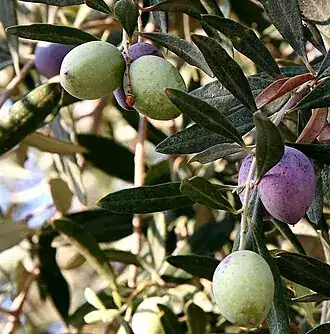
The cultivated olive (botanical name Olea europaea subsp. europaea) is a subspecies of subtropical evergreen tree in the family Oleaceae. Modern cultivars are traced primarily to the Near East, Aegean Sea, and Strait of Gibraltar. Olea europaea is the type species for its genus, Olea, which lends its name to the Oleaceae plant family. The olive fruit is classed botanically as a drupe, similar in structure and function to the cherry or peach. The term oil was originally synonymous with olive oil.
The olive has deep historical, economic, and cultural significance in the Mediterranean. It was one of the first fruit trees to be domesticated, being first cultivated in the Eastern Mediterranean between 6,000 and 4,000 BC. It gradually spread around the Mediterranean Basin via trade and human migration. Olive cultivation was vital to the growth and prosperity of several Mediterranean civilisations.
The fruit is eaten as table olives; the oil extracted from the fruit is used in food and formerly for lamp fuel; and the wood is used for decorative objects. The olive branch is a symbol of peace. The olive is a core ingredient in Middle Eastern and Mediterranean cuisines, particularly in the form of olive oil, and a defining feature of local landscapes, commerce, and folk traditions.
Description
The olive tree, Olea europaea, is an evergreen tree that grows in a Mediterranean climate. Its trunk is typically gnarled and twisted. It grows to some 10 m in height, with grey bark. The leaves are oblong, grey-green above and whitish below.
Small, white flowers are borne generally on the previous year's wood, in erect racemes springing from leaf axils. Each flower has four yellowish white petals fused at the bottom and joined to a base of four fused green sepals. The flower buds grow slowly for 4 to 6 weeks until they reach a length of about 2 cm and bloom; blooming lasts 5–6 days in hot weather and 2 weeks in colder areas.
Growth and propagation
Olive trees prefer calcareous soils; they grow best on limestone slopes and crags, and in coastal climates. They can grow in any light soil, even on well-drained clay, but in rich soils, they are predisposed to disease and produce poor quality oil, as noted by Pliny the Elder. Olives like hot weather and sunny positions without any shade, while temperatures below -10 C may injure even a mature tree. They tolerate drought well because of their sturdy and extensive root systems. Olive trees can remain productive for centuries as long as they are pruned correctly and regularly.
Olives are propagated by various methods, especially by cuttings and layering; the trees root easily in favourable soil and throws up suckers from the stump when cut down. Trees can also be grown from seed. However, yields from trees grown from suckers or seeds are poor; they have to be budded or grafted to do well. To facilitate germination, the oily pericarp is softened by slight rotting, or soaked in hot water or in an alkaline solution.
Cultivars
There are hundreds of cultivars of the olive. An olive's cultivar has a significant impact on its colour, size, shape, and growth characteristics, as well as the qualities of olive oil. An olive cultivar may produce oil, table olives, or both.
Since many olive cultivars are almost or completely self-incompatible, they are usually planted in pairs with a single primary cultivar and a secondary cultivar selected for its ability to fertilise the primary one. The self-incompatibility system has only two groups, based on a gene with just two alleles, causing the extreme self-sterility seen in the olive.
Breeding efforts have been directed at producing hybrid cultivars with qualities useful to farmers, such as resistance to the fungal disease Verticillium wilt.
As an invasive species
Since its first domestication, the olive has repeatedly escaped to the wild, with feral plants swamping the original wild populations of southern Europe.
In South Australia, the olive is a serious invasive species affecting native vegetation. In that region, its seeds are spread by the introduced red fox and by bird including the European starling and the emu. They germinate in woodlands, growing to form a dense canopy that crowds out native tree seedlings. As the climate there is dry and prone to bushfires, the oil-rich feral olive tree substantially increases the fire hazard of native sclerophyll woodlands.
Harvesting
In the Mediterranean region, olives are harvested in the autumn, from October onwards. Most olives are harvested by shaking the tree or individual branches. Another effective method has the harvester stand on a ladder with a sack tied around their waist; they then "milk" the olives into the sack. Varieties for table olives are more delicate to harvest, as damaged fruit become bitter; baskets that hang around the worker's neck are used. In some places in Italy, Croatia, and Greece, olives are harvested by hand because the terrain is too mountainous for machines. As a result, the fruit is not bruised, which leads to a superior finished product. The method involves sawing off branches, which is healthy for future production.
The amount of oil in the fruit varies greatly by cultivar; the pericarp is usually 60–70% oil. Typical yields are 1.5 – 2.2 kg of oil per tree per year.
Global production
Olives are among the most extensively cultivated fruit crops in the world. As of 2024, 58 countries across five continents maintained commercial olive groves, which occupied roughly 11.6 million hectares (28.6 million acres), a quarter of the world's permanent cultivated area. By comparison, in 2011, about 9.6 e6ha were planted with olive trees, which was more than twice the amount of land devoted to apples, bananas, or mangoes; only coconut trees and oil palms commanded more space.
According to the Food and Agriculture Organization, the 10 leading producers are all in the Mediterranean region and responsible for 95% of the world's olives. Spain is the world's leading producer and concentrates the largest land area to olive cultivation, with more than 180 million trees spanning over 2,507,684 hectares, followed by Tunisia (1,746,360 ha) and Italy (1,143,363 ha). In Italy, olive tree cultivation is widespread in the south, accounting for three quarters of its production; it is less abundant in the colder north of Italy, although production there has increased, particularly in the more temperate microclimates of Liguria and the hills around Lake Garda. Approximately 170 million plants are distributed over one million farms.
More to savor

Chicken Vindaloo
Spaghetti alla Carbonara
Spice in the Kitchen: Exploring an Everyday Ingredient